I want to attempt a sort of bird’s-eye view of both parties as we enter the first summer of the Trump administration. For the Republicans, the headline is moving forward on various Trump policies (immigration, trade, budget) that, in the aggregate, have sparked neither widespread support nor overwhelming alarm. It’s all wait and see. The fate of the budget bill will seriously impact the president’s standing—“Magic Man pulled it off,” or “Whoa, he lost and is hobbled.”
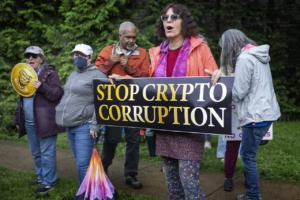 Underlying all this is an air of unusual corruption. I don’t know of any precedent. Charges of influence peddling, access peddling—$TRUMP coins, real-estate deals in foreign countries, cash for dinners with the president, a pardon process involving big fees for access to those in the president’s orbit, $28 million for the first lady to participate in a biographical documentary, the Trump sons’ plan to open a private club in Washington with a reported $500,000 membership fee—those are only some of the items currently known.
The Journal this week reported major donors to the inauguration benefiting from early government actions. In April the administration put enforcement of the Foreign Corrupt Practices Act on hold, pulling back on cases involving charges of foreign bribery, public corruption, and money laundering. “In some cases the administration is effectively redefining what business conduct constitutes a crime,” the Journal noted.
All this is establishing the character of the administration in a way Americans simply won’t respect over the long term. It will no doubt continue, grow more garish with time, and become a major national scandal.
The Republican Party also looks split on spending. This area tends to become dominated by the new war between Elon Musk and President Trump, which may be more consequential to the administration’s standing than we currently guess. But the fight highlights a policy division that will likely grow.
Until 2016, the GOP had been aligned in agreement: Spending is too high, get it down, if most of the money is in entitlements then go there. But the old agreement was blown up and replaced by the new Trumpian one: Americans on the ground are in trouble, we can’t balance the budget on the backs of workers during rolling cultural and financial crises, leave Medicare and Social Security alone.
But the size, scope and seemingly uncontainable growth of the past quarter-century’s budget deficits and debt are breaking through in some new way and leaving people anxious. The 21st century has been one long fiscal bender, for both parties. The federal budget was in surplus in 2000. In 2008 spending was half a trillion in the red, by 2020 a $3 trillion deficit, which is holding at close to $2 trillion. The national debt was $5.6 trillion in 2000, $9 trillion in 2010, $17 trillion by 2020, and the Congressional Budget Office forecasts it will be almost $30 trillion this year. In a quarter century the public debt quintupled.
A lot went into the making of this—wars, the 2008 financial crisis, the pandemic. But these numbers would give even the most blasé populist national conservative a start. Mr. Trump will likely get his budget bill, but the emerging division won’t be healed by his victory.
Add to this the likelihood of foreign-policy crises in the coming year—at least two of which (Ukraine, Taiwan) could turn grave and immediate—and the Republicans will have many challenges. Their biggest weapon is the figure of Mr. Trump, who retains a hold on the public imagination that will never be fully seen in the polls. The other day, Antoine Massey, one of the 10 prisoners who escaped in last month’s New Orleans jailbreak, made a video from wherever he was holed up asking for support. Mr. Massey then appealed for help in proving his innocence to rappers Lil Wayne and Meek Mill and Mr. Trump. Mr. Massey seemed sincere and trusting in his request. It spoke of a connection between common man and president the likes of which I don’t know we’ve ever quite seen in our national political life.
But for Republicans, everything right now is provisional. And Democrats are in a better position than they think. They’ve been badly damaged by the allegations, obviously true, that they covered up Joe Biden’s decline. It is the biggest political scandal of this century, and it will linger in history: It will be in the first paragraph of Mr. Biden’s obituary.
But as an active, on-the-ground issue its impact will thin out, just as the downsides of the reputation of the administration in power will thicken.
Democrats are doing what parties out of power do, misunderstanding their position and misinterpreting their loss. Much of the Democratic conversation about what to do—learn how to talk to young men, improve local organizing, adapt new communication methods—is off point. The idea of readjusting party attitudes toward the regulatory state to become liberals who want to build things again is constructive, but it isn’t new. Certainly it shouldn’t come with the force of revelation. The dullest conservative businessmen would have told you 40 years ago that regulation that starts in the public interest has a way of growing like kudzu and strangling all possible growth nearby. You have to keep your eye on things . . . .
The Democratic Party is struggling because of issues to which it’s attached and that it hasn’t yet faced, that it somehow can’t face. These are the progressive policies and stands having to do with various cultural obsessions, including identity politics. They need to push away from these things and turn to more traditional economic interests, and sobriety in foreign affairs.
There’s not much sign on a national level they’re doing this.
Sometimes parties go into a long losing streak. They can’t just have one presidential defeat, they have to have a few of them before they change. This was the Democratic Party from 1980 until 1992. They had to lose elections repeatedly to work the unpopular policies out of their system.
That’s what I feel the Democrats are doing now, signaling that they can’t just lose once, they’re gonna need more educatin’.
One thing they have to learn: It isn’t shameful to be popular. It isn’t an embarrassment to hold policies somewhat similar to those of your countrymen. It doesn’t mean you’re craven or unserious or inauthentic. It doesn’t mean you lack guts or are insincere. It means you are capable of feeling respect for those who don’t see the world as you do. It means you are willing to make the compromises that give you a chance at being elected. If you are serious about the purposes of power and about democracy, you would want that.
There are Democratic donors now who have their eyes trained on 2026. A Democratic House is an achievable goal: It’s split almost 50/50 as it is, and midterms famously tend to go against the party in power.
It is likely the Democrats will win the House. But they can do it smart or dumb. Doing it smart means putting money, energy and focus on centrists and moderates who want to reorient the party’s reputation. Doing it dumb would be also backing progressives who, if they make it to Washington, will simply remind people every day why they lean Republican.