Isolationism is essentially emotional. You’re angry at the cost in blood and treasure of your country’s international forays and adventures and want to withdraw from the world. Emotionalism can hold sway and dominate politics for a time, even an era, but you can’t build anything on it. It doesn’t last because emotions change because facts change.
The problem is that you can quit the world but the world won’t quit you. If you tell the world, “Earlier in the century America was too uproarious and aggressive. We’ll stop now. Goodbye,” the world won’t respond by saying, “What geopolitical modesty you evince! Goodbye now, and best wishes to you.”
The world instead will see new opportunities to continue to do what it does—harry and harass, undermine a perceived foe’s interests, provoke and prey.
China’s rulers won’t stop their mischief if America declares itself more retiring; they’ll ramp it up. They want to be the most powerful nation in the world, they believe this is their destiny, and there’s one thing standing in their way and it’s America. They’ll poke, prod and try their own adventures. Russia, of course, too. Others.
Only a fool would carelessly aggress in this world, and only a fool would think he could fully withdraw. We are enmeshed in layered financial, security and trade systems; pandemics and cyberterrorism are borderless. You can’t be reflexively “isolationist” or “internationalist” in this world; you have to hit the ball from where it lands.
But you can bring attitudes and ways of operating. Don’t look for trouble, don’t aggress, build bridges where you can. Be peaceable and prudent but have hard eyes. Don’t carry yourself forward into the world with hubris about your grand democratic system; be quietly proud and see to its wholesomeness. Be an example, a beacon. Have humility: We don’t run the world any more than we run life, and we won’t try. Use force sparingly but when used make sure it is annihilative. Keep your military not only peerless but highly professional, so accidents don’t happen. Choose your battles carefully. Know your people. Don’t announce that if Syria uses poison gas that will be crossing a red line, and then when it uses deadly gas slink away saying oh, never mind. President Obama surely thought conservatives would come to his aid and rouse public opinion for a hard line on Syria. But the right had been bruised by Iraq, and Mr. Obama hadn’t noticed. And there must be clarity. World War I broke out because leaders were unclear about their intentions and priorities. Lack of clarity kills.
Know history and be able to act on what you know from it. John F. Kennedy didn’t mean to start a land war in Asia when he sent advisers to Vietnam. But he was up soon for re-election in a country whose great 20th-century pastime after baseball was accusing its presidents of being weak, afraid of the commies, and not standing for freedom. So he sent special forces, helped our allies, and set us on a trajectory toward quagmire. His admirers are sure he would have pulled back when re-elected. We’ll never know.
So much of the history of the world is the history of unintended and unexpected consequences.
Vladimir Putin is a monster of history: We used to call him a junior monster here, but no, he’s full-size. He wants what he wants and will play a long cool game to get it, and if the game gets hot that’s fine with him too. Donald Trump has always liked him because he is drawn to powerful men, dictators, people who can drag their countries around like a robed king in procession flicking his velvet train.
But Mr. Trump has been trying to broker a peace over Ukraine, and Mr. Putin has been jerking him around since January, saying seemingly plausible things that turn out to be just another tactic in the long cool game. Or as Mr. Trump himself said on Wednesday, at his long, live cabinet meeting, “We get a lot of bulls— thrown at us by Putin,” who is “very nice all the time, but it turns out to be meaningless.” Of the war, Mr. Trump recently told the press, “I don’t think he’s looking to stop, and that’s too bad.”
Mr. Trump is renewing U.S. arms shipments to Ukraine, and he is right to do it.
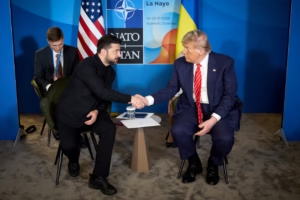
It won’t be good for the world if Mr. Putin winds up taking what he wants of Eastern Europe. Ukraine is a country of courage, ingeniousness and some irritating people, including President Vladimir Zelensky. The video of him getting beaten about the head in the Oval Office in February will always be remembered as an ambush by a glowering Mr. Trump and Vice President JD Vance. I’ve watched it beginning to end half a dozen times. Mr. Zelensky provoked the argument, Mr. Trump tried to deflect it, Mr. Vance opportunistically pounced, and at the end both the Americans piled on. Mr. Zelensky was full of himself, thought he’d press his case before an admiring American media, expected to triumph and didn’t. He overplayed his hand and weakened his position.
But he is a brave man, tough and capable, and his continued resistance to Mr. Putin is good for the world.
If Mr. Putin wins, Eastern Europe will feel directly threatened: “Let’s not kid ourselves, we are all on the Eastern flank now,” said the North Atlantic Treaty Organization’s Secretary General Mark Rutte last month. They will militarize quickly in a new arms race, which will be good for arms makers but no one else. NATO might fall apart or be rendered inoperative, and the world’s rising authoritarians will conclude that the path to greatness is to build an army and take what you want. This will make for a less stable world.
The U.S. will lose more of what remains of its power to deter. Mr. Putin will spend what he likes to restore his military and pick his next target, his ambition not satisfied but stoked. China will be emboldened; Iran, currently licking its wounds, re-inspired. Again, more trouble for the world, including us.
Mr. Trump’s decision isn’t isolationist or internationalist but realistic. The question is whether he sticks with it and it’s enough.
In this decision he again moves against the feelings of his base, or rather its influencers and self-proclaimed leaders. I actually doubt his base, or his 77 million voters, are going to abandon him because he’s changing his approach on Ukraine. Walking away from Ukraine was never fully compatible with a lot of conservatives’ Born Fighting DNA. Mr. Trump has more to lose from Jeffrey Epstein, whose case is an enduring MAGA obsession.
The GOP will have to think its way through all this. “Isolationist,” “interventionist”—those labels don’t seem right for now. The party will have to decide, again, what it’s about on foreign affairs.
It started this century with nation building and snapped back, after its failure, toward isolationism. I wonder if now they’re snapping back, or starting to evolve, into something new, not halfway between isolationism and interventionism but more deeply thought through than those two impulses. Something more dry-eyed.