There have been reports all over of Immigration and Customs Enforcement raids in workplaces—restaurants, construction sites, farms. In a June ICE raid at an Omaha, Neb., meatpacking plant, more than 100 employees suspected of using false IDs were taken away. The owner of the plant told the New York Times that some of them had been with him for decades—they were “salt-of-the-earth, incredible people who helped build this company.”
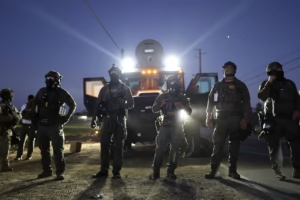
The administration believes its toughness delivers a message—don’t come here illegally—and of course it would. But there are other ways to deliver it. Donald Trump’s presence alone has delivered it, and the border is pretty much closed. In these raids the administration is making a grave moral and political mistake.
The American people want criminals, thugs and abusers in the country illegally thrown out, full stop. But workers who are living constructive lives, who are contributing, who help keep America up and operating each day? No.
The Trump White House is given so much credit for understanding America, but if they’re storming workplaces, they don’t understand America.
We are about work. We respect it. We have an almost mystical attachment to the idea of it. We think “hard worker” means “good American.”
Why do we work? To support ourselves. To belong to something. To build wealth. To be integrated into life, whether we think of it like that or not. To pursue a vocation or be part of an admirable profession. To not be alone.
It’s in our DNA. Whether you came here on the Mayflower or landed at JFK five years ago, you arrived with the expectation of work. You assumed its necessity. This has never changed in our history.
There is a mystical element to it. When you earn your keep honestly, you are putting something into the world. You are pouring yourself in. It is an act of devotion whether you know it or not. The old Catholic priests used to say “Laborare est orare”—to work is to pray. You aren’t distracted from God when you work; you’re honoring him, whether you’re a professor at Harvard or a kindhearted clerk at the DMV. It feels soulless only if you forget you have a soul. Work is an act of stewardship. It helps things continue.
Americans have always had a moral vision of it. We pushed away from old Europe and its titles, traditions and ways. The New England settlers looked for freedom of faith, and the sterner among them came to see labor as connected to the divine. “God helps those who help themselves.” Success was a mark of favor.
The German sociologist Max Weber spoke of the Protestant ethic, in which every honest trade seemed connected to a moral calling. That old ethic met and meshed with the ideals of the American frontier—physical labor, self reliance and giving it your all would make this land and make you.
Here is Abraham Lincoln in 1859: “The prudent, penniless beginner in the world labors for wages a while, saves a surplus with which to buy tools or land for himself, then labors on his own account another while, and finally hires another new beginner to help him.” That is how things grow and lives become better.
Frontier thinking met and meshed with the immigrant ethic: You’re free here and the streets are paved with gold, I will get me and mine a piece. How could such a nation not be preoccupied with work?
The great novelist Willa Cather wrote of the 19th-century immigrants who settled the Nebraska plains, bringing together the immigrant and frontier experiences. In “My Antonia” the title character, a strong and undefeatable Bohemian immigrant, says after some years on hungry farms, “I can work like mans now. . . . School all right for little boys. I help make this land one good farm.” The narrator, Jim Burden, says Nebraska’s immigrants brought not only an expectation of hard work and the ability to endure it, but also a special kind of cooperation, which he characterized as being a good neighbor in hard times. Their entire lives had been hard times.
I end this section by quoting Studs Terkel in his landmark 1974 oral history, “Working,” on which he worked for years. Work “is about a search . . . for daily meaning as well as daily bread, for recognition as well as cash, for astonishment rather than torpor; in short, for a sort of life rather than a Monday through Friday sort of dying.”
Americans feel they’ve been overrun the past five years with five million or 10 million people flooding in illegally across the border, because the Biden administration didn’t mind it. Officials could have stopped or slowed it but didn’t. They know their reasons and live with the political consequences of their vast carelessness. Mr. Trump appears to have controlled that border, and begun to get the bad guys out. Good. But even his greatest supporters won’t be long reconciled to work raids.
We like and admire people who work because that’s who we came from, and because we root for the underdog and have eyes and can see in this drama who the underdog is. When you raid a restaurant and drag out the people busing tables, cooking, taking orders—we won’t back that. You can’t really be American and back that. If the Trump administration doesn’t know that it doesn’t know a lot.
I have opposed illegal immigration in this space for more than two decades, have urged the border be closed, that the nation digest, absorb and in time adjudicate. I was beaten about the head in the George W. Bush era for opposing so-called comprehensive immigration plans. I think it is important right now for hard-liners like me to say that while stopping illegal immigration is any nation’s right and duty, we also have to hold in our heads that if you look around—and I mean no offense—we have the best immigrants in the world. Our actions should reflect that.
The ones who came here legally came to work, from doctoral candidate to Uber driver. The great majority of those who came illegally over the southern border are in close tune with the majority of Americans both culturally and in terms of their essential understanding of the meaning of life. (Go to the 4 p.m. Sunday Spanish language mass at New York’s St. Patrick’s Cathedral to see dignity of devotion, and also the future of the church.)
Immigrants, legal and not, keep my town going. I know them, they work themselves hard and are all about family, and they touch my heart (sorry to be corny) and if you’re reading this you know they touch your heart too, and you’re for them.
The border appears to be closed; hypervigilance is no longer in order; it’s past time to show a filial connection and appreciation.
Stop picking on them. Cease and desist. Get the bad guys, not the good guys.
The American people won’t support these raids. It is wicked to remove a man or woman from an honest job. And we aren’t a wicked people.