Wistful August tapers down. Headlines feel far away but stalk us by phone. The writer Philip Howard calls the news cycle “both terrifying and tedious.” He’s right. So I’ve decided it’s a good time for an homage to the HBO series “The Gilded Age.”
We begin with what’s wrong with it, just to show we’re not carried away. It is not golden-age television. It’s not even first-rate television. It’s not even drama, it’s melodrama.
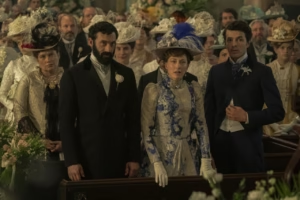
Its story lines until the season just ended, and especially given the material—the clang, clash and fire of industrial America being born and high society being invented—were unimaginative. It’s largely without wit. Actually it has the rhythm of wit without the content. The quips of Christine Baranski, as Agnes van Rhijn, are underwhelming, but she carries them off because she is Christine Baranski and carries everything off.
The dialogue is often hopeless. From memory, Gladys Russell to her husband, the duke: But I have not had word as to my father’s condition since receiving the telegram alerting us to his shooting as we left the port of Southampton en route to the reunion. Not from memory but word for word, one businessman to another: “I’m like a cockroach with a thousand lives!” No, you idiot, you’re a cockroach that can’t be killed or a cat with nine lives.
The show’s creator, Julian Fellowes, the justly celebrated English writer and producer, isn’t American, doesn’t speak American, doesn’t have it in his bones and doesn’t get the whole ethnic brew.
But the awfulness of the dialogue sharpens your admiration for the actors who have to say it. Carrie Coon as the scheming Bertha Russell seemed at first miscast but fully conquers. Every time she’s in a scene, she’s the one you watch. Morgan Spector as her husband, George, has a truly beautiful stillness and command. Cynthia Nixon for once is given an attractive character to inhabit and is nervously endearing.
Much has been made of the treatment of race, which is fresh, with no special pleading but a lot of knowing looks. New York had a vibrant, glamorous black upper middle class of entrepreneurs and intellectuals, but it has been largely lost to history. Mr. Fellowes refinds it and gives it a stage. The biggest snobs on the show are the Baranski character, who traces her family back to before the American Revolution, and the black matriarch Elizabeth Kirkland, played by Phylicia Rashad, who doesn’t want her doctor son to marry the writer Peggy Scott, also of the high black bourgeoisie but with less standing and a secret past. We love Peggy, love the doctor, find mother’s apparent comeuppance delightful.
So is the subplot of a husband and wife in an arranged marriage she desperately resisted and he oafishly, greedily negotiated. They appear to be beginning to fall in love. My friend, a young playwright I will call Brendan, captures the transgressive nature of this twist. “A more old-fashioned or woke show would have the Duke beat her, berate her—she would run away and get divorced, throw her bra in a garbage can and run for Congress. And that is not real life! Propaganda allows no depth, a woman must be victim until she overthrows her male oppressors. Here it can go all kinds of ways—and that makes it interesting.”
Variety has called the show a hit, its numbers each episode climbing. Here are thoughts on why.
Because it’s beautiful. It fills not only a longing for glamour, which people always have, but for a glamour that is recognizable, discernible. It isn’t the freakish glamour of the Met Gala but a glamour secure in the values it asserts, confident in its definitions. Men dress like men, dark clothes and sharp lines; women like women, color, texture and line. They are all so beautiful, the women in their gowns and bustles, hats and jewels. The men in their three-quarter-length suits, bright silk waistcoats, white shirts whose collars are never loosened.
All this implies discipline. You don’t rig yourself up like that to present yourself to the world without effort. That effort is a kind of tribute to the world, a way of showing it respect. We all notice this without noticing we notice.
I think we like its picture of a society that had brute but recognizable rules that, in some weird way, were democratic. Make a whole pot of money, be generous with it to gain notice but enact modesty when thanked, learn to imitate personal dignity and a little refinement, and you’re in. It wasn’t much tighter than that. Now it’s more just the money, no one has to bow to some phony old value system, and the money spurts in all directions, creating a themeless chaos, and tech billionaires in sweatshirts give us moral lectures from Jeffrey Epstein’s plane.
I like the show because in it America isn’t over. America, as the 20th century came to know it, was just beginning. This is in contrast to HBO’s “Succession,” a true golden-age show that features piercing speeches about America as a fading power. Logan Roy to tech titan Lukas Matsson: “America . . . I don’t know. When I arrived there were these gentle giants smelling of f— gold and milk. They could do anything. Now look at them.”
In “The Gilded Age” they are still gold and milk and can do anything. The footman invents a new clock and is suddenly wealthy, with staff of his own. The city official thinking to make a killing in a shady stock deal goes bust instead and shoots himself in the head. It’s all up and down, rise and fall. It’s all movement.
The show is fiction but famously based on real characters and events. As everyone who follows it knows, the poor, married-off Gladys is based on Consuelo Vanderbilt Astor, the American heiress who married the duke of Marlborough to less happy effect. George Russell seems an amalgam of pirates, including rail tycoon Jay Gould. Ward McAllister (1827-95) really did exist and saw himself as gatekeeper of the society he and Caroline Schermerhorn Astor cooked up out of new money and old bloodlines.
We end with ideas for seasons 4 through 6, if the actors stay on board.
Here is a real-life character ripe for a subplot. A plain, earnest, book-reading girl of old New York society is maneuvered into what seems a good match with a sporty, wealthy older man who proves emotionally unstable and financially reckless. They part with great pain on her part but for many years don’t divorce. She goes into the world alone to become who she is: Edith Wharton, the great Gilded Age novelist and the first woman to receive the Pulitzer Prize for the Novel. Among her themes: personal desire thwarted by societal expectations.
Build an episode around London’s Oscar Wilde, who visits the great houses of New York on tour. I see a brief, eyebrow-raising love affair, possibly with Oscar van Rhijn. Mrs. Winterton won’t like it a bit. “The only difference between the saint and the sinner is that every saint has a past and every sinner has a future,” Wilde said. That is what the show is about.
And the Industrial Revolution reaches its peak as political reaction intensifies. A winsome anarcho-communist schemes to bomb the New York Central. Call him Zohran, just for fun.