I spent time this week talking to people about how to think about the burst of U.S. diplomatic activity surrounding the Ukraine war. I wasn’t sure how to view it but began with certain predicates. Movement to end war is generally good, new initiatives can be constructive, new focus can encourage things in the right direction. If talks and meetings yield nothing, so be it, but would the world be worse for the effort? Russian President Vladimir Putin and Foreign Minister Sergei Lavrov have amused themselves the past few years signaling their openness to the use of tactical nuclear weapons. At the moment, we’re talking about the exact nature of security guarantees in an overall peace plan. That is a better conversation.
Beyond that, be skeptical but not cynical, and don’t secretly hope for bad outcomes for those you politically oppose if what benefits them would be good news for the world.
What follows is a combination of the best thoughts and observations, on background, of two non-MAGA foreign-policy professionals of significant achievement.
Don’t dismiss the current initiative as mere showbiz or posturing. The war in Ukraine has caused devastation, disruption, probably a million casualties. Give Donald Trump credit, he lit a fire under the diplomatic dimension.
People don’t know what to think because the story changes every day. You can’t follow the balls and strikes every minute, you can’t follow every pitch. The story’s moving all over the place because it’s not linear because Mr. Trump is not linear.
An appropriate attitude is tentative hopefulness. Mr. Trump appears to know Mr. Putin isn’t someone easy to bring to agreements. Mr. Trump tries to charm him, but Mr. Putin’s behavior has led him to understand progress will take time.
Mr. Putin is in no hurry. The next two months are still fighting season. In November comes the mud. Russia will use this time to inflict more damage, demoralize more Ukrainians, maybe gain ground. But Mr. Putin has been getting bad economic soundings from his experts and central bankers. The war has cost him plenty in blood and treasure, and Russia hasn’t gained much. There’s a high cost to perpetually grinding it out. The pieces are there for some kind of a stoppage of the war.
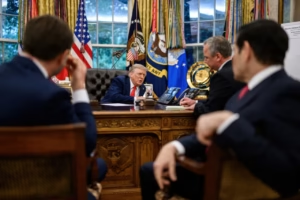
The meeting this week of the major leaders of Europe, President Volodymyr Zelensky and Mr. Trump was a historic ten-strike, more than is probably appreciated. Mr. Putin didn’t want to see that meeting, that unity. It was brilliant to have them come to the White House. It underscored America’s enduring convening power, and was an admission of their calculation as to Mr. Trump’s stature. France, Germany, Britain, Italy, Finland, the European Union and Mr. Zelensky pulled together—they want Ukraine saved and the war over. They don’t know if Mr. Trump can handle Mr. Putin, but they badly want him to, because while Mr. Putin lives the future of Europe is in play. That is a terrible fact and from outward appearances they are facing it.
Mr. Trump’s foreign-policy team is coming into its own. Secretary of State Marco Rubio, Treasury Secretary Scott Bessent, Joint Chiefs Chairman Gen. Dan Caine—they are the forces around U.S. foreign policy, behind the careful negotiating of things. John Ratcliffe, director of the Central Intelligence Agency, has also emerged as a voice.
The devil is in the details, and some details are essentials. What exactly do the Europeans, and Americans, mean by “security guarantees” for Ukraine? What will Mr. Zelensky accept, and Mr. Putin? The definition of success can’t become peace at any price; it has to be a peace that establishes a certain order and stability so it can settle in. What if Mr. Putin endlessly plays things along?
It may well prove true that Mr. Trump was too quick to stop his own push for a cease-fire, accepting instead an aim for a peace agreement. A cease-fire means everyone stops shooting. You don’t have to drop your demands or claims, even your delusions; you just put down your arms and begin negotiations toward negotiations toward peace. Cease-fires don’t have to be short-term. Some last 50 years. Many Ukrainians and Russians will die without one.
There are those saying Mr. Trump is a naïf, a fool propelled by his own vanity. If that’s true, and it wouldn’t be shocking—really, would you be shocked?—it will be apparent soon enough, and the overall effort will likely fizzle. They make fun of him for wanting to win a Nobel Peace Prize, but so what? It’s a prize for peace, not war, it would be a better world if every leader competed for one. Mr. Trump told Fox News’s Sean Hannity this week that he’s pushing for peace in part because he wants to go to heaven. That’s what we call a new one. Whether he was serious or the line just jumped into his head, or it was the kind of gassy formulation to which Mr. Hannity especially seems receptive, heaven is not a terrible reason to want to do something. And is preferable to “See you in hell, suckers.”
It is hard to imagine the effort succeeding. But why begrudge Trump for trying? Instead, he could have spent the last few months telling Mr. Zelensky he’s on his own and good luck with maintaining your status as a sovereign nation. And much of his base would have liked it just fine. He isn’t playing to it.
When JD Vance was running for the Senate in Ohio three years ago, he reacted to news of Russia’s invasion with “I don’t really care what happens to Ukraine one way or the other.”
I am told the vice president isn’t playing the part of the hard-line isolationist now but having constructive talks with Russians and Ukrainians. This might be because he hopes to be part of building something helpful, successful and significant. It also may be because if you want to be president the last thing you need is for Ukraine to collapse in, say, 2027 or ’28.
In any case things are breaking in interesting ways.
I close with an attitude toward history that can be a helpful attitude toward life. It’s an old folk tale. A horse thief is arrested and found guilty, the king sentences him to death at dawn. The thief says wait, please, there’s something I’ve never told anyone—I not only steal horses, I have the power to make them laugh. It’s a gift! Give me a month and I’ll train the king’s horse to laugh at all his jokes.
The king agrees. Days later a guard, seeing the thief get nowhere with the horse, asked why he’d made such a stupid promise. The thief said, “Well, in a month the king may die and everyone forget why I’m here and release me. Or I may die. Or the horse may laugh.”
Take a chance, try something, you never know.
There will be plenty of time to laugh at Mr. Trump in coming months and years. Madeleine Albright once observed that when Americans talk foreign policy, everything always comes down to either Munich or Vietnam. If this is Munich we’ll know it soon enough, but we don’t know it now. Hope for the best. Maybe the horse will laugh.