Somebody is going to get hurt.
Somebody already has.
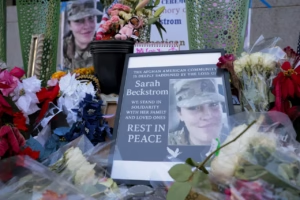
This is a partial list of those killed or wounded recently in politically driven violence:
Two members of the West Virginia National Guard ambushed while on patrol near the White House on Nov. 26. Spc. Sarah Beckstrom, 20, killed; Staff Sgt. Andrew Wolfe, 24, is in serious condition. Prosecutors say a nearby guard saw them fall to the ground as the accused shooter, an Afghan exile, screamed, “Allahu Akbar!”
Charlie Kirk was assassinated as he spoke at a peaceful outdoor rally at Utah Valley University on Sept. 10. On June 14, 2025, Minnesota state Rep. Melissa Hortman and her husband, Mark, were shot and killed in their home in Brooklyn Park by a man impersonating a police officer. Earlier the same night state Sen. John Hoffman and his wife, Yvette, were shot and wounded in their home. The shooter is reported to have had a list of about 70 targets. In May, two Israeli Embassy staffers were shot to death outside the Capital Jewish Museum in Washington. In December 2024 Brian Thompson, CEO of UnitedHealthcare, was assassinated on the sidewalk outside a Manhattan hotel. The accused shooter was angry about protocols surrounding health-insurance coverage. On July 13, 2024, Donald Trump was wounded in an assassination attempt in Butler, Pa. In September 2024 another assassination attempt was thwarted at a golf club in West Palm Beach, Fla.
After the Kirk shooting, Reuters reported the first half of 2025 saw roughly 150 “politically motivated attacks,” nearly double the previous year’s number for that period.
This April the residence of the Pennsylvania Gov. Josh Shapiro, was firebombed. The dining room, earlier that evening used for a Passover Seder, was destroyed. The accused arsonist said he was protesting what Mr. Shapiro “wants to do to the Palestinian people.”
In an important piece called “In the Line of Fire” in this week’s New Yorker, Mr. Shapiro told journalist Benjamin Wallace-Wells that he gets a lot of calls from people asking his advice on whether to run for office. But the calls have changed. “I’d say that 10% of their questions are political, and 90% are about what can I do to protect my family.”
The head of the U.S. Capitol Police told Mr. Wallace-Wells that a decade ago lawmakers typically reported fewer than 2,000 threats of violence per year. Around 2017 it began to escalate. “Last year it was almost 10,000.”
This week Sophia Cai of Politico reported on a meeting of Department of Government Efficiency alumni who had gathered near Elon Musk’s space facilities in Bastrop, Texas. Mr. Musk, who attended by video from an undisclosed location with a pitch-black screen around him, told attendees he couldn’t appear in person because he believes he is an assassination target. In June 2024 on a Tesla shareholder call, he reported that “two homicidal maniacs” had “come to aspirationally try to kill” him in the preceding seven months. “I mean, it’s getting a little crazy these days,” Mr. Musk said.
You cannot trace the incidents of political violence the past 18 months without feeling that we are entering or have fully entered a very bad time. I have been thinking of the dreaded era of assassinations that began with the murder of JFK in 1963, and went on to include Malcolm X in 1965, Martin Luther King and Robert F. Kennedy in 1968, and the nonfatal shooting of George Wallace in 1972.
It’s hard to pinpoint when this latest era began because eras don’t declare themselves, and such shootings aren’t new. Rep. Gabrielle Giffords was shot in 2011, Rep. Steve Scalise and three others at a congressional baseball game in 2017. Nancy Pelosi’s husband, Paul, was attacked by an intruder in their San Francisco home in 2022.
But we’re seeing such cases more steadily now, the tempo is up.
In the past at this point in a column like this I’d speak of gun control, because surely controlling the number of guns out there would help. Tightening red-flag laws and applying other such limitations to gun purchases might still help, but “gun control” is pretty much gone as an issue—the guns won. We famously have more guns than people in America, and as long as people feel their institutions are failing, their culture going down, and 911 calls going to voicemail, that will continue.
In the past too I would have talked about what I saw as a coming mental-health crisis among the young in America. Dealing with that is a long-term project, as is the issue of young men and online culture—a whole generation raised by screens, which prompt them to think sick and destructive thoughts. There is a reaction going on in that area; parents are trying to become more careful, and schools are beginning to ban smartphones.
In the shorter term, at least we have what we say in public. Couldn’t we make some progress there? The parties, the podcasters and streamers—everyone’s trying to excite a country that’s too excited already. They never think they’re doing “incitement” with the supercharged and accusatory things they say; they just think they’re telling the truth and breaking through.
But I want to speak of Mr. Trump. He is less careful in what he says than any previous president in history, we know this, and it is unfortunate because presidents—more than we like, more than is right and is good for us—set a tone. His is often menacing and dehumanizing. What he is doing right now with the press is very dangerous.
In the past few months he has been isolating and going after women who are reporters. A New York Times reporter is “ugly both inside and out,” a Bloomberg reporter is told, “Quiet! Quiet, piggy.” An ABC news journalist is “a terrible person and a terrible reporter.” A CBS News reporter is “a stupid person” and an anchor “stupid” and “nasty.” The New York Times is “degenerate,” the Wall Street Journal “rotten.”
More seriously—more sinister—the White House has just put up a wall-of-shame webpage tracking media outfits and reporters who “misrepresent” or “lie” about the administration. Names are named, outfits identified and shamed. All this is meant to intimidate; it institutionalizes attacks on the media and, considering the broader context, potentially prompts and gives permission to unstable people who might want to act in the president’s supposed defense. The webpage, paid for by taxpayers as part of the White House website, looks not like an insult but part of a sustained campaign. It is a threat. It should be taken down.
We have to notice that the moment we’re in appears to be one of incipient political violence. It is a strange peculiarity of Mr. Trump that he constantly pumps the pedal of this already speeding car.
Everyone who speaks publicly in America needs to take it down a notch, be cooler, more deliberate, more aware of the context.
Because somebody’s going to get hurt. We know this because people already have.