Next week marks the first anniversary of Donald Trump’s second inauguration, so it’s a good time to revisit his essential nature, which appears to drive everything.
 I queried acquaintances of mixed political disposition: What have you seen of Donald Trump the past year that is different from his first administration?
A Trump foe said, “He is more confident, alas.” Another bowed to “his capacity to stick to the script and at the same time drive a wider range of concerns.”
A Trump supporter quoted the satirical history of the English Civil War, “1066 and All That”: Mr. Trump and his aides are the Roundheads, “right but repulsive,” his Republican and Democratic opponents the Cavaliers, “wrong but romantic.”
A middle-of-the-roader (there still are such) quoted the Scottish poet Robert Burns: “And forward though I cannot see, I guess and fear.” He is supportive but “deeply afraid on a number of things (Greenland, Iran, where ICE enforcement goes).”
A Trump critic said, “Years ago he talked about taking oil and acquiring Greenland. In the second term, he is taking himself both seriously and literally.” He continued, “In his first term he saw Versailles and longed to be the Sun King. In his second he crowned himself and is building his own Versailles.”
I would add: In terms of policy judgments and predicates, Mr. Trump is unchanged. He’s for what he was always for, against what he was against. But he’s operating in a different internal and external context. Internally he is more confident than last time and less restrained. He’s less needy of approval: He’s written off the mainstream press. He works hard, has high energy, can’t repress his essential nature.
“I hate my opponents and I don’t want the best for them,” he said at Charlie Kirk’s memorial service in September. It was classic Trump in that it was boastful—I’m tough, don’t cross me—and in a way modest—I am less than you nice Christians—and in another way it was just a line, meant to entertain, a way to vamp until he thought of something better.
Something that is clear that wasn’t in 2017: Mr. Trump is world historic. He’ll be a trope, an instantly recognizable figure, to America and the world for the rest of this century and beyond.
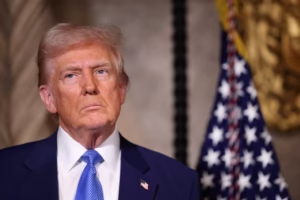
The iconic image: Big man, dark suit, red tie, orange face, slight stoop, tough-guy expression. That image will prove as iconic as the bearded man in the stovepipe hat. It is as iconic as portraits of Napoleon when I was a kid: He’d been dead more than 100 years and wasn’t even an American, and we all knew who he was.
Anyone can imitate Mr. Trump because the sound is cuttingly clear and unchanging: It’s the rhythm and cadence of the Borscht Belt comics of “The Ed Sullivan Show.” You can say his act is getting stale, the whole shtick thinning out, but only when an act is truly vivid and has truly pierced can you trace the ups and downs of its lifespan.
I see two big differences between Trump 1 and Trump 2. Mr. Trump has hardened. Many of those around him have hardened too. Their job isn’t to win you over but to win—that’s what will settle what history says, winning. Scholars and intellectuals dilating in their little books: None of that matters anymore. Because they don’t matter anymore.
Mr. Trump seeks not to persuade but overpower. There is a daily mood in his administration of finally settling all family business. That of course is a famous line from “The Godfather” and is uttered by Michael Corleone, the smart son, the day he kills the heads of the other mafia families. “Today I settle all family business.”
Mario Puzo, on whose novel the movie was based, created the iconic three brothers of the film—fiery Sonny, cool and methodical Michael, incapable Fredo. It is a mainstay of political journalism that a political figure, especially one from a large family, is one of the brothers.
Mr. Trump in this term is the first president to be all three. He has a Michael side, but it’s overwhelmed by the Sonny side, and his Fredo side is more than a third of the whole.
That is what is so exhausting about him (and yes, Trump intellectuals, so capacious, so Shakespearean—in a sense!) and for some horrifying, that he’s all three, and you never know which one is coming to work today.
Second difference: In his first term Mr. Trump tested boundaries, probing like the proverbial Russian soldier who keeps sticking the bayonet in until he strikes bone. Now he operates as if he sees no boundaries. In the first term there was a sense he didn’t quite know what was constitutional and needed to be told. Now there is the sense he doesn’t really care, that the old parchment may not be equal to the demands of the moment. (He shares this with populists of the left.) The thinking: You can’t wait forever for the courts to resolve an issue, for Congress to do the right thing.
He has been charged with being preoccupied with the world and less so with domestic realities and legislation, things he has to see to and fake enthusiasm for. There’s truth in it. The world, he thinks, is where a political figure makes his mark. He desires a big legacy, still wants to show Manhattan (not to be too reductive, but there’s still something in it) that the outer-borough kid you patronized became a world-historic figure you ignored because you couldn’t recognize innate genius, and because you looked down on your country’s own popular culture, not noticing he was rising like a rocket within it. He’s wowed them now. I wonder if his victory is fully satisfying. The people he was once trying to impress aren’t there anymore, it was all half a century ago, they’re gone. Do you feel the full joy of revenge when you’re triumphing over ghosts?
A thing that many Trump opponents don’t say but feel: The idea of Trump as president is still so shocking that they can’t believe the American people did it. They don’t really care about “the reasons” or how others were experiencing America, whose ox the past few decades was being gored. They’re mad, and they think less of their countrymen now. They don’t really like them anymore and don’t feel they have to.
A thing many Trump supporters don’t say but feel: They enjoy the suffering they’ve caused, and not only because they’re in charge of the ship now. Also because many of those who have been dealt the mortification were comparatively affluent and accomplished. What Trump supporters felt toward them was social and professional envy. Trumpism gave this flaw a new carapace of meaning, a political rationale that lifted it out of pure and eternal human spite.
The most American thing in the world is to be born and immediately seek to rise. The second most American thing is to find reasons to resent those who rose.
They don’t resent Mr. Trump because he was born into wealth. They’d like to be wealthy too. And he never allowed it to make him classy. He stayed regular.
We are a complicated country.