At Buckingham Palace the Coldstream Guards Band played “9 to 5” when they heard of her death. The White House ordered flags flown at half staff. In New York they turned the top of the Empire State Building pink and sparkly.
She was born in the hills of Tennessee, the fourth of 12 children of a sharecropper and his wife who lived in a shack without electricity or running water. She went on to become an icon, legend, goddess and what they were calling her all over social media, the earth angel. What a stupendous life.
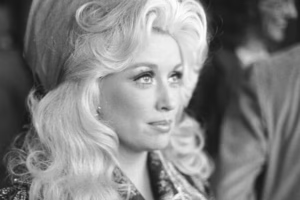
TV anchors always lead into the story of a celebrity who’s died, “The nation mourns today.” It’s almost never true; it takes a lot to make a nation mourn. But it’s true this time. Things feel lonelier without that girl.
I’ve been thinking about some of the elements of her extraordinary impact.
I will call her Dolly because we all did.
She was a great artist and a great person. They can’t always go together and maybe often don’t, but she took her talent and worked it to the bone, took the profit and gave a lot of it away. How would you like to have it said of you that you would have been a billionaire if you hadn’t been so generous?
She knew where she was from but didn’t build a fence around it. She was a white working-class girl, a Southerner from the hollers. You are old moneyed establishment from back East? Come on in, put your feet up. You’re a black intellectual from a great university up north? Settle in. You didn’t have to be uncomfortable that you were different from her, because she wasn’t uncomfortable being different from you.
“I had an ambition and it burned inside of me,” she once said. “It was something I knew would take me out of the mountains.” She loved where she was from and wanted to get out as soon as possible. Can’t get more American than that.
She was modest and wryly self-deprecating, but she knew exactly who she was. Sometimes in life you’re modest because you don’t know who you are, and sometimes you know who you are but it leaves you arrogant. She had the balance: You’re just a human and so you have a lot to be modest about, and yet, as American Evangelical Christians used to say, “Head high, you’re the daughter of a King.” Her last song is locked in a vault to be opened on her 100th birthday, in 2046, and has to do with her place in history. That isn’t a sign of chronic self-doubt.
She had an earned authority and somehow communicated that it might not be wise to mess with her. On CNN a former assistant, Wendy Brokaw, said it’s true Dolly had “the biggest heart,” but “she was also really wise”—meaning she could look you in the eye and quickly take your measure.
She was merry about her public persona and invented a Dolly who would be famous forever and stuck with it. She said she modeled her look on the “town tramp”: “It costs a lot of money to look this cheap.”
She didn’t fight the dumb clichés that early on gathered around her. The joke about Dolly Parton for at least the first half of her career was that she had big breasts and they must always be the leering object of talk-show hosts: “And now, here they are.” She could have shown indignation and confided her pain in interviews. What about my art? Instead, she laughed louder than anyone. She told Oprah Winfrey, gesturing toward herself, “I call these my weapons of mass distraction.” She complained to David Letterman: “Nobody notices I’ve got a great ass too.”
She believed in her talent, bet everything on it. She told interviewers that based on the evidence of old tapes it appeared “Jolene” and “I Will Always Love You” might have been written on the same day. That would have been prodigious if they’d been written the same year.
She never seemed shallow. The shallow can never quite be tender, only sentimental. “Coat of Many Colors,” to pick one song, is tender about people who have nothing and make do. I have always wondered if, while it was based on the truths of Dolly’s childhood, it might also have been inspired by Edna St. Vincent Millay’s, “The Ballad of the Harp Weaver,” a kind of magical-realism poem about the power of familial love. For artists, inspiration comes in many ways and I trace it there because Parton was widely read and had good taste. When Marie Claire magazine asked her to survey her reading shelf, she picked up John Steinbeck’s “The Grapes of Wrath.” She said she loved it, had read it three times, and identified with “the hard work and the poor people and the struggles and the times.”
Show business isn’t prissy, it’s fleshy, earthy. We think of stars as an elevated species shining in heaven, but they’re in the most physical and earthbound of businesses, and it involves wigs, corsets, sweat, an itch on your nose when you’re doing the close-up, the fly that flew into your mouth as you sang and you had to swallow it. Dolly always sort of signaled her love of the mess of it, and it didn’t bring her down to earth in your eyes, it elevated her even more. Because people who enjoy the earthiness of life are the most elegant.
She was a believing Christian and spoke often and believably of prayer, and of her prayers. The day she died her longtime friend Kathie Lee Gifford said on Fox News, “She loved people because she knew God did.” If you think there really is a God, and he really made you and everyone else, then you have to infer that you should be exactly as charitable toward others as you hope God, the day you die, will be to you. That kind of thought will soften your edges. Dolly wasn’t hard-edged.
In her philanthropy she wasn’t abstract but particular and concrete. This was out of keeping with the philanthropic style of the turn of the century, in which big money from Silicon Valley and the great banks went to things like targeted microloans for struggling female entrepreneurs far away. That wasn’t bad, but it could have been Camden, N.J. Dolly’s way was simpler. If a child was preliterate she sent books, if floods destroyed towns she gave cash. She paid sharpest attention to those in her ken, broadly defined as America, where she had the truest sense of need and sharpest eye for what would help. She had been poor in this country, and so she knew the poor existed.
On the “Late Show with David Letterman” on March 24, 1999, she, Emmylou Harris and Linda Ronstadt sang Neil Young’s “After the Gold Rush.” Their strong, clear-bell voices found and locked into perfect vocal harmony. I am listening to it now. It was the last splendid moment of the 20th century.
The first advice of all show business is, “Always leave them wanting more.” Did she ever.
Goodbye, li’l darlin’. We will always love you.