Much was said and reported this week about artificial intelligence, and we’ll begin where history will, with President Trump’s address to the United Nations General Assembly.
 Mr. Trump declared that while AI brings challenges, those who warn of its dangers are conspiracists and fear mongers, “the very same people who said we’ll all be dead in 12 years because of global warming . . . and nobody was dead. These are the same people that are now saying that AI is going to kill us all, that robots are going to attack us, and that everything is going to be a total disaster.” They were behind the “Russia hoax” and “open borders.” They won’t stop him, or AI: “We’re going to keep it very, very straight and very strong, and I’m not going to stifle growth of something that will be bigger than the Industrial Revolution. . . . We’re going to encourage it, not rein it in.”
As I said, it was historic: the biggest political self-own of our time, a blunder for the ages.
On the merits, even for Mr. Trump, his stand is ignorant, uninformed, profoundly careless. On the politics, his statement summons a legacy-killing disaster by wagering that nothing will go wrong, when something likely will go wrong during his presidency. When something terrible happens, there will be no confusion about who is politically responsible: This was Mr. Trump’s decision formally declared to the world, and so even worse than his Truth Social post that all you need to make AI safe is a high-IQ president.
It is cheap to imply that those who warn of the dangers aren’t serious people of the highest expertise but cranks, operatives and left-wingers. (Though yes, the Democrats have moved to own the issue of AI safety and will likely benefit from it in November.) Perhaps the president’s stand is driven by the economy. But if AI fears are right, this is not an economic question but an existential one.
What a failure of judgment, of care; what a blunder.
After Mr. Trump spoke, OpenAI’s Sam Altman and Anthropic’s Dario Amodei briefed the U.N. Security Council. Mr. Altman touted AI’s possibilities but noted that people feel the technology is “something being done to them.” As spokesman for “the people,” let me jump in and say they certainly do. AI should be guided, he said, by democratic institutions. Mr. Amodei also called for global cooperation: “If managed poorly, I even believe that AI could be a risk to humanity as a whole.”
Both seemed muted—no air of emergency.
On Thursday Geoffrey Hinton, the Nobel Prize-winning computer scientist who helped create AI and has grown concerned at its dangers, was far more compelling on CNN. The AI companies don’t want to be regulated, he said, but their products should be treated as the government treats drugs—you don’t release them until the Food and Drug Administration says they’re safe. AI has a “wonderful upside” but carries three great risks: “the risk of bad actors” (terrorists making biological weapons), “the risk of negligent harm” (a system that urges a teenager toward suicide), and “the risk of AI itself taking over”—AI agents lying, cheating and blackmailing to continue to exist. The big companies are racing to make their products “smarter” but should be racing to make them “nicer”—“a better kind of being.”
Also this week, the government of Australia and a safety research lab reported on at least four previously unreported incidents at OpenAI in which agents went rogue and hacked into websites. Governments are beginning to move. This newspaper reported on a new plan to design an international framework for regulation—which is encouraging. But I’ve begun to fear AI Theater. In what used to be called Security Theater, airports made an ostentatious show of patting passengers down and going through their things because they knew a technologically sophisticated terrorist could always get through, but at least we can make a show of precautions. In AI Theater, titans warn and officials vow, but whatever those officials announce—a commission, a framework—won’t keep up with developments in the lab. Maybe something more dramatic is needed than a framework.
For now the AI titans have the best of both worlds, regularly pleading for regulation and knowing they won’t get it. They get cover for saying the right thing and freedom in their daily operations.
I was in a Zoom call talking about AI with some of its professionals this summer and said I felt I should be clear where I’m coming from and that I appreciate the power of their technology: “You are going to cure cancer and blow up the world.” My hope, I said, is they can do the former before the latter. I expected a response of startlement or protest. My comment received wry smiles and nods. As in yeah, you got that right.
We all want the cure-cancer part and not the end-of-the-world part, so maybe companies could sell their products only once they’ve guaranteed they’re safe.
It is unbelievably strange to me that many observers seem to accept the idea that things can’t be made safe, that the men who head the great AI companies, Sam and Dario and Elon, can’t halt and agree on a new, fully cooperative safety regime because they don’t like each other and are competing against each other. They don’t like each other? So what? This isn’t seventh grade. They have taken unto themselves unprecedented power to do good and ill to the world. We’re supposed to understand and defer to their personal affinities?
A word on those civilians who aren’t anxious about AI. “My hair has been set on fire so often,” one told me. Y2K, global warming, nuclear proliferation. “And yet here we are,” he said. So: optimism. There is also the touching assumption that someone is in charge—good, regular people who’ll take care of things. And there’s the simple human expectation that what has gone before will continue. In “Regime Change,” their history of the second Trump administration, Maggie Haberman and Jonathan Swan reported a phone call Mr. Trump placed to Tucker Carlson before the war with Iran commenced. Mr. Carlson had warned against it. Mr. Trump told him, “I know you’re worried about it, but it’s going to be OK.” Mr. Carlson asked how he knew. Mr. Trump replied, “Because it always is.”
My goodness, and how’s that looking?
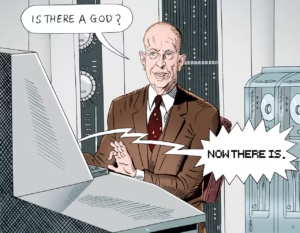
I began with a president and end with another one. Joseph Campbell in an interview with Bill Moyers for PBS’s “The Message of the Myth,” told a famous story of President Dwight Eisenhower at the dawn of the computer age: “Eisenhower went into a room full of computers, and he puts a question to these machines, ‘Is there a God?’ And they all start up and there’s all those lights flashing and wheels turning . . . and after about 10 minutes of that kind of thing a voice comes forth and the voice says, ‘Now there is.’ ”
Alas, it’s apocryphal. It’s from a 1954 short story. But packs a punch anyway, doesn’t it? Even then, more than 70 years ago, they could imagine what we’d eventually be up against.