Nicolás Maduro wasn’t the president of Venezuela but an illegitimate head of state, brutal and criminal, whose presence was ruinous for his country and its people. No good person mourns his fall.
Beyond that, some points:
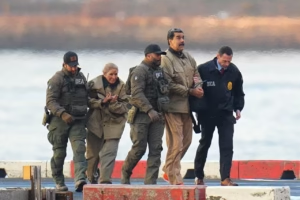
The U.S. military reversed the script. After news broke Saturday of Mr. Maduro’s removal, gone was the picture you keep in your head of the slovenly withdrawal from Afghanistan. It was replaced by a predawn raid that was brilliantly executed and valiant. High stakes, high pressure, every piece of the machine had to work for the whole thing to work, and it did. One hundred fifty warplanes from 20 locations, a successful cyberattack that turned off Caracas’s lights, Russian-built air defenses taken out. The New York Times reported on the pilot of the first helicopter in the assault, who was hit in the leg three times when the MH-47 Chinook came under fire, kept flying, and struggled to stay aloft. He and the co-pilot stuck the landing, army commandos poured out, there was an intense firefight with Mr. Maduro’s security. Many U.S. troops were brave, all were professional, none were lost.
Can competence be moving? Yes.
The decision to go in was Trumpian in its boldness, Trumpian in its blur—he has ad-libbed and free associated about his strategic reasoning a lot but never issued a truly formal and persuasive statement, as if he didn’t trust his own reasons or didn’t trust others’ ability to understand them. It was Trumpian too in the sense that after the military success it all looks ad hoc and thrown-together, and maybe ill thought through in the long term.
No one knows what’s next. How does this work? A quagmire—a thugocracy left able and intact, with the likelihood of U.S. boots on the ground? An against-the-odds triumph—it’s only when you push over the tree that you find out how hollow it was inside? Something in between? What does that look like?
Everyone knows “You break it, you own it” is true. The administration is saying we didn’t break it, we just removed a bad guy and left his government standing, but under pressure and on notice.
The dog that didn’t bark was conservative influencers and media figures passionately inclined toward nonintervention in the world. Part of their silence would be personal loyalty to a president who had just launched a military operation, part would be professional prudence: If this foray works, they won’t have been tarnished by opposing a success; if it turns south, they’ll announce they were loyal but have eyes and now must speak up. But part of the reason they said little is that they weren’t sure how their own base felt. The base itself wasn’t sure.
Trumpian Republicans came to hate what they called “forever wars.” What they really hated is what we have called them in this space, “long, unwon wars” that bled blood and treasure for years and yielded nothing. That was what they hated: all that loss and nothing good. Capped off by Afghanistan—our aircraft and vehicles abandoned to the people we went there to fight, the Taliban, as they took charge. That is what Donald Trump’s supporters hate.
If this “war,” if that’s what it is, “works,” however that looks, they will be happy with it.
I don’t buy a major reason not to have removed Mr. Maduro, which is to avoid giving Vladimir Putin and Xi Jinping a rationale for their own past and future aggressions: We can take Taiwan, he took Venezuela. Messrs. Putin and Xi do what they want within systems that allow it. “Trump did it” isn’t an excuse they need or require.
It is more likely they’ve been impressed by what Mr. Trump did—he was bold, made a big gamble, and U.S. military and intelligence were first-rate. If you think Mr. Putin with his shambolic military and envious nature didn’t notice, you’re wrong.
This is Mr. Trump’s second big win in this administration from the military and intelligence agencies, the first being the complex and successful bombing of Iran’s nuclear sites last June. Venezuela will sharpen his taste for such endeavors.
Is it possible to be happy Mr. Maduro is gone and still feel disquiet and unease? It is. Which gets us to the larger point, that we’re in a new time. What I felt Saturday morning was that something good had happened, and yet something had been unleashed.
In 2014, when Mr. Putin took Crimea, many in the U.S. foreign-policy establishment were rocked and shocked. I attended a gathering of diplomats, journalists and scholars, and they had blanched faces as they discussed what it means. But they dwelled on secondary and tertiary issues and had fantastical notions—was Mr. Putin just making a point, and having made it, will he retreat?
I thought no, you are missing the heart of it. What just happened is an endpoint. The old post-1989 way is over for Mr. Putin, we’re in new territory. I thought of the name of Tom Wolfe’s then-recent final novel, “Back to Blood”: The world is going back to something basic, grimy and tribal.
Concerned, sophisticated liberals are warning the world is devolving into “spheres of influence,” going in the direction of Russia dominating Europe, China dominating Asia, America dominating the Americas. No higher belief is held high, not democracy or pluralism.
They are right to be concerned. Such a world replaces the old imperfect one—it de-emphasizes the long and never fully satisfying work of friendship and alliances, of stabilizing international institutions and arrangements, of active diplomacy that can make things better. It isn’t creedal or expansive, will likely be more brutish and narrow.
Venezuela is within our sphere. So is Greenland, which within days the administration was threatening.
Connected to this, at least in my mind, are the words of Stephen Miller, White House deputy chief of staff for policy, to CNN’s Jake Tapper on Tuesday. This is the mood music of the Trump White House right now:
The world must be governed by “force,” Mr. Miller said. “We live in a world in which you can talk all you want about international niceties and everything else, but we live in a world, in the real world, Jake, that is governed by strength, that is governed by force, that is governed by power. These are the iron laws of the world since the beginning of time.”
He didn’t say “You can’t handle the truth,” as Jack Nicholson did in “A Few Good Men,” but that was the flavor. He didn’t say, as Osama bin Laden did after 9/11, that the world respects only “the strong horse.” But it had that sound.
There’s truth in it: This brute world respects strength. But you wonder how you’d feel if those words came from a high aide to the leader of China or Russia. How does it make anything better that Americans talk like this now, suggesting they’re more willing to act just like the world, think like it, leaving it with no higher standard to meet or better behavior to be impressed by? I can’t figure how that makes things better.