In his Iran speech Wednesday, President Trump asserted much and argued for little. There were some boasts, some threats—“We are going to hit them extremely hard. . . . We’re going to bring them back to the stone ages, where they belong.” And some of what appeared to be magical thinking: “When this conflict is over, the strait will open up naturally.”
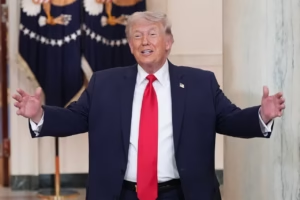 The central message seemed to be that the war isn’t over but may be over in a while, the U.S. will continue bombing for two or three weeks, and, unstated but made clear through subject matter, setting, symbolism and the length, extent and success of the military campaign: Of course this is a war.
It was strange that Mr. Trump didn’t prepare the country for any possible repercussions. A somber admission that U.S. actions in Iran might be followed by serious counteraggression was needed, and is part of the president’s responsibility.
I was thinking this week that Mr. Trump’s vision of himself as primarily a dealmaker is unsuited to a necessity of presidential leadership, which involves laying out the logic of a difficult case. Deal makers gain advantage through strategies that don’t necessarily involve transparency and forthrightness. I went back to Mr. Trump’s 1987 “The Art of the Deal.” A strong undercurrent of that lively book is that it’s good to be unreadable and sneaky: “I play it very loose.” “Sometimes it pays to be a little wild.” “The truth is I’m keeping my options open.” “I also protect myself by being flexible. I never get too attached to one deal or one approach.” “I keep a lot of balls in the air.” “Once I’ve made a deal, I always come up with at least a half dozen approaches to making it work because anything can happen.” Money is a way of keeping score. “The real excitement is playing the game.”
I want to swerve here to talk about the word that keeps coming to mind when I look at the president’s leadership, and it is “mood.” A lot seems to depend on matters of personal choice, will and mood. In Iran for instance, maybe he’ll bomb the rubble until it jumps, maybe he’ll declare victory and withdraw by May, maybe he’ll send in troops. But it will be his choice, no consultation needed with that pesky branch, the legislative.
There is something not at all right when the weightiest decisions of a democratic republic depend so much on the mood of one man. With the great majority of past presidents personal mood didn’t have such precedence. There were forms and traditions and processes, there were strictures, rules, the law, expectations, all of which would hem in the head of the executive branch, at least eventually. The president’s mood didn’t reign and determine everything. But now mood mows down all. People have become habituated to this, tolerate it, factor it in. But of course when you factor it in you are enabling and continuing it.
Fear of the president’s mood has reduced otherwise impressive appointees to anxious ferrets sparring with Sunday news show anchors in a way that is performatively smug but also fearful—always aware of the famous “audience of one.”
Things are out of whack, and even though we all know this, it still should be said now and then.
Ronald Reagan late in his presidency, in a valedictory appearance at a Republican National Convention, spoke of how he personally experienced the office: “You don’t become president of the United States. You are given temporary custody of an institution called the presidency, which belongs to our people.” He approached his two administrations as “a sacred trust.” This was pushback against the idea of an imperial presidency, in which man and office are fused and personal power the point. But man’s life is limited and the institution is continuous, an inheritance accumulated across time. It was also a rebuke to the idea of grandiosity, in which inflated self-regard amounts to a distorted relationship with reality.
The Founders would agree. James Madison felt the ambitions and vanities of men must be countered and balanced through conscious governmental structures. Alexander Hamilton wanted energy in the executive—the president must be strong enough to do what is necessary, to lead and leave his mark, but that office can’t become a tool of personal ambition, whim or will. President Washington’s actions were more eloquent than words can be: When he left office and lay down power, he was implying the presidency ran through him but would now be redirected, by the people, to run through someone else for a time, and so on.
It’s all gotten too ego-driven, too strangely dependent on the magic of personality, too vainglorious and, yes, grandiose. This style has been growing, unevenly, among presidents for some time, but never as it is now and under Mr. Trump.
Last week the Treasury announced Mr. Trump’s signature will appear on U.S. currency. Why? Maybe he was in the mood to sign dollars and those around him, knowing everything in their lives depends on him, that what power they enjoy flows from him, said: Yes sir, your mood is all.
Mr. Trump was in the mood to knock down the East Wing of the White House and build in its place something huge and imposing, certainly needed, possibly grand. But the drawings appear strange, with the new edifice dwarfing all around it in a way that is disharmonious, dominating.
At the beginning of the war, exact U.S. objectives weren’t clearly or formally stated, and I guessed the president would make them clear the day operations cease. Whatever the state of play at that point will be exactly what he set out to achieve. I still believe that is true.
And if he’s in the mood for it, we’ll have a parade.
The president’s foes keep saying we are losing our democracy, but if we continue down this path we will lose our republic—chipping away at its balance, its expectations and wisdom.
Imagine a Congress that looks at a war and denies it’s a war so it won’t have to debate the war in front of the American people.
Imagine a president going to the Supreme Court oral arguments on birthright citizenship and sitting in the audience to stare down the justices who may rule against his government’s case. That actually happened Wednesday morning. It has never happened before in all U.S. history. (And surely, it will prove a miscalculation. That court is not going to be afraid of his glowering visage. That court is part of a branch that still knows its job.)
This whole big shambolic miracle machine only keeps rolling because we are an amazing thing—a democratic republic. Both are important words, both essential. But “democratic” is an adjective modifying a noun.
In a republic, the noun, supreme power is held by the people and their elected representatives, constrained by law. In a democratic republic the people choose those representatives through elections with broad suffrage. The republic brings with it constitutional limits, separations of power. Democracy brings with it popular will, and implies popular passion, and the possibility of excess.
We are both, and must be.