This being Holy Week and Passover, a small reflection on Scripture. There are stories and moments in the Old and New Testaments that grab hold of us, some from the first time we heard them, and stay. One, for me, is the story of the good thief.
Christ is on the cross, being put to death between two common criminals. The soldiers jeer. The thief on the left bitterly mocks him. “Aren’t you the Messiah? Save yourself and us!” The criminal on the other side rebukes him. “Have you no fear of God, when you are subject to the same condemnation? And indeed, we have been condemned justly, for the sentence we received corresponds to our crimes, but this Man has done nothing criminal.” He looks at Christ and says, “Jesus, remember me when you come into your kingdom.” And Jesus answers, “Amen I say to you, this day you will be with me in paradise.”
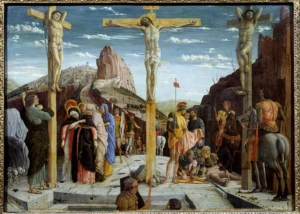
Always hits me like a punch. They’re minutes from death. One thief goes out the way he’d always likely been, insolent and mean. The other thief has a heart for justice—we deserve what’s happening to us, but he doesn’t—and asks for mercy. Christ tells him, essentially, you’re not forever alone, soon we’ll be together in Heaven.
The story, in Luke’s Gospel, is understood as a moment of grace and redemption, and it is those things, but it’s also a story involving the simple idea that it’s never too late. Famous words—we say it’s never too late to learn physics or go to Machu Picchu—but this story is about the infinitely more important idea that it’s never too late to become a better human being.
When I asked New York’s Cardinal Timothy Dolan why the story moves so many of us, his response sounded like a merry devotional poem. “I’m ecstatic at your interest / In my buddy St. Dismas.” (The good thief became known as Dismas, no one’s sure why, and has been called a saint from the first centuries.)
“I love him,” the cardinal said. “I’ve always had a deep devotion. When I was a kid at Catholic school, Sister called him ‘the thief who stole Heaven.’ ”
It isn’t just that Christ comforted the thief, the thief comforted him. “Here is Jesus at the most desolate moment of his life. He was alone, the apostles had run off. He thinks, ‘This thief professes faith in me. He’s asking me to perform a miracle and get him into Heaven.’ This is an immense consolation to Jesus.”
“Pope Benedict once said it’s the only time in the Gospels someone calls the Lord just by his first name—Jesus, not ‘Jesus, son of God’ or ‘Rabbi Jesus.’ This thief felt so close to him he uses his first name.” For Christians the story resonates because “we’re talking about all of us—if the thief got in, we could all get in; if he receives mercy, we all got a chance.”
“As a priest, I hear those at the end of their life, reconciling with God, talking about things they’ve done. They are asking, ‘Will he remember me?’ ”
He asks if I know the old story about what happened to Joseph, Mary and Jesus as they journeyed to Egypt to escape Herod’s murderousness. “The legend is that a band of robbers and brigands descends on them. A little boy with the bandits sees Jesus and goes to his father, the band leader, and says, ‘Please let them live, there’s something about that child.’ And the Holy Family was spared. And that little boy—was Dismas!” Who spared Christ, who later spared him. “As the Italians say, if it ain’t true it oughta be true!”
Afterward I found a medieval poem: “Let them pass, the young one said / There’s light around that baby’s head.”
But what about the idea that people don’t change? In your years of spiritual counseling, do they?
“Do they ever. Every Christmas I get a card from a woman, now in her 90s. She came to me, I was a young priest 49 years ago, she was an alcoholic without hope. I get a card every year saying, ‘I’m still sober.’ ”
“We have Easter in springtime. Nature is changing, new growth coming. We think winter has the last word but no, springtime comes, life trumps death. The change in nature connects to changes that happen in the human heart, there’s a desire for renewal. We turn to the beyond, we say, ‘Lord, help me.’ ”
“Look at what he did for the Jews fleeing Egypt. He turned a sea into dry land so they could pass on dry ground. He leads them and sends them food, manna.”
“When we turn to God and ask for some renewal, some rehab, some reform—once we turn to him in our need, We’re like Dismas.”
A few blocks from St. Patrick’s Cathedral is Central Synagogue. People don’t think of Midtown Manhattan as a spiritual powerhouse, but it’s been a busy place this week and last, and Rabbi Angela Buchdahl had thoughts on how people deepen themselves.
“I absolutely believe people can change, and Judaism makes it very clear that it’s always possible for people to change.”
“In Hebrew we call it teshuva. It has to do with repentance, but it literally means ‘return.’ You can ‘make teshuva’—it is returning to the pure soul you were born with, you return back to that original goodness.”
We often resist. “Look at the story of Jonah in the Hebrew Bible,” she says. “God asked Jonah, who was a prophet, to go to the city of Nineveh, and tell them to reform. Jonah says he doesn’t want to go, not because he thinks they can’t change but because he’s sure they’ll repent, and he doesn’t think they deserve it! After he flees God’s command he ends up living in solitary confinement in the belly of a whale.” Freed, he goes to Nineveh, they repent, God forgives them, and Jonah is . . . still upset. “Human beings can be resistant to give people an opportunity for a second chance. But in our shared textual tradition God wants people to change.”
She spoke with someone at Central Synagogue’s Wise Aging group. The woman said she thought the decade between 60 and 70 is the time of the most growth in a person’s life. Rabbi Buchdahl demurred: Studies emphasize adolescence. “But the woman said, ‘When you’re 60 you’re at the peak of your power—running the law firm, the most respected doctor. At 70 you’re having to grapple with transitions, with who am I, and the aging of the body. It is the time of confronting the big questions of life. It is then you can change your spiritual outlook, your character.’” And the rabbi reconsidered and thought yes, “the big questions are the things that cause us to change.”
“Christians believe this season is one of resurrection, Jews a time of rebirth—a rebirth in the natural world, but also coming out of Egypt into freedom. This is a fruitful time to ask the questions about what we want to be. We are on a journey, all of us leaving a narrowing, constricted place for a place of freedom. This is a narrative that happens in every generation, and in each of our lives.”