The fiery Tucker Carlson interview with Sen. Ted Cruz is the perfect distillation of the split among conservatives on Iran. And that split is all about the unhealed wound of Iraq.
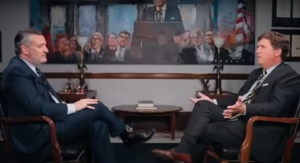
Mr. Cruz made his personal case—it seemed to rest on his reading of the Bible—for joining the Israeli action against Iran. Mr. Carlson pushed back. It got pretty personal pretty fast. Mr. Carlson called Mr. Cruz “a sleazy feline,” Mr. Cruz accused Mr. Carlson of “reckless rhetoric.” Mr. Cruz compared Mr. Carlson’s foreign policy to Jimmy Carter’s. Mr. Carlson: “This is one of the weirdest conversations I’ve ever had.”
Everything harked back to the Iraq war. Two parts said it all. The first has been all over social media:
Mr. Carlson: “How many people live in Iran, by the way?
Mr. Cruz: “I don’t know the population.”
Mr. Carlson: “At all?”
Mr. Cruz: “No, I don’t know the population.”
Mr. Carlson: “You don’t know the population of the country you seek to topple? . . . How could you not know that?”
Mr. Cruz: “I don’t sit around memorizing population tables.”
Mr. Carlson: “Well it’s kind of relevant because you’re calling for the overthrow of the government.”
Mr. Carlson challenged Mr. Cruz on the ethnic mix of Iran. Mr. Cruz seemed uncertain.
Mr. Carlson: “You don’t know anything about Iran.”
The second part hasn’t been so noticed.
Mr. Carlson noted Mr. Cruz supports “regime change.” “What does regime change look like in Iran?
Mr. Cruz: “Somebody else in charge.”
Mr. Carlson: “How do you get there?”
Mr. Cruz: “Look, that ultimately has to be a popular uprising from the people.”
Mr. Cruz, a member of the Foreign Relations Committee, was glib, as is his way, and didn’t seem to have thought things through. Mr. Carlson was hectoring and inconsistent. But it was all about Iraq. Mr. Carlson said as much. “I am the product of the last 25 years watching carefully . . . and I see an unending string of foreign policy disasters.” “I feel very stung by what happened in Iraq, if I’m being honest.” He had supported that war, even “promoted” it. “The cost on so many levels” to the U.S. “was just so profound.”
The conversation brought me back to that epochal year 2003 and the lead-up to the Iraq war. The arguing between Republicans was bitter, though it was largely suspended when the war commenced and loyalty to the troops closed ranks. When the war began to go sideways the argument began again and has never been resolved. By 2010 or so Republicans on the ground were saying the war’s originators hadn’t known anything about Iraq, didn’t know a Shiite from a Sunni, it was all bluster. That was the context of Mr. Carlson’s questions to Mr. Cruz: You don’t know anything.
Before Iraq, local Republicans thought, in general, of the government: They know what they’re doing. The White House has more information than the rest of us—spies and overflights and aerial photos. They have expertise we don’t have, they know all about the workings of foreign governments and armies. After Iraq went bad they’d never think that again.
They didn’t just feel their trust had been misplaced, they felt they’d been fooled. There were no weapons of mass destruction; our spies had been taken in by some operator named Curveball. And they’d lost their sons, more than 4,000 of them.
It changed the party’s nature. Iraq and illegal immigration produced the conditions that made Donald Trump possible, then inevitable. Twenty-two years after the beginning of that war it continues to have profound repercussions on American thinking about the world.
One thing I came to conclude about the men and women who put that war together was that they had grown up in such a blessed, prosperous and stable country that they had a false sense of endlessly sunny skies. Personally they hadn’t been unlucky—they were at the top of the pile, had never been losers. They thought good things would follow their good efforts in the same way study had produced honors at college and discipline had produced their professional rise. They didn’t think dark because they’d never known darkness. It was a disadvantage. To make solid decisions at that scale you have to know in your gut that history’s an abattoir and the floors are slippery. The price a government or party pays for being dramatically wrong can have foreign-policy reverberations that last generations.
This is Donald Trump’s first big, immediate and urgent foreign-policy crisis of this term, maybe both. It is a time of real drama. It appears at this writing Mr. Trump has punted or is delaying a decision for two weeks.
Few normal people seem certain their view on a U.S. bombing of the Fordow nuclear installation is the wise one. Will it forestall some future horror? Will it give rise to loss of innocent life, a mess, a quagmire? At this point in the debate what you hear is “then again.” We don’t walk the world looking for monsters to destroy, but then again this is as clear a shot as we’re likely to get, so take it. Then again if the ayatollah falls the guys who replace him may be worse. Then again the death throes of the Iranian regime won’t be pretty.
If Mr. Trump moves boldly and it’s a clear success, he’s a world-class hero. Nobody loves Iran, many want to see it humbled. If he moves boldly and it yields some kind of failure, his own supporters will never feel the same about him. If he doesn’t move boldly and Tehran limps back and in time develops nuclear weapons, he will suffer with some of his base and in the eyes of the world. Presidents try hard to keep themselves from situations in which the political outcomes are so stark. They don’t like those choices—“hero,” “politically dead.”
It feels like an epochal decision because it is. In this space we’re certain of this: Congress should be involved. Reps. Thomas Massie (R., Ky.) and Ro Khanna (D., Calif.) this week introduced a War Powers Resolution to prohibit U.S. forces from engaging in hostilities against Iran without authorization from Congress. The bill will move forward or not, interestingly, in the next two weeks. The White House would be wise to support it. America would be surprised in a positive way to see Mr. Trump, professional upsetter of norms, bow to Congress’s war powers. We are not only a democracy, we are a republic; the legislative branch has a role. Restoring that norm would also shore up the president’s position. If he moves and it’s a success, he’ll still get all the credit, but if he moves and it isn’t, blame will be more dispersed.
Congress should rush to rescue its rightful constitutional role, and take a stand in the war drama as it was elected to do. But for many it’s more pleasant to complain your power has been stripped away and blame the president if things go badly.
There’s little chance it will pass but it would be a good thing if it did. In unstable times it would add a note of stability—of a nation, as opposed to one man, deciding.