White smoke. The cardinals moved quickly, after only four or five ballots. Is that a good sign? But the smoke is white, and people came running, and the crowd in St. Peter’s Square burst into sustained cheers, with chanting and then laughing, and the huge ancient bells began to ring.
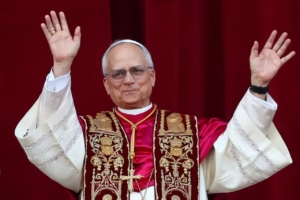
On the Vatican feed the camera panned the crowd and you could see the flags of all the different countries, and get a sense the whole world was coming, and in spite of myself I felt moved and hopeful because you never know in life, it renews itself, surprising things happen. The crowd was dominated by young people wanting something to follow, something to love. If that isn’t moving—the old church trying to renew itself—then nothing is moving. “Oh let it be a great man,” I thought, so many thought. “Let him cheer the world up.”
As I watched the networks’ live shot of the Vatican balcony, I remembered a conversation with a businessman 28 years ago. He wasn’t interested in religious things, was nominally Protestant but didn’t get a headache about it, and we stood in a friend’s kitchen as John Paul II’s last visit to America played out live on a screen in the background. He kept turning to it. “I don’t know what it is, but when I see him, I get moved,” he said. Many felt that way in those days, and it’s what I hope they’ll feel with the new pope.
I texted around to see if anyone knew anything. Nobody did.
You know, because you are an adult and not a child and have read a bit of history, that maybe the new pontiff will be a nullity, maybe a place-keeper—history has been full of such popes—maybe he’s a good man, maybe a great one, and maybe mischief from day one.
But you know this too: “And I tell you that you are Peter, and on this rock I will build my church, and the gates of hell shall not prevail against it.”
And as dusk approached, the velvet-draped balcony filled and Cardinal Dominique Mamberti proclaimed, “Habemus Papam!” We have a pope.
And he is an American.
And he will be Leo XIV.
And he has a nice smile.
Just before the “habemus” a friend had texted, “I hope it’s a big surprise—someone we’ve never heard of.” Meaning someone we’re not tired of knowing. Very soon afterward he texted, “He’s an American!!”
It has shocked the world, and it has shocked America too. There’s something moving in it, to see this suppleness in the ancient institution, to see its continued ability to surprise. The first American pope in the history of the Catholic Church.
But to those who watch the Vatican closely, the choice of Leo wasn’t a massive surprise. Cardinal Robert Francis Prevost had been on the lists of possible popes since Pope Francis died, and he’d inched up on those lists in the past week. He is an American, age 69, but is probably best understood as an international figure. He was born in Chicago, bred in the suburb of Dolton, attended parochial schools there, was an altar boy, graduated from Villanova University and received his master’s in divinity at Catholic Theological Union in Chicago in 1982. Then off to the world, in a missionary order. Most of his priestly life, with some brief stints in America, has been spent on other continents, in Peru and in Rome. This makes him something new, more a cardinal from the world than a specific place. He was made a cardinal by Pope Francis in 2023 and headed the Vatican office responsible for choosing bishops of the Latin rite. In a conclave this week where many of the cardinals didn’t know each other, they knew him.
He will be the first pope in history to speak English as his native language.
We will find in coming days what the thoughts of the members of the conclave were, and how they chose him. But it isn’t a big jump to assume part of the story is that the Vatican is in grave financial crisis, and the Roman Curia has never faced a boss who is assumed to be versed in the general principles of American management.
What is most important and revealing is the name he took: Pope Leo XIV. The name a pope chooses is a signal, always. I had been hoping he would choose Leo but didn’t expect it.
The two big Leos were Leo the Great and Leo XIII. Leo the Great, whose papacy lasted from 440 to 461, was known for a refined intelligence: He was a diplomat good at stopping trouble. This came in handy when he met, in 452, with Attila the Hun. Attila intended to take and pillage Rome. Leo persuaded him not to, and Rome was spared. In 455 Leo met with a Vandal king and negotiated to save the city’s basilicas and the many taking shelter there. He also battled back against many heresies. He was an especially capable man, was sainted, and is buried not far from St. Peter’s tomb in Rome.
Leo XIII was an equally important character, serving as pope from 1878 to 1903. He saw the church into the 20th century, and his great work was his 1891 encyclical “Rerum Novarum,” which outlined what would become Catholic social teaching, including the rights of workers (fair wages, safe conditions, a right to unionize) while blending it with support for property rights and free enterprise. They called him “the pope of the workers.”
The new Leo’s choice of his name is already considered a subtle continuation of Francis’ general leadership, and I suspect it is, but wonder if it is also more than that: Catholic social teaching is embraced by modern political categories of left, right, and center, and Leo XIV may be signaling respect for the idea of synthesis—you can feel respect for both people and systems, things don’t have to compete, they can go hand in hand.
We’ll see. Onward into history. One of our countrymen has been raised high, a Midwestern boy, a Chicago kid raised to the throne of Peter. Did you ever think you’d see a Yank there? Really?
There are words attributed to Pope Benedict XVI that seem appropriate to the moment. “The keys entrusted to the successor of Peter are his for only a speck of time, and as steward, the pope is not answerable to the here and now.” He can’t solve all the ills of the world. He can only do his very best, with the help of God.
What stays with me after this momentous Thursday of the white smoke is the kindness with which the huge crowd cheered Leo, the encouragement and ready affection they showed. Other great faiths don’t do it this way, don’t present their leaders with everyone cheering and half of them weeping and all of them together in the great square. There’s a deep sweetness to how the Catholics do it, inviting the world. It reminds me of James Joyce, and his definition of the church’s universality: “Here comes everybody.”