On Memorial Day we have a duty to remember. Part of how we remember is through film. Its makers should be thanked for capturing war’s valor and loss.
World War II got the great movies, scores of them. There are acknowledged classics—“The Bridge on the River Kwai,” directed by David Lean, with a long-uncredited screenplay by the blacklisted Carl Foreman and Michael Wilson. “From Here to Eternity,” from the James Jones novel, directed by Fred Zinnemann. Everyone of a certain age has personal favorites. Among mine, “They Were Expendable,” produced in 1945, directed by John Ford and starring the Duke, John Wayne.
After the 50th anniversary of D-Day there was renewed interest in the Normandy invasion, and 1998 saw “Saving Private Ryan.” I went to its opening day in New York with my friend John Whitehead, who’d been in the first wave at Omaha Beach more than half a century before. As the famous first 20 minutes rolled out, John wordlessly pointed at the screen and didn’t take his hand down. I said “What?” and he said softly, with awe: “That’s exactly what it looked like.” He couldn’t believe all those years later he was seeing it again. Director Steven Spielberg gave John that moment.
Korea, the forgotten war, didn’t get what it deserved. There was one immediate classic, 1954’s “The Bridges at Toko-Ri,” directed by Mark Robson, from a novella by James Michener. The Vietnam era got at least two great films. “The Deer Hunter,” directed by Michael Cimino, was about Pittsburgh-area factory workers who fought that war. (To see it now is to think: That’s the white working-class Trump vote being born.) “Born on the Fourth of July,” directed by Oliver Stone (who also did “Platoon”) deserves rank as a classic. Sooner or later we’ll have to come to terms with Mr. Stone’s greatness as a filmmaker.
Iraq has some great films, “The Hurt Locker” and “American Sniper.” More will likely be made about the Mideast wars as America absorbs all aspects of what happened there.
But I go back to World War II for the movie that best captured veterans returning home. “The Best Years of Our Lives,” from 1946, is a movie with such rich texture it’s like entering a world.
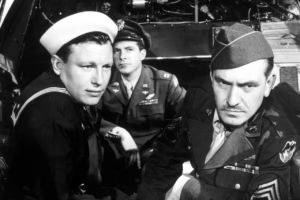
Three men came home from war. On the journey back to fictional Midwestern Boone City, they became friends. Army Sgt. Al Stephenson was an upper-class banker going home to make loans again. Homer Parish was a middle-class sailor who lost his hands in a fire when his ship went down. Fred Derry was a working-class hero who’d experienced a status change as an Air Force captain: Now the dashing officer and gentleman was going back home to the house on the wrong side of the tracks. The movie is about their trying to become normal again, trying to be like what they were in a country that had changed. They hadn’t served limited tours, they’d been over there for the duration.
It was directed by William Wyler, who flew bombing missions in the war while making documentaries for the Air Force, and written by Robert E. Sherwood, the playwright who’d been a speechwriter for Franklin D. Roosevelt. It has one of the most gorgeous and stirring scores in movie history. Its composer, Hugo Friedhofer, studied under Max Steiner, the father of film music.
A famous scene: The three servicemen are just coming back. It’s a long flight home, a lot of stops; they fell asleep overnight in the plexiglass nose turret. As the sun rises, they come awake, the music swells.
Suddenly below they see: Boone City. Meaning: America. Its quiet dignity, its undestroyed buildings. “There’s the golf course!” “People playing golf just as if nothing had ever happened.”
But it has changed: “Hey, that must be the new airport.” “Holy smoke.” The field is full of junked bombers. “What we coulda done with those in ’43.”
The sailor with prosthetic hands was afraid to go home. They all were. They didn’t know how to present their new selves. Who were their wives and kids now?
Another famous scene: Al walks into the fancy apartment building where his family lives, rings the bell. His teenage son answers. Al puts his hand over his mouth to stop the boy shouting his name, shushes his daughter. His wife, Milly, is in the kitchen setting the table for dinner. She calls out: Who’s at the door? No answer. Who’s at the door?! And suddenly she knows, and walks into a long hallway, and she and Al walk toward each other shocked, embarrassed, full of yearning. That’s the scene they used in the commercials on TV in the 1960s. “And tonight, this special presentation . . .”
It came out a year after the war and won the major Academy Awards—best picture, adapted screenplay, actor and original score. Sam Goldwyn, the buccaneer who helped invent Hollywood, saw it as his triumph.
Everyone involved knew they’d done something beautiful. Myrna Loy, who played Milly, said in her memoir, “Being and Becoming,” that it was the best movie she’d ever been in. “Everything about it was right.” Fredric March, who played Al, said it was a privilege to be in it: “This picture tells the truth. That’s why it matters, and why people remember it.” Wyler thought it one of his most meaningful movies because it helped with the great homecoming as it happened.
There’s a subtext of class struggle—the movie literally begins with a portly, golf-playing businessman bumping a weary GI from a flight home. Ayn Rand, a brilliant idiot who had deep insight except into the essence of things, attacked it as anti-capitalist. In the film, Al, back at the bank, had taken to approving loans to veterans with insufficient collateral beyond their character. This was dangerous for investors, Rand said. But it wasn’t anticapitalist, it was pro-goodness, pro-guts.
There’s a scene in a drugstore in which a businessman shows Homer sympathy and then snarls that it’s too bad he lost his hands for nothing. It’s all in the papers, he says, Hitler and the Japs didn’t want to fight us, they just wanted to stop the commies and the Limeys. Homer gets mad and tears the American flag pin from the guy’s lapel. Fred, a soda jerk again, jumps across the counter and decks him. The dialogue—you could hear it on a podcast today.
So a Memorial Day thank you to artists who make movies.
And thank you to American technology. It’s a gift to live in a world where you can think of a movie you fell in love with 60 years ago, and in three taps of a keyboard or clicker see it again, fill your house with that music, those words. What an enrichment of life. You used to have to wait and watch the movie listings, now you go to Amazon Prime. We’re all used to this but shouldn’t forget: Holy smoke.
This movie is great because it reminds you we’re all in this together. We’re all recovering from World War II, or any war, or any era, together.
It is a communal and collective undertaking, being alive in America on any given day. It’s good to be reminded, good to see it can all work out.