Only five years ago, in the first autumn of the pandemic, the big question was whether New York was over, finished. It was a real debate. The threatened collapse of commercial real estate, the rise of remote work and the growing knowledge you didn’t really have to be here to be at the top of your profession, the financial hit of the pandemic itself, the demonization of the police after George Floyd, the retirements and departures from the New York City Police Department, the rise in crime . . .
We made it through that. We are up and operating again, getting our strut back. Midtown Manhattan is clogged again with impossible traffic, downtown’s booming, people are back in the office and out on the town, Broadway is back.
It didn’t happen overnight, took a lot of moxie and grit, but we made it through. And you wouldn’t think we would be on the verge of handing ourselves a brand new setback in the choice of our next mayor. But we are.
So I guess this piece goes under the heading “Often in life after a bad thing happens, those who allowed it say, ‘I’m not sure we were sufficiently warned.’ ” Here’s a warning:
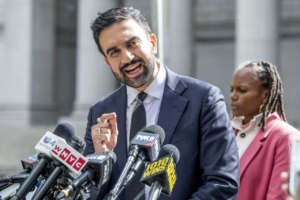
New York should breathe deep, think twice, then think again before electing the socialist mayoral candidate, Zohran Mamdani. He is barely 34, has never had a real job, was elected five years ago to the state assembly, which is a badge you wear while you scrounge around for attention and connections. This isn’t the résumé of the person you want in a position to guide the future of one of the largest economies in the world.
Different things are needed at different times. With our footing just back, what the city needs is an air of energy, bounce, expansion—more enterprise, more of a welcoming attitude for the woman who wants to open a small store or new restaurant. Make it easier for her. We don’t need more of the dead hand of government; we need to return more of a sense to the young that striving is still a realistic attitude, that grieving for a system that seems broken and can’t fit you in is premature.
Mr. Mamdani’s major stands are famous and often repeated. They involve freezing rents, increasing property taxes in “richer neighborhoods,” and no-cost child care up to age 5. The platform of the Democratic Socialists of America, of which he is a longtime member, is what you would expect—tax the rich, fight police brutality and mass incarceration, free college and medical care for everyone.
How will “the rich” react? They’ll understand all this means taxes and crime will go up, so they’ll be less inclined to stay. In the pandemic we worried as billionaires fled to Florida; now I fear millionaires fleeing nearby. It’s too early to say, everything at this point is anecdotal, but the New York Post this week reported sudden bidding wars among New Yorkers on million-dollar homes in Westchester County and Connecticut: “Real-estate brokers in these suburban markets report a frenzy reminiscent of the early pandemic exodus.” At a recent open house in Scarsdale, the report went on, a real-estate agent said the SUVs were double-parked down the block. “It’s like the Knicks at the Garden right now.”
A young Zohran supporter will wave a hand: Goodbye, who needs you? But every Upper West Side family buying a $1.5 million home in Greenwich was a New York family that threw off a whole world of local jobs and spending—delis, hair salons, babysitters, dog walkers, cleaners, dentists—and every one of them paid the already-high New York City taxes that pay the bills in this town. We’re going to miss them if they leave. Left behind will be the kulaks who won’t leave even after their crops are confiscated.
Mr. Mamdani has long been accused of a deep, persistent antisemitism. I won’t quote the clips suddenly flooding social media, the apparent result of someone’s late and incompetent oppo research, of his saying things that betray to my ear an obvious animus. There is a reason more than 1,000 American rabbis have warned his victory would threaten the safety of Jews.
He closed out his campaign this week unembarrassed to manipulate, implying that if you don’t vote for him it just might be because you’re “Islamophobic.” In a speech outside the Islamic Cultural Center of the Bronx, he said: “To be Muslim in New York is to expect indignity, but indignity does not make us distinct. There are many New Yorkers who face it. It is the tolerance of that indignity that does.”
He said, “I want to speak to the memory of my aunt who stopped taking the subway after Sept. 11 because she did not feel safe in her hijab.”
Here his voice caught. It was quite something. He was talking about the city he is asking to choose him to lead, and accusing it of casual and habitual bigotry. “The dream of every Muslim is simply to be treated the same as any other New Yorker. And yet for too long we have been told to ask for less than that, and to be satisfied with whatever little we receive.” Accounts on X later found that Mr. Mamdani’s aunt doesn’t wear a head covering and apparently didn’t live in New York, and he later said he meant a cousin, who turns out, perhaps conveniently, to be no longer living.
In an embarrassingly self-valorizing way, he vowed, “I will not change who I am, I will not change how I eat, I will not change the faith that I am proud to belong to. But there is one thing I will change. I will no longer look for myself in the shadows. I will find myself in the light.”
Oh please. This man is from the top rung of New York society, his father a Columbia professor who lectures against colonialism and his mother a director whose films have had two Academy Award nominations. A place was made for him in society the day he was born.
More important, New York is such a moving and astonishing place in part because what Mr. Mamdani suggested—fierce and widespread public discrimination against Muslims after 9/11—didn’t occur, and could never have occurred because it is at odds with the city’s essential nature. We don’t like bigotry. We pride ourselves on this. Individuals do jerky things every day and everywhere, but all the messages of this city’s culture are to be open, not narrow, and fair, not unjust. He is probably our next mayor because New Yorkers are more like this than he understands.
History moves and does what it does. The polls suggest that more than half the city opposes Mr. Mamdani, but his opposition is split between Republican Curtis Sliwa, who has no chance, and former Gov. Andrew Cuomo, a Democrat running as an independent, who maybe, maybe, could squeak through if absolutely everything suddenly goes his way.
At the very least, New York, don’t give the Democratic Socialist a mandate or anything he can claim as such. Make it a close one. That might at least limit the setback for a city newly back on its feet and starting to be itself again.