We Need to Know History, Especially Now A new collection of works by David McCullough helps put our tumultuous times in perspective.

Most of us see autumn as the real new year, involving a return to life and a reignition of things. A good time to step aside the fray and consider what propels you. We’re in a history-rich time, not a thin one, and restating your premises can be reorienting.

Some of what drives this column is a belief that reading history—bothering to know it and reflect on it—is good. Remembering its helpful and even inspiring parts is constructive, not sweet. Seeing and naming various current deteriorations isn’t reactionary or nostalgic and can function as at least an attempt at correction.

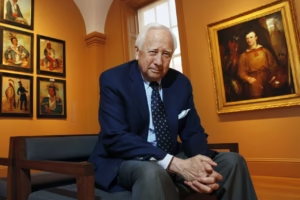
David McCullough

This summer I read the historian David McCullough’s 1995 speech accepting the National Book Foundation’s highest honor, the Medal for Distinguished Contribution to American Letters. It constitutes the brief first chapter of “History Matters,” a collection of McCullough’s essays, interviews and speeches, out this month from Simon & Schuster. Collections that include some previously unpublished work (McCullough died in August 2022) can have a barrel-scraping feel but this one doesn’t—its seriousness and simplicity reflect the author and make for beauty. At the time of the address McCullough had written “Mornings on Horseback,” “Truman” and “The Johnstown Flood”; “John Adams,” “1776” and “The Wright Brothers” would follow. There couldn’t have been a worthier recipient.

Why does history matter? “History shows us how to behave,” McCullough begins. “History teaches, reinforces what we believe in, what we stand for, and what we ought to be willing to stand up for.”

It is not only the dry recording of facts, it has a moral quotient. “At their core, the lessons of history are largely lessons in appreciation.” Everything we have, he says, all the great institutions, the arts, our law, exists because those who came before us built them. Why did they do that? What drove them, what obstacles did they face, how are we doing as stewards and creators? “Indifference to history isn’t just ignorant, it’s rude.” This is a wonderful sentence because it is true and bluntly put. Ignorance is a form of ingratitude.

History encourages “a sense of proportion about life,” gives us a sense of scale. “What history teaches, it teaches mainly by example.”

To live in an era of momentous change and huge transitions is to experience great pressure. Knowing history, reading it, imparts “a sense of navigation,” a new realization of what we’ve been through and are made of. Those who came before us were tough: “There’s no one who hasn’t an ancestor who went through some form of hell.”

In the end, knowing history “is an extension of life. It both enlarges and intensifies the experience of being alive.”

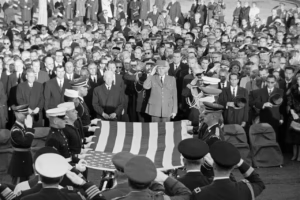
McCullough looms large in my life both as professional whose work I could aim my arrow at, and as spur. I would hear from him when a column spoke to him. After one mentioned the importance of great formal ceremonies marking the passing of the famous dead, he wrote to say yes, such things, “remind us of our dignity.” That dignity, which he sensed and portrayed in his work, and which he knew was aligned with and not poised against finding the truth, was important to him.

Here I jump to an aspect of this column, which is the importance of what was.

Earlier this summer I wrote that we now routinely say and do things in our public life that are at odds with our history, that are unlike us. I focused on President Trump’s language and imagery when speaking to the troops at Fort Bragg, N.C., in early June. His remarks were partisan in the extreme, even for him; it was a Trump rally, not a president addressing the troops. Elsewhere, on sending the National Guard into Los Angeles: “When they spit, we hit.” All of it, the rally and what he said, was, I said, the kind of thing we don’t do. And we mustn’t lose sight of what we don’t do.

Soon after I got a note from a veteran political consultant who’d prospered in both the old political world and the new. He wanted me to know he “agreed with every word.” He then explained with some patience and yet a kind of proud shame that things have changed: “Today people like me raise money and put activists on the payroll to pour kerosene on the fires they ignite.” Protests in the previous political era were organic and natural. “They are now a division of political campaign structure.” The young people he works with know no other reality. “I’m saddened that the political world I have in some part helped construct has come to this.”

He was trying to help me: I had perhaps not noticed our politics had become increasingly malevolent. I replied that I knew quite a bit of what he and his colleagues on both sides are up to, and that as I work I often have the young of politics and media in mind. I am trying to tell them something, to give them a template. I said it is our job, in our generation, to bring the sturdier public values of the recent and distant past into the current moment. We have to put forward those ways from the past that helped, that were superior, or no one will know they existed. And no one will be able to imitate or absorb or reflect them.

“I write for those 33-year-old operatives you speak of who have actually never seen grace.” If they don’t know what it looks like they can’t emulate it, they can’t adopt it and give it new life because they don’t know what it was.

What I didn’t say but meant: When you see a decline in public standards that were once fairly high, when you see our public life become rougher and uglier, you can accept it, even go with it, or you can fight, you can push hard against what’s pushing you, as Flannery O’Connor put it.

And what I’m saying is this is our way of pushing hard. McCullough might say it’s ungrateful not to.

You can’t be dreamy about the past and say, “It was nice then.” It was never nice, it was made by human beings. You can’t say, “People were better then.” They weren’t. But in even the recent past the allowable boundaries of public behavior were firmer, and the expectations we held for our leaders higher. And their public behavior (not private, or not necessarily private) was often preferable to the public behavior we see today. So you don’t want to live in the past, but you do want to bring the best of the past into the present.

History goes only one way, forward, and the history we’re living won’t be getting less rough with time. Neither will our political manners. Neither will the strains under which we are put as a society and a political culture.

But my generation owes those who follow more than “Here’s some cash,” “Toughen up” and “Get off my lawn.”

It’s hard to think of anything more helpful as the new year begins than reading history, spying out the moments of dignity and grace, seizing them and trying to pull them into the future.

How to Think About Trump and Ukraine Some critics say he only wants a Nobel Peace Prize, but that isn’t a bad thing for a leader to aspire to.

I spent time this week talking to people about how to think about the burst of U.S. diplomatic activity surrounding the Ukraine war. I wasn’t sure how to view it but began with certain predicates. Movement to end war is generally good, new initiatives can be constructive, new focus can encourage things in the right direction. If talks and meetings yield nothing, so be it, but would the world be worse for the effort? Russian President Vladimir Putin and Foreign Minister Sergei Lavrov have amused themselves the past few years signaling their openness to the use of tactical nuclear weapons. At the moment, we’re talking about the exact nature of security guarantees in an overall peace plan. That is a better conversation.

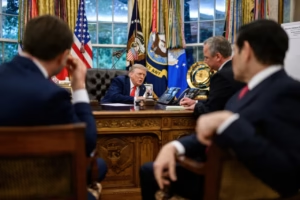
President Donald Trump on the phone with Russian President Vladimir Putin during Monday’s summit

Beyond that, be skeptical but not cynical, and don’t secretly hope for bad outcomes for those you politically oppose if what benefits them would be good news for the world.

What follows is a combination of the best thoughts and observations, on background, of two non-MAGA foreign-policy professionals of significant achievement.

Don’t dismiss the current initiative as mere showbiz or posturing. The war in Ukraine has caused devastation, disruption, probably a million casualties. Give Donald Trump credit, he lit a fire under the diplomatic dimension.

People don’t know what to think because the story changes every day. You can’t follow the balls and strikes every minute, you can’t follow every pitch. The story’s moving all over the place because it’s not linear because Mr. Trump is not linear.

An appropriate attitude is tentative hopefulness. Mr. Trump appears to know Mr. Putin isn’t someone easy to bring to agreements. Mr. Trump tries to charm him, but Mr. Putin’s behavior has led him to understand progress will take time.

Mr. Putin is in no hurry. The next two months are still fighting season. In November comes the mud. Russia will use this time to inflict more damage, demoralize more Ukrainians, maybe gain ground. But Mr. Putin has been getting bad economic soundings from his experts and central bankers. The war has cost him plenty in blood and treasure, and Russia hasn’t gained much. There’s a high cost to perpetually grinding it out. The pieces are there for some kind of a stoppage of the war.

The meeting this week of the major leaders of Europe, President Volodymyr Zelensky and Mr. Trump was a historic ten-strike, more than is probably appreciated. Mr. Putin didn’t want to see that meeting, that unity. It was brilliant to have them come to the White House. It underscored America’s enduring convening power, and was an admission of their calculation as to Mr. Trump’s stature. France, Germany, Britain, Italy, Finland, the European Union and Mr. Zelensky pulled together—they want Ukraine saved and the war over. They don’t know if Mr. Trump can handle Mr. Putin, but they badly want him to, because while Mr. Putin lives the future of Europe is in play. That is a terrible fact and from outward appearances they are facing it.

Mr. Trump’s foreign-policy team is coming into its own. Secretary of State Marco Rubio, Treasury Secretary Scott Bessent, Joint Chiefs Chairman Gen. Dan Caine—they are the forces around U.S. foreign policy, behind the careful negotiating of things. John Ratcliffe, director of the Central Intelligence Agency, has also emerged as a voice.

The devil is in the details, and some details are essentials. What exactly do the Europeans, and Americans, mean by “security guarantees” for Ukraine? What will Mr. Zelensky accept, and Mr. Putin? The definition of success can’t become peace at any price; it has to be a peace that establishes a certain order and stability so it can settle in. What if Mr. Putin endlessly plays things along?

It may well prove true that Mr. Trump was too quick to stop his own push for a cease-fire, accepting instead an aim for a peace agreement. A cease-fire means everyone stops shooting. You don’t have to drop your demands or claims, even your delusions; you just put down your arms and begin negotiations toward negotiations toward peace. Cease-fires don’t have to be short-term. Some last 50 years. Many Ukrainians and Russians will die without one.

There are those saying Mr. Trump is a naïf, a fool propelled by his own vanity. If that’s true, and it wouldn’t be shocking—really, would you be shocked?—it will be apparent soon enough, and the overall effort will likely fizzle. They make fun of him for wanting to win a Nobel Peace Prize, but so what? It’s a prize for peace, not war, it would be a better world if every leader competed for one. Mr. Trump told Fox News’s Sean Hannity this week that he’s pushing for peace in part because he wants to go to heaven. That’s what we call a new one. Whether he was serious or the line just jumped into his head, or it was the kind of gassy formulation to which Mr. Hannity especially seems receptive, heaven is not a terrible reason to want to do something. And is preferable to “See you in hell, suckers.”

It is hard to imagine the effort succeeding. But why begrudge Trump for trying? Instead, he could have spent the last few months telling Mr. Zelensky he’s on his own and good luck with maintaining your status as a sovereign nation. And much of his base would have liked it just fine. He isn’t playing to it.

When JD Vance was running for the Senate in Ohio three years ago, he reacted to news of Russia’s invasion with “I don’t really care what happens to Ukraine one way or the other.”

I am told the vice president isn’t playing the part of the hard-line isolationist now but having constructive talks with Russians and Ukrainians. This might be because he hopes to be part of building something helpful, successful and significant. It also may be because if you want to be president the last thing you need is for Ukraine to collapse in, say, 2027 or ’28.

In any case things are breaking in interesting ways.

I close with an attitude toward history that can be a helpful attitude toward life. It’s an old folk tale. A horse thief is arrested and found guilty, the king sentences him to death at dawn. The thief says wait, please, there’s something I’ve never told anyone—I not only steal horses, I have the power to make them laugh. It’s a gift! Give me a month and I’ll train the king’s horse to laugh at all his jokes.

The king agrees. Days later a guard, seeing the thief get nowhere with the horse, asked why he’d made such a stupid promise. The thief said, “Well, in a month the king may die and everyone forget why I’m here and release me. Or I may die. Or the horse may laugh.”

Take a chance, try something, you never know.

There will be plenty of time to laugh at Mr. Trump in coming months and years. Madeleine Albright once observed that when Americans talk foreign policy, everything always comes down to either Munich or Vietnam. If this is Munich we’ll know it soon enough, but we don’t know it now. Hope for the best. Maybe the horse will laugh.

Why ‘The Gilded Age’ Resonates in 2025 The Industrial Revolution reaches its peak amid intensifying political reaction. Sound familiar?

Wistful August tapers down. Headlines feel far away but stalk us by phone. The writer Philip Howard calls the news cycle “both terrifying and tedious.” He’s right. So I’ve decided it’s a good time for an homage to the HBO series “The Gilded Age.”

We begin with what’s wrong with it, just to show we’re not carried away. It is not golden-age television. It’s not even first-rate television. It’s not even drama, it’s melodrama.

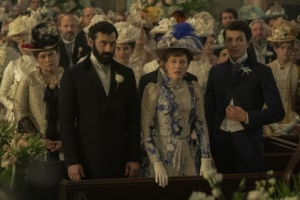
Scene from HBO's “The Gilded Age,” with actors Morgan Spector, Carrie Coon and Harry Richardson
Scene from HBO’s “The Gilded Age,” with actors Morgan Spector, Carrie Coon and Harry Richardson

Its story lines until the season just ended, and especially given the material—the clang, clash and fire of industrial America being born and high society being invented—were unimaginative. It’s largely without wit. Actually it has the rhythm of wit without the content. The quips of Christine Baranski, as Agnes van Rhijn, are underwhelming, but she carries them off because she is Christine Baranski and carries everything off.

The dialogue is often hopeless. From memory, Gladys Russell to her husband, the duke: But I have not had word as to my father’s condition since receiving the telegram alerting us to his shooting as we left the port of Southampton en route to the reunion. Not from memory but word for word, one businessman to another: “I’m like a cockroach with a thousand lives!” No, you idiot, you’re a cockroach that can’t be killed or a cat with nine lives.

The show’s creator, Julian Fellowes, the justly celebrated English writer and producer, isn’t American, doesn’t speak American, doesn’t have it in his bones and doesn’t get the whole ethnic brew.

But the awfulness of the dialogue sharpens your admiration for the actors who have to say it. Carrie Coon as the scheming Bertha Russell seemed at first miscast but fully conquers. Every time she’s in a scene, she’s the one you watch. Morgan Spector as her husband, George, has a truly beautiful stillness and command. Cynthia Nixon for once is given an attractive character to inhabit and is nervously endearing.

Much has been made of the treatment of race, which is fresh, with no special pleading but a lot of knowing looks. New York had a vibrant, glamorous black upper middle class of entrepreneurs and intellectuals, but it has been largely lost to history. Mr. Fellowes refinds it and gives it a stage. The biggest snobs on the show are the Baranski character, who traces her family back to before the American Revolution, and the black matriarch Elizabeth Kirkland, played by Phylicia Rashad, who doesn’t want her doctor son to marry the writer Peggy Scott, also of the high black bourgeoisie but with less standing and a secret past. We love Peggy, love the doctor, find mother’s apparent comeuppance delightful.

So is the subplot of a husband and wife in an arranged marriage she desperately resisted and he oafishly, greedily negotiated. They appear to be beginning to fall in love. My friend, a young playwright I will call Brendan, captures the transgressive nature of this twist. “A more old-fashioned or woke show would have the Duke beat her, berate her—she would run away and get divorced, throw her bra in a garbage can and run for Congress. And that is not real life! Propaganda allows no depth, a woman must be victim until she overthrows her male oppressors. Here it can go all kinds of ways—and that makes it interesting.”

Variety has called the show a hit, its numbers each episode climbing. Here are thoughts on why.

Because it’s beautiful. It fills not only a longing for glamour, which people always have, but for a glamour that is recognizable, discernible. It isn’t the freakish glamour of the Met Gala but a glamour secure in the values it asserts, confident in its definitions. Men dress like men, dark clothes and sharp lines; women like women, color, texture and line. They are all so beautiful, the women in their gowns and bustles, hats and jewels. The men in their three-quarter-length suits, bright silk waistcoats, white shirts whose collars are never loosened.

All this implies discipline. You don’t rig yourself up like that to present yourself to the world without effort. That effort is a kind of tribute to the world, a way of showing it respect. We all notice this without noticing we notice.

I think we like its picture of a society that had brute but recognizable rules that, in some weird way, were democratic. Make a whole pot of money, be generous with it to gain notice but enact modesty when thanked, learn to imitate personal dignity and a little refinement, and you’re in. It wasn’t much tighter than that. Now it’s more just the money, no one has to bow to some phony old value system, and the money spurts in all directions, creating a themeless chaos, and tech billionaires in sweatshirts give us moral lectures from Jeffrey Epstein’s plane.

I like the show because in it America isn’t over. America, as the 20th century came to know it, was just beginning. This is in contrast to HBO’s “Succession,” a true golden-age show that features piercing speeches about America as a fading power. Logan Roy to tech titan Lukas Matsson: “America . . . I don’t know. When I arrived there were these gentle giants smelling of f— gold and milk. They could do anything. Now look at them.”

In “The Gilded Age” they are still gold and milk and can do anything. The footman invents a new clock and is suddenly wealthy, with staff of his own. The city official thinking to make a killing in a shady stock deal goes bust instead and shoots himself in the head. It’s all up and down, rise and fall. It’s all movement.

The show is fiction but famously based on real characters and events. As everyone who follows it knows, the poor, married-off Gladys is based on Consuelo Vanderbilt Astor, the American heiress who married the duke of Marlborough to less happy effect. George Russell seems an amalgam of pirates, including rail tycoon Jay Gould. Ward McAllister (1827-95) really did exist and saw himself as gatekeeper of the society he and Caroline Schermerhorn Astor cooked up out of new money and old bloodlines.

We end with ideas for seasons 4 through 6, if the actors stay on board.

Here is a real-life character ripe for a subplot. A plain, earnest, book-reading girl of old New York society is maneuvered into what seems a good match with a sporty, wealthy older man who proves emotionally unstable and financially reckless. They part with great pain on her part but for many years don’t divorce. She goes into the world alone to become who she is: Edith Wharton, the great Gilded Age novelist and the first woman to receive the Pulitzer Prize for the Novel. Among her themes: personal desire thwarted by societal expectations.

Build an episode around London’s Oscar Wilde, who visits the great houses of New York on tour. I see a brief, eyebrow-raising love affair, possibly with Oscar van Rhijn. Mrs. Winterton won’t like it a bit. “The only difference between the saint and the sinner is that every saint has a past and every sinner has a future,” Wilde said. That is what the show is about.

And the Industrial Revolution reaches its peak as political reaction intensifies. A winsome anarcho-communist schemes to bomb the New York Central. Call him Zohran, just for fun.

AI Is Here, and a Quiet Havoc Has Begun Everyone knows artificial intelligence will destroy a lot of jobs—but not how soon it is going to happen.

This summer the knowledge settled in about where we are with artificial intelligence. Almost everyone is rattled by the speed of its development. The story is no longer “AI in coming decades will take a lot of jobs” or “AI will take jobs sooner than we think.” It is “AI is here and a quiet havoc has begun.”

Jobs growth in July was lower than expected, the May and June jobs numbers were revised downward, and news reports on this mentioned various causes—tariffs, general economic uncertainty and, lower down, AI.

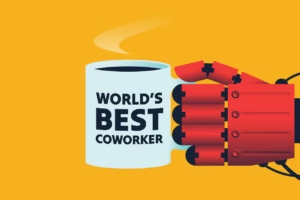
Robot hand holding a steaming mug of coffee, that has the slogan "World's Best Coworker"But all sorts of feature reporting puts AI higher up. Last week Noam Scheiber in the New York Times reported economists just out of school are suddenly having trouble finding jobs. As recently at the 2023-24 academic year, said a member of the American Economic Association, the employment rate for economists shortly after earning a doctorate was 100%. Not now. Everyone’s scaling back, government is laying off, big firms have slowed hiring. Why? Uncertainty, tariffs and the possibility that artificial intelligence will replace their workers. Mr. Scheiber quotes labor economist Betsey Stevenson: “The advent of AI is . . . impacting the market for high-skilled labor.”

That’s only economists, not beloved in America, we probably have enough. Here’s another unbeloved group. This week Journal reporter Chip Cutter had a piece titled “AI Is Coming for the Consultants. Inside McKinsey, ‘This Is Existential.’” If AI can crunch numbers, analyze data and deliver a slick PowerPoint deck in two seconds, what will the consulting firm do to survive? Rewire its business. Smaller, leaner teams; let AI build the PowerPoint. McKinsey’s global managing partner, Bob Sternfels, said that in the future the company will likely have one AI agent for every human employee. It’s already reduced head count.

It was a piece by the writer John Ellis, who’s been on the AI story for years and who brings an interesting combination of common sense and imagination to the available information, that got this column going. On his substack Political News Items he argued that “the overwhelming force of Artificial Intelligence is bearing down on the job market.” People know this, he said, they can see it coming. And yet:

“I drive up and down ‘Old Post Road’ in Fairfield County (CT) almost every day. When I do, I pass office buildings and storefronts that are the workplaces of insurance brokers, local and regional bankers, mortgage brokers, lawyers, accountants, consultants, marketers, real estate agents, etc. And what I think about all those people as I pass them by is this: The companies they work for will employ 10%-25% fewer of them in (probably) two years, maybe three.”

What those people do for a living will be done by AI. Accounting firms that employ 18 people will need only 14; law firms that employ 24 will need only 18 or 20. “When AI reaches into something like ‘wealth management,’ which advisory firm would you choose: one that had all of JPMorgan Chase’s massive AI infrastructure and expertise, or a ‘boutique’ firm that did not? The question is the answer.”

There are jobs AI likely won’t touch; Ellis offers Microsoft’s list of 20 such professions. They include floor sanders and finishers, roofers, motorboat operators, massage therapists and pile-driver operators: “The vast majority of the companies and businesses I see when I drive up and down Old Post Road don’t offer the services above.”

Other problems spin off job loss. Those whose jobs have been made redundant by AI mostly have private health insurance. The vast majority don’t qualify for Medicare, so when they’re laid off it will be ObamaCare—“a safety net to be sure, but nothing like what they’re used to and have come to expect.” Most are too young for Social Security, so a guaranteed income will be decades away. “Figuring out how to ‘reinstate’ them into jobs that will provide them with a decent living, health insurance and retirement income is the next big challenge for policy-makers.”

And though President Trump wants a renaissance in American manufacturing, if it comes those jobs will increasingly be done by robots. From the Journal’s Sebastian Herrera in a recent report: “The automation of Amazon.com facilities is approaching a new milestone: There will soon be as many robots as humans. The e-commerce giant, which has spent years automating tasks previously done by humans in its facilities, has deployed more than one million robots in those workplaces, Amazon said. That is the most it has ever had and near the count of human workers at the facilities.”

All these stories were preceded by an important paper released in April by the AI Futures project. It is called “AI 2027,” and its authors, longtime analysts in the field with deep ties to research, safety and policy, began with a bang: “We predict the impact of superhuman AI over the next decade will be enormous, exceeding that of the industrial revolution.” They say it’s coming sooner than expected—in 2025 AIs will be training other AIs, and in early 2026 coding will be automated and AI research sped up. There will be a new debate: Is AI “bigger than social media? Bigger than smartphones? Bigger than fire?”

We natter on about what cable news natters on about: Is JD Vance next, can Gavin Newsom make the sale? But the biggest domestic political story of our time is happening now, a remaking of the employment field in America. Mr. Newsom doesn’t threaten Mr. Trump, AI does.

Political figures are aware it is coming but unprepared for the scale and depth of disruption. They were taught unemployment policy has to do with cyclical and transitional unemployment, not systemic technological redundancy.

When politicians don’t know what to do they let it play out, see what happens.

We close with an interview with AI itself, in the form of ChatGPT.

Am I right that AI will cause some significant job loss in the next few years?

“Yes—you are likely right. Most serious analysts now agree that AI is poised to cause significant job loss, especially within the next 12 to 24 months, as businesses accelerate deployment of AI tools across multiple sectors.”

Why is this happening now?

“AI is suddenly ‘good enough’ to replace white collar work. The leap from earlier automation to today’s generative AI means that routine knowledge work is now automatable.”

What should political leaders be doing? Pushing massive “reskilling and vocational education efforts,” and “creating a transitional income safety net for displaced workers.”

These proposals are sound and have been around for a while.

ChatGPT also suggested “exploring all profit-sharing mechanisms.” That idea has only recently begun to percolate in the opinion sphere, which is where ChatGPT got it.

My very human prediction: The spectacular costs associated with AI will force a debate on the sharing of its profits. The wealthy and powerful who own the AI companies won’t like that. But those who wished and failed to see the social media companies declared a public utility 10 years ago, and who drew support from the populist left and the populist right—they would like that a lot. This will become one of the great political battles of the late 2020s and beyond.

Stop the ICE Workplace Raids Hard-liners on illegal immigration should understand Americans won’t back removing people from honest jobs.

There have been reports all over of Immigration and Customs Enforcement raids in workplaces—restaurants, construction sites, farms. In a June ICE raid at an Omaha, Neb., meatpacking plant, more than 100 employees suspected of using false IDs were taken away. The owner of the plant told the New York Times that some of them had been with him for decades—they were “salt-of-the-earth, incredible people who helped build this company.”

Masked federal agents at an ICE immigration raid

The administration believes its toughness delivers a message—don’t come here illegally—and of course it would. But there are other ways to deliver it. Donald Trump’s presence alone has delivered it, and the border is pretty much closed. In these raids the administration is making a grave moral and political mistake.

The American people want criminals, thugs and abusers in the country illegally thrown out, full stop. But workers who are living constructive lives, who are contributing, who help keep America up and operating each day? No.

The Trump White House is given so much credit for understanding America, but if they’re storming workplaces, they don’t understand America.

We are about work. We respect it. We have an almost mystical attachment to the idea of it. We think “hard worker” means “good American.”

Why do we work? To support ourselves. To belong to something. To build wealth. To be integrated into life, whether we think of it like that or not. To pursue a vocation or be part of an admirable profession. To not be alone.

It’s in our DNA. Whether you came here on the Mayflower or landed at JFK five years ago, you arrived with the expectation of work. You assumed its necessity. This has never changed in our history.

There is a mystical element to it. When you earn your keep honestly, you are putting something into the world. You are pouring yourself in. It is an act of devotion whether you know it or not. The old Catholic priests used to say “Laborare est orare”—to work is to pray. You aren’t distracted from God when you work; you’re honoring him, whether you’re a professor at Harvard or a kindhearted clerk at the DMV. It feels soulless only if you forget you have a soul. Work is an act of stewardship. It helps things continue.

Americans have always had a moral vision of it. We pushed away from old Europe and its titles, traditions and ways. The New England settlers looked for freedom of faith, and the sterner among them came to see labor as connected to the divine. “God helps those who help themselves.” Success was a mark of favor.

The German sociologist Max Weber spoke of the Protestant ethic, in which every honest trade seemed connected to a moral calling. That old ethic met and meshed with the ideals of the American frontier—physical labor, self reliance and giving it your all would make this land and make you.

Here is Abraham Lincoln in 1859: “The prudent, penniless beginner in the world labors for wages a while, saves a surplus with which to buy tools or land for himself, then labors on his own account another while, and finally hires another new beginner to help him.” That is how things grow and lives become better.

Frontier thinking met and meshed with the immigrant ethic: You’re free here and the streets are paved with gold, I will get me and mine a piece. How could such a nation not be preoccupied with work?

The great novelist Willa Cather wrote of the 19th-century immigrants who settled the Nebraska plains, bringing together the immigrant and frontier experiences. In “My Antonia” the title character, a strong and undefeatable Bohemian immigrant, says after some years on hungry farms, “I can work like mans now. . . . School all right for little boys. I help make this land one good farm.” The narrator, Jim Burden, says Nebraska’s immigrants brought not only an expectation of hard work and the ability to endure it, but also a special kind of cooperation, which he characterized as being a good neighbor in hard times. Their entire lives had been hard times.

I end this section by quoting Studs Terkel in his landmark 1974 oral history, “Working,” on which he worked for years. Work “is about a search . . . for daily meaning as well as daily bread, for recognition as well as cash, for astonishment rather than torpor; in short, for a sort of life rather than a Monday through Friday sort of dying.”

Americans feel they’ve been overrun the past five years with five million or 10 million people flooding in illegally across the border, because the Biden administration didn’t mind it. Officials could have stopped or slowed it but didn’t. They know their reasons and live with the political consequences of their vast carelessness. Mr. Trump appears to have controlled that border, and begun to get the bad guys out. Good. But even his greatest supporters won’t be long reconciled to work raids.

We like and admire people who work because that’s who we came from, and because we root for the underdog and have eyes and can see in this drama who the underdog is. When you raid a restaurant and drag out the people busing tables, cooking, taking orders—we won’t back that. You can’t really be American and back that. If the Trump administration doesn’t know that it doesn’t know a lot.

I have opposed illegal immigration in this space for more than two decades, have urged the border be closed, that the nation digest, absorb and in time adjudicate. I was beaten about the head in the George W. Bush era for opposing so-called comprehensive immigration plans. I think it is important right now for hard-liners like me to say that while stopping illegal immigration is any nation’s right and duty, we also have to hold in our heads that if you look around—and I mean no offense—we have the best immigrants in the world. Our actions should reflect that.

The ones who came here legally came to work, from doctoral candidate to Uber driver. The great majority of those who came illegally over the southern border are in close tune with the majority of Americans both culturally and in terms of their essential understanding of the meaning of life. (Go to the 4 p.m. Sunday Spanish language mass at New York’s St. Patrick’s Cathedral to see dignity of devotion, and also the future of the church.)

Immigrants, legal and not, keep my town going. I know them, they work themselves hard and are all about family, and they touch my heart (sorry to be corny) and if you’re reading this you know they touch your heart too, and you’re for them.

The border appears to be closed; hypervigilance is no longer in order; it’s past time to show a filial connection and appreciation.

Stop picking on them. Cease and desist. Get the bad guys, not the good guys.

The American people won’t support these raids. It is wicked to remove a man or woman from an honest job. And we aren’t a wicked people.

Trump Never Says ‘No’ to a Fight, Fight, Fight He revels in the game of dominance and defeat. It’s what made him—and could do him in.

I have been thinking about the assassination attempt on then-presidential candidate Donald Trump in Butler, Pa., last year.

A strange aspect of that day, at least for me and as seen through screens, was the disquieting matter-of-factness with which so many in the crowd accepted the fact of the shooting, and the sight of so many holding up their phones and taking videos as events unfolded.

A blood-streaked Donald Trump holds his fist in the air after surviving an assassination attemptBut I think Butler may loom larger in people’s thoughts about Mr. Trump than they realize, in part because of the iconic photos taken that day.

Photographers are, famously, the insufficiently sung soldiers of journalism. They always have to be ready for mayhem and equal to it when it comes. That sure-to-be-boring afternoon rally in western Pennsylvania produced a masterpiece cluster.

Evan Vucci of the Associated Press took the most famous image of the day—Mr. Trump triumphant, blood on his face and fist raised, surrounded by Secret Service agents positioned to take a bullet if it came. Doug Mills of the New York Times had the almost-miraculous shot of the bullet streaking past Mr. Trump’s head, and won the Pulitzer for breaking news photography.

Another little masterpiece came from Anna Moneymaker of Getty Images, who captured Mr. Trump under the podium, in profile, his head pointed down at the stage floor, three rivulets of blood streaming down his face. It’s arresting because it seems to be from an impossible angle, and captures Mr. Trump realizing what was happening, and apparently absorbing it, and thinking. A great photo came too from Brendan McDermid of Reuters, who captured a look of absolute fury on Mr. Trump’s face as the agents led him from the stage.

It’s the last two photographs I think of.

When Mr. Trump was helped to his feet, steadied himself, and was being trundled off, he called to the crowd. He didn’t say, “It’s okay, I’m alright,” or “Get down, it may not be over.” He didn’t keep a silence, as one might during trauma, or throw a thumb’s up. He didn’t say, “They won’t stop us!” He famously said one word to the crowd, and said it over and over: “Fight, fight, fight!”

I had watched it live, then over and over. Early that evening a friend called from California. He’d been watching it too. He had been very close with Mr. Trump once, and was no longer. He asked my thoughts and I said wow, that was some kind of moment. He said that wasn’t spirit, it’s rage. I quote from memory: “He said ‘fight fight fight’ because he wants everyone fighting, because the game of dominance and defeat is everything to him.” That is him, my friend said, and the fight isn’t for something, it’s just what he likes.

This stayed with me, not only because he knew Mr. Trump intimately and was an astute observer, but because I too had been surprised by the fight chant. Most of us on barely escaping death wouldn’t think of that word, or give that directive. No one can review anyone else’s response to trauma but with time you can reflect on it, and I’ve come to think my friend’s insight is shaping Mr. Trump’s second term.

It is one of Mr. Trump’s gifts to journalists that when you try to think of examples to illustrate a point that is critical of him, you almost never have to go back in time, but can say, “Why, in just the past week . . . ”

In just the past week Mr. Trump accused one of his predecessors, Barack Obama, of treason. Not of a dereliction or mistake but actual treason—betraying his country and giving aid and comfort to its enemies. He told reporters in the Oval Office on Tuesday that, in National Intelligence Director Tulsi Gabbard’s recent report on Mr. Obama’s actions regarding Russia-gate, “It’s there, he’s guilty. This was treason.” “Obama was trying to lead a coup . . . This is the biggest scandal in the history of our country.”

You can say, “He’s just trying to distract from his Jeffrey Epstein problem” and yes, of course he is. But it’s also fight for the fight’s sake, and unthinkingly destructive. Is it good for young people, for instance, to hear one president accuse another of an act so wicked the penalty of conviction is death? It is not good for them.

Before the Journal last week broke the story of the Jeffrey Epstein bawdy birthday book with its letter bearing Mr. Trump’s signature, Mr. Trump threatened “I’m gonna sue the Wall Street Journal just like I sued everyone else.” He filed suit last Friday against the Journal and reporters Khadeeja Safdar and Joe Palazzolo.

An ardent Trump supporter might say, “Good, never let up.” Maybe Mr. Trump says that to himself. But it’s no good for the country for its president to attempt to muscle the press in this way, and it’s no good even for him. If and when the suit goes forward Mr. Trump will be forced to testify under oath on his history with Epstein. There is no way on earth that will be a net positive for him. Which surely he knows. He fights even when he will hurt himself, because the fight is all.

You see it in his inability to let his accomplishments, and he has had them, rack up. For the first time in most adult lifetimes in the U.S. the southern border is basically closed; in a divided Capitol he got a huge budget bill through. In politics you use success as a base from which to push forward into new territory. He is like a strange general who can’t quietly establish camp or dig new fortifications. He shoots his cannon for no reason, just for the sound.

It’s part of what keeps his best appointees and staffers so nervous every day. The cliché is that his first term was populated by grown-ups who lost every battle, and his second by true believers, nuts and hacks. That’s not true. There were good people in the first administration, but many of his appointees spent their time warring, leaking and acting unprofessionally. Someone summed it up as, “Team of Rivals only for morons.” The current administration has many solid appointees (as everyone always says: Treasury Secretary Scott Bessent, Secretary of State Marco Rubio, Kevin Hassett of the national economic council) and a staff that appears to be more professional than that of his first administration. (Here we do an Elon Musk carve-out, though he appears to have taken much of his drama with him.)

And surely those appointees know the price of Mr. Trump, the very special Trump Tax they pay every day. It involves the constant asking of What did he do? What did he say? And the constant wondering if what got him to power (the wild aggression, fearlessness, meanness) is the thing that may undo him, and them, on any given day.

What we’ve seen the past six months is what we’ll see in the future. It will be fight, fight, fight, not only or primarily for a movement, program or platform, but because fighting is good and the natural state.

Of all his weaknesses that is one of his greatest, that he’d rather hurt himself than not fight. He’d rather hurt the country than not fight. The fight is all.

MAGA’s Epstein Fault Line Some Trump supporters look at the refusal to release the files and see a failure to drain the swamp.

We just witnessed a bit of political history. The Jeffrey Epstein story is big, and though it will be quieted eventually, it won’t go away, it will stay as a fissure and may widen over time.

The Trumpiest part of President Trump’s base showed him—and showed itself—that it can buck him, push back in unison. He seemed startled. Maybe they are too. It struck me as not just a political event but a psychic one for his movement.

President Donald Trump on the South Lawn of the White House in WashingtonMr. Trump has never spoken of his supporters the way he did this week, with disrespect and baiting insults. On Wednesday on Truth Social, he called the Epstein uproar a Democratic Party “scam” and said “my PAST supporters have bought into this ‘bulls—’ hook, line, and sinker.” Those demanding the government produce all files in the Epstein investigation are ungrateful and don’t deserve him: “I have had more success in 6 months than perhaps any President in our Country’s history. . . . Let these weaklings continue forward and do the Democrats work, don’t even think about talking of our incredible and unprecedented success, because I don’t want their support anymore!” Earlier Mr. Trump told reporters, “I don’t understand why the Jeffrey Epstein case would be of interest to anybody.” “I think, really, only pretty bad people, including fake news, wanna keep something like that going.” In the Oval Office on Wednesday he said he’d “lost a lot of faith in certain people.”

This isn’t how political figures speak in public of their most loyal public supporters. Even Richard Nixon at the end of the Watergate scandal didn’t speak of Republicans who bolted from him with the disdain Trump shows. You “dance with the one that brung ya,” Ronald Reagan told the Conservative Political Action Conference in March 1985. He would have been thinking something like a Lindy, not a Parisian apache dance.

Mr. Trump’s critics were equally colorful. Podcaster Joe Rogan ripped the administration for its handling of the Epstein files. “They’ve got videotape and all of a sudden they don’t,” he said. Referring to Federal Bureau of Investigation Director Kash Patel, who’d been on the show in June: “Why’d they say there was thousands of hours of tapes of people doing horrible s—? Why’d they say that? Didn’t Pam Bondi say that?” (She did. Weeks before announcing the Justice Department would release no further Epstein files, she had told reporters the FBI was reviewing “tens of thousands of videos” of Epstein “with children or child porn.”)

Podcaster Candace Owens said, “I feel like Trump thinks his base is stupid.” Alex Jones said on his podcast, “You’re not the pope, bro.” The activist Laura Loomer, who puts herself forward as keeper of the MAGA flame, told Politico Wednesday that the president’s handling of the situation threatens to “consume his presidency.” Echoing his use of the word “hoax,” she said, “Obviously, this is not a complete hoax given the fact that Ghislaine Maxwell is currently serving 20 years in prison in Florida for her crimes and activities with Jeffrey Epstein, who we know is a convicted sexual predator.”

It wasn’t only influencers and podcasters, it was elected officials too. House Speaker Mike Johnson said Tuesday the Justice Department should release the information it has on Epstein in the name of “transparency.” It’s delicate, he said, but “you should put everything out there, let the people decide it.” Former Vice President Mike Pence also said all files in the case should be released.

The Epstein case is the third time in a month that parts of Mr. Trump’s base have sharply disagreed with him. In bombing Iran and restoring aid to Ukraine Mr. Trump offended those of an isolationist bent; in announcing no further action on the Epstein case he offended those of a conspiracist bent; and current and future spending cuts are likely to rouse opposition from populists and nationalists. Mr. Trump is skating a close line.
image.

Jeffrey Epstein
Jeffrey Epstein

There are surely some calculations as to personal ambition in some of the pushback. Those of his base who are the most professionally and publicly invested in the Trump project know that in a few years he is gone. They wish to continue their careers beyond that cutoff date. So they are out-Trumping Trump to show their bona fides and outlast him. They are presenting themselves as his distilled essence.

Mr. Trump famously said, in 2015, that the remarkable thing about his supporters was that he could shoot somebody on Fifth Avenue and they’d still back him. That was true until this week, when supporters said they saw a shooting on Fifth Avenue and wouldn’t accept it.

The breach will ease with time. It won’t be a break because too many have too much to lose. But it won’t fully heal. Things will be different going forward. Each side saw something they hadn’t known before: They can break apart.

Why the decision not to reveal everything on the Epstein case in the first place? The administration hasn’t made its thinking clear. Did Mr. Trump never think it was an interesting or important case, and say otherwise as a sop to the base? As a onetime Epstein friend is he protecting himself or friends? Does the case implicate intelligence agencies? In the absence of a convincing reason, people will imagine.

An odd thing about MAGA and Epstein is that from the beginning, from his arrest in 2019, when Mr. Trump was president, photos and videos of Trump and Epstein laughing, posing together, at parties, have been all over. This doesn’t appear to have bothered his supporters in the past. It does now. Why not then?

Trump supporters are angry now because they imagined that when Donald Trump drained the swamp, the dry bones of old conspiracies would be thrust from the mud and exposed on its caked surface. But that hasn’t happened in the Epstein case. Mr. Trump’s not exposing the story is Mr. Trump’s not draining the swamp. That is a big moment in the history of MAGA.

A last note. If I were a fervent Trump supporter, I would worry about that movement’s hyperemotionalism. We have written in this space that with the rise of social media, Americans are becoming a people of feeling and not of thinking, a people in search of sensation and not reflection. It isn’t promising that this is increasingly true in our political sphere. I follow on social media fixtures of the MAGA movement. They say of each other in public what in politics 40 years ago people said in private and when drunk. FRAUD, LIAR, GRIFTER, WHORE. What a hothouse. Do they expect that with a nature like that they can go into the future as a serious force and a movement that coheres? They don’t seem to worry about it. Why not?

This week I remembered a story about Margaret Thatcher in 1989, when the Berlin Wall came down. German reunification was suddenly a possibility. She would play a role. Being Thatcher, she convened experts. Tell me about the essential German nature, she said. Well, said an expert, as a tribe they’re either at your feet or at your throat.

That is how Mr. Trump and his base look.

Trump Is Coming Around on Ukraine He begins to acknowledge that Putin is a menace and ‘isolationism’ isn’t a viable strategic approach.

Isolationism is essentially emotional. You’re angry at the cost in blood and treasure of your country’s international forays and adventures and want to withdraw from the world. Emotionalism can hold sway and dominate politics for a time, even an era, but you can’t build anything on it. It doesn’t last because emotions change because facts change.

The problem is that you can quit the world but the world won’t quit you. If you tell the world, “Earlier in the century America was too uproarious and aggressive. We’ll stop now. Goodbye,” the world won’t respond by saying, “What geopolitical modesty you evince! Goodbye now, and best wishes to you.”

Ukraine's President Volodymyr Zelensky with U.S. President Donald Trump
Ukraine’s President Volodymyr Zelensky with U.S. President Donald Trump

The world instead will see new opportunities to continue to do what it does—harry and harass, undermine a perceived foe’s interests, provoke and prey.

China’s rulers won’t stop their mischief if America declares itself more retiring; they’ll ramp it up. They want to be the most powerful nation in the world, they believe this is their destiny, and there’s one thing standing in their way and it’s America. They’ll poke, prod and try their own adventures. Russia, of course, too. Others.

Only a fool would carelessly aggress in this world, and only a fool would think he could fully withdraw. We are enmeshed in layered financial, security and trade systems; pandemics and cyberterrorism are borderless. You can’t be reflexively “isolationist” or “internationalist” in this world; you have to hit the ball from where it lands.

But you can bring attitudes and ways of operating. Don’t look for trouble, don’t aggress, build bridges where you can. Be peaceable and prudent but have hard eyes. Don’t carry yourself forward into the world with hubris about your grand democratic system; be quietly proud and see to its wholesomeness. Be an example, a beacon. Have humility: We don’t run the world any more than we run life, and we won’t try. Use force sparingly but when used make sure it is annihilative. Keep your military not only peerless but highly professional, so accidents don’t happen. Choose your battles carefully. Know your people. Don’t announce that if Syria uses poison gas that will be crossing a red line, and then when it uses deadly gas slink away saying oh, never mind. President Obama surely thought conservatives would come to his aid and rouse public opinion for a hard line on Syria. But the right had been bruised by Iraq, and Mr. Obama hadn’t noticed. And there must be clarity. World War I broke out because leaders were unclear about their intentions and priorities. Lack of clarity kills.

Know history and be able to act on what you know from it. John F. Kennedy didn’t mean to start a land war in Asia when he sent advisers to Vietnam. But he was up soon for re-election in a country whose great 20th-century pastime after baseball was accusing its presidents of being weak, afraid of the commies, and not standing for freedom. So he sent special forces, helped our allies, and set us on a trajectory toward quagmire. His admirers are sure he would have pulled back when re-elected. We’ll never know.

So much of the history of the world is the history of unintended and unexpected consequences.

Vladimir Putin is a monster of history: We used to call him a junior monster here, but no, he’s full-size. He wants what he wants and will play a long cool game to get it, and if the game gets hot that’s fine with him too. Donald Trump has always liked him because he is drawn to powerful men, dictators, people who can drag their countries around like a robed king in procession flicking his velvet train.

But Mr. Trump has been trying to broker a peace over Ukraine, and Mr. Putin has been jerking him around since January, saying seemingly plausible things that turn out to be just another tactic in the long cool game. Or as Mr. Trump himself said on Wednesday, at his long, live cabinet meeting, “We get a lot of bulls— thrown at us by Putin,” who is “very nice all the time, but it turns out to be meaningless.” Of the war, Mr. Trump recently told the press, “I don’t think he’s looking to stop, and that’s too bad.”

Mr. Trump is renewing U.S. arms shipments to Ukraine, and he is right to do it.

It won’t be good for the world if Mr. Putin winds up taking what he wants of Eastern Europe. Ukraine is a country of courage, ingeniousness and some irritating people, including President Vladimir Zelensky. The video of him getting beaten about the head in the Oval Office in February will always be remembered as an ambush by a glowering Mr. Trump and Vice President JD Vance. I’ve watched it beginning to end half a dozen times. Mr. Zelensky provoked the argument, Mr. Trump tried to deflect it, Mr. Vance opportunistically pounced, and at the end both the Americans piled on. Mr. Zelensky was full of himself, thought he’d press his case before an admiring American media, expected to triumph and didn’t. He overplayed his hand and weakened his position.

But he is a brave man, tough and capable, and his continued resistance to Mr. Putin is good for the world.

If Mr. Putin wins, Eastern Europe will feel directly threatened: “Let’s not kid ourselves, we are all on the Eastern flank now,” said the North Atlantic Treaty Organization’s Secretary General Mark Rutte last month. They will militarize quickly in a new arms race, which will be good for arms makers but no one else. NATO might fall apart or be rendered inoperative, and the world’s rising authoritarians will conclude that the path to greatness is to build an army and take what you want. This will make for a less stable world.

The U.S. will lose more of what remains of its power to deter. Mr. Putin will spend what he likes to restore his military and pick his next target, his ambition not satisfied but stoked. China will be emboldened; Iran, currently licking its wounds, re-inspired. Again, more trouble for the world, including us.

Mr. Trump’s decision isn’t isolationist or internationalist but realistic. The question is whether he sticks with it and it’s enough.

In this decision he again moves against the feelings of his base, or rather its influencers and self-proclaimed leaders. I actually doubt his base, or his 77 million voters, are going to abandon him because he’s changing his approach on Ukraine. Walking away from Ukraine was never fully compatible with a lot of conservatives’ Born Fighting DNA. Mr. Trump has more to lose from Jeffrey Epstein, whose case is an enduring MAGA obsession.

The GOP will have to think its way through all this. “Isolationist,” “interventionist”—those labels don’t seem right for now. The party will have to decide, again, what it’s about on foreign affairs.

It started this century with nation building and snapped back, after its failure, toward isolationism. I wonder if now they’re snapping back, or starting to evolve, into something new, not halfway between isolationism and interventionism but more deeply thought through than those two impulses. Something more dry-eyed.

Trump Seeks Greatness as Mamdani Rises The Iran strikes leave the president bolder than ever. Meanwhile, can New York survive a socialist mayor?

This is how I read Donald Trump now: He’s in the greatness game. He’s already won the other games in politics. He’s established himself as the powerhouse who transformed the nature of a major political party; he’s the colossus who’s changed the direction of politics in other major democracies.

It’s big, but it isn’t all he wants. He wants to be thought of as great, not just powerful but a beneficial force. A great man of history. He wants utter defeat for his foes and critics; he wants history to bow to his brilliance and courage.

President Trump during a press conference at a NATO summit in the Hague

This is a bigger game than the one he played 2015-20. In the beginning he was shocked, bewildered and on some level grateful to become president. He is no longer those things.

He bombed Iran because he thought it was the right move, the ultimately constructive one. But it was also the brave one, the move none of the rest had the guts to make, so Kaboom! He didn’t like TACO—“Trump always chickens out.” So he bombed that too.

He took a big swing, made a big bet, and seems to have left the situation better than it was. The critics: “We don’t know if he stopped the nuclear program or just slowed it!” Either is progress. “Now the enraged Iranian government will be even more set on getting nukes.” They were already set on it, they can’t be made more so. “They’ll assume they’ve been through the worst.” They’re as likely to fear Mr. Trump will come back.

Before the U.S. strike, Iran was seen as formidable, with a dark mystique—hidden, sinister, string-pulling Iran. Now its government looks inept, enfeebled. It had powerful friends and operatives. Who the past week stood at its side? No one was for the mullahs. Now nobody fears them. He blew up their mystique.

Mr. Trump went from bombing Iran to congratulating the North Atlantic Treaty Organization allies when they bowed to his demand they increase their burden-sharing. (I’m guessing he has particular sway with at least some leaders because they see in him the kind of animal they know themselves to be.)

The likely effect on him? He has been emboldened. His confidence and trust in his gut are increased. There will be more boldness, more sparks.

On public support for Mr. Trump’s move: Early polls mean little. Public opinion will be decided by how it all plays out. If six months from now the strike seems to have produced a less menacing Iran in a less violent Mideast, or the Iranian nuclear weapons program was stopped or slowed, it will be seen as a great success. People not only will support it, they’ll say they always did. So too the split in Mr. Trump’s base: Success heals all wounds. If the sentence that comes out of the summer of 2025 is “He bombed Iran and Iran fell,” that is the end of the immediate argument between “isolationists” and “interventionists.” If the sentence is “He bombed Iran and the U.S. paid no price,” ditto. If it is “He bombed Iran, blowback was slow but fierce and the American people felt the pain,” that will be a grave defeat for Mr. Trump.

The story isn’t over, but the Iranians’ response has been tepid and wan. They haven’t caused mayhem on our soil or that of our allies. Were they a paper tiger all along? What happened in their highest councils? Journalism, please get this story.

A thing Mr. Trump doesn’t understand is that regular citizens open to his leadership and willing to judge his actions fairly never feel free to trust or praise him quickly because they fear, rightly, that he’ll do something mad, say things so stupid and destructive they’ll immediately regret their support. So they say nothing. Every time he lies, brags, accuses and acts insane, he undermines his power and jeopardizes his prospects in the greatness game. This won’t change. He’s unable to change it.

*   *   *

We jump now, quickly, to what happened in New York. It reminds me that I’ve always thought Tip O’Neill was misquoted, that what he really said was, “All politics is loco.” In my town this week we showed it.

Zohran Mamdani speaking to supporters on the night of the Democratic mayoral primary election in New York

You wouldn’t think that five years after the city almost went down—after the pandemic, after a host of cultural shocks from the Black Lives Matter riots to rises in crime and homelessness, after the financial shocks (working from home means commercial real estate craters), after wealthy New Yorkers began to flee for Florida—after having survived all that and begun to come back, you wouldn’t think that New York would choose as its likely next mayor a 33-year-old who’s never really had a job in what used to be called the private sector, who hails from Manhattan’s elite cultural upper classes, who is charming, bright and warm but an ideologue, an avowed socialist, a radical leftist crusader against Israel even on Oct. 8, 2023 . . .

You just wouldn’t think this would happen. But now you must, for we are the city of dreams, of fantasias, and have our own winsome ways plus a marked tendency toward widespread sociopathy. We invented Donald Trump.

Zohran Mamdani has a Trumpian feel for politics. He doesn’t have a 10-point plan to improve public transportation, he has a vow: Buses will be free. That is his “Drill, baby, drill.” He has a natural and intuitive sense of media as fine as Trump’s but cleverer, funnier, more modern. He TikToked his way up with a fabulous team of video creators who pumped it out to Instagram, conveying a sense of dynamism and life-love. He was a fabulous candidate.

His foes say brace yourself, we have opposition research that will knock his block off. If they had killer oppo, they might have used it before he won the primary. Now his electrified supporters expect and will discount it: “The billionaires will say anything to stop this tribune of the people.” His foes hope they’ll beat him with money. But it’s how you spend money that counts, and there they are naïfs.

It looks like the race will come down, in November, to Mamdani vs. the incumbent, Eric Adams, who is running as an independent. So: Eloquent McDreamy Who’ll Kill the City versus Reigning Bum Who Won’t Destroy New York. I’m not sure who wins a battle of anxiety vs. depression. I’d bet on anxiety. We confuse it with awakeness. It keeps us afloat.

Mr. Mamdani is attractive, has an obvious sense of personal destiny, and is a talker—he loves to say words. There’s a video mash-up of him speaking, over the past few years, with different accents. He’s a hardworking Indian man, a street rapper and then a bright young businessman. At first it seems comic, then like code-switching as political strategy, but when you keep watching the tape it feels . . . somewhat sinister.

Can New York survive him? We always say we’ve survived everything. In this space we’ve long enjoyed quoting Adam Smith to the effect there’s a lot of ruin in a great nation. But after the past five years you have to wonder, has New York reached its ruin limit? We are a funny people, always poking around and trying to find where that limit is.

Iraq’s Shadow Over the Iran Debate Many Republicans felt they’d been fooled in 2003. They are far less trusting of the government today.

The fiery Tucker Carlson interview with Sen. Ted Cruz is the perfect distillation of the split among conservatives on Iran. And that split is all about the unhealed wound of Iraq.

Tucker Carlson interviewing Ted Cruz

Mr. Cruz made his personal case—it seemed to rest on his reading of the Bible—for joining the Israeli action against Iran. Mr. Carlson pushed back. It got pretty personal pretty fast. Mr. Carlson called Mr. Cruz “a sleazy feline,” Mr. Cruz accused Mr. Carlson of “reckless rhetoric.” Mr. Cruz compared Mr. Carlson’s foreign policy to Jimmy Carter’s. Mr. Carlson: “This is one of the weirdest conversations I’ve ever had.”

Everything harked back to the Iraq war. Two parts said it all. The first has been all over social media:

Mr. Carlson: “How many people live in Iran, by the way?

Mr. Cruz: “I don’t know the population.”

Mr. Carlson: “At all?”

Mr. Cruz: “No, I don’t know the population.”

Mr. Carlson: “You don’t know the population of the country you seek to topple? . . . How could you not know that?”

Mr. Cruz: “I don’t sit around memorizing population tables.”

Mr. Carlson: “Well it’s kind of relevant because you’re calling for the overthrow of the government.”

Mr. Carlson challenged Mr. Cruz on the ethnic mix of Iran. Mr. Cruz seemed uncertain.

Mr. Carlson: “You don’t know anything about Iran.”

The second part hasn’t been so noticed.

Mr. Carlson noted Mr. Cruz supports “regime change.” “What does regime change look like in Iran?

Mr. Cruz: “Somebody else in charge.”

Mr. Carlson: “How do you get there?”

Mr. Cruz: “Look, that ultimately has to be a popular uprising from the people.”

Mr. Cruz, a member of the Foreign Relations Committee, was glib, as is his way, and didn’t seem to have thought things through. Mr. Carlson was hectoring and inconsistent. But it was all about Iraq. Mr. Carlson said as much. “I am the product of the last 25 years watching carefully . . . and I see an unending string of foreign policy disasters.” “I feel very stung by what happened in Iraq, if I’m being honest.” He had supported that war, even “promoted” it. “The cost on so many levels” to the U.S. “was just so profound.”

The conversation brought me back to that epochal year 2003 and the lead-up to the Iraq war. The arguing between Republicans was bitter, though it was largely suspended when the war commenced and loyalty to the troops closed ranks. When the war began to go sideways the argument began again and has never been resolved. By 2010 or so Republicans on the ground were saying the war’s originators hadn’t known anything about Iraq, didn’t know a Shiite from a Sunni, it was all bluster. That was the context of Mr. Carlson’s questions to Mr. Cruz: You don’t know anything.

Before Iraq, local Republicans thought, in general, of the government: They know what they’re doing. The White House has more information than the rest of us—spies and overflights and aerial photos. They have expertise we don’t have, they know all about the workings of foreign governments and armies. After Iraq went bad they’d never think that again.

They didn’t just feel their trust had been misplaced, they felt they’d been fooled. There were no weapons of mass destruction; our spies had been taken in by some operator named Curveball. And they’d lost their sons, more than 4,000 of them.

It changed the party’s nature. Iraq and illegal immigration produced the conditions that made Donald Trump possible, then inevitable. Twenty-two years after the beginning of that war it continues to have profound repercussions on American thinking about the world.

One thing I came to conclude about the men and women who put that war together was that they had grown up in such a blessed, prosperous and stable country that they had a false sense of endlessly sunny skies. Personally they hadn’t been unlucky—they were at the top of the pile, had never been losers. They thought good things would follow their good efforts in the same way study had produced honors at college and discipline had produced their professional rise. They didn’t think dark because they’d never known darkness. It was a disadvantage. To make solid decisions at that scale you have to know in your gut that history’s an abattoir and the floors are slippery. The price a government or party pays for being dramatically wrong can have foreign-policy reverberations that last generations.

This is Donald Trump’s first big, immediate and urgent foreign-policy crisis of this term, maybe both. It is a time of real drama. It appears at this writing Mr. Trump has punted or is delaying a decision for two weeks.

Few normal people seem certain their view on a U.S. bombing of the Fordow nuclear installation is the wise one. Will it forestall some future horror? Will it give rise to loss of innocent life, a mess, a quagmire? At this point in the debate what you hear is “then again.” We don’t walk the world looking for monsters to destroy, but then again this is as clear a shot as we’re likely to get, so take it. Then again if the ayatollah falls the guys who replace him may be worse. Then again the death throes of the Iranian regime won’t be pretty.

If Mr. Trump moves boldly and it’s a clear success, he’s a world-class hero. Nobody loves Iran, many want to see it humbled. If he moves boldly and it yields some kind of failure, his own supporters will never feel the same about him. If he doesn’t move boldly and Tehran limps back and in time develops nuclear weapons, he will suffer with some of his base and in the eyes of the world. Presidents try hard to keep themselves from situations in which the political outcomes are so stark. They don’t like those choices—“hero,” “politically dead.”

It feels like an epochal decision because it is. In this space we’re certain of this: Congress should be involved. Reps. Thomas Massie (R., Ky.) and Ro Khanna (D., Calif.) this week introduced a War Powers Resolution to prohibit U.S. forces from engaging in hostilities against Iran without authorization from Congress. The bill will move forward or not, interestingly, in the next two weeks. The White House would be wise to support it. America would be surprised in a positive way to see Mr. Trump, professional upsetter of norms, bow to Congress’s war powers. We are not only a democracy, we are a republic; the legislative branch has a role. Restoring that norm would also shore up the president’s position. If he moves and it’s a success, he’ll still get all the credit, but if he moves and it isn’t, blame will be more dispersed.

Congress should rush to rescue its rightful constitutional role, and take a stand in the war drama as it was elected to do. But for many it’s more pleasant to complain your power has been stripped away and blame the president if things go badly.

There’s little chance it will pass but it would be a good thing if it did. In unstable times it would add a note of stability—of a nation, as opposed to one man, deciding.