A New Administration’s Signal Failure The national-security communications snafu shows a government in the hands of immature bros.

The Signal mess is a real mess, not something that will fade away quickly, because it’s one of those scandals that give the world a picture of a new administration.

At just about this time in John F. Kennedy’s presidency (April 17-20, 1961) came the Bay of Pigs disaster, the failed invasion of Cuba by U.S.-backed and trained exiles who had been assured of American air support but learned on the beach it wouldn’t be forthcoming. It shadowed JFK for a long time. The Soviets concluded he was a dilettante and inferred from his actions an ambivalence about the use of force, which led Premier Nikita Khrushchev to rough him up at their first summit, that June in Geneva. JFK wasn’t prepared for such treatment. He confided to the journalist James Reston that it was “the worst thing in my life”; Khrushchev “savaged me.”

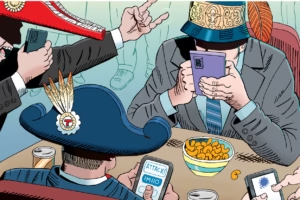
Bros in dictator hats, noses buried in phonesIn August the Soviets erected the Berlin Wall; a year later they put missiles in Cuba. Kennedy’s mastery in the latter crisis, in October 1962, had a reordering effect on his international reputation. Good things followed, including his American University address in which he felt free, having proved himself, having established a more grounded relationship with the Soviet government, to unveil a new plea for nuclear arms control. His speechwriter, the great Ted Sorensen, told me years later that of all the speeches they worked on—the Inaugural Address, the announcement of the missile crisis—the one at American University was the most important.

An opposite example: It was at almost exactly this point in the new administration of Ronald Reagan, on March 30, 1981, that the president was shot outside the Washington Hilton. His aplomb, the warmth of his gallantry as he joked with doctors and nurses—“I hope you’re all Republicans”—even though his wound was nearly fatal, also carried immense implications. Among world leaders: This cowboy star is both tough and lucky. (Some of them hated a lucky American president, but all saw the luck as a major factor: Politicians are among the most superstitious people on earth.) The shooting also cemented Reagan’s relationship with the American people. Even Democratic House Speaker Tip O’Neill’s Massachusetts voters were impressed: Tip, don’t be too tough on my Ronnie. That was the beginning of serious bipartisan progress between the White House and Congress, when O’Neill realized you can’t ignore this guy or try to roll him every day, you’d better play ball.

The Signal mess lacks the size and depth of both these events. But it too will have implications for the reputation of this White House because, again, it gives a picture that is not so forgettable.

Every government in the world, even those with the best intelligence services, has wondered exactly what it’s like in there, how exactly it works. To see the transcripts of the now famous “Houthi PC small group” is to conclude it’s pretty ad hoc. Pretty messy. The word jejune comes to mind. So does callow. There’s a lot of freelancing. The vice president questions what appears to have been a presidential decision, and the debate is conducted on a publicly available encrypted app. No one on the 19-person call said, “Guys, should we be doing this on Signal?”

They don’t come across as steely-eyed pros, and often express themselves in ways that are emotional (JD Vance: “I just hate bailing Europe out again.” It made me think of a 1950s housewife in a Rinso commercial: “I just hate those stubborn stains!” Defense Secretary Pete Hegseth: “I fully share your loathing of European free-loading. It’s PATHETIC.” There was also a lot of drama: “We are a GO for mission launch. . . . (1st strike package),” Mr. Hegseth texted. A Trump-supporting congressional veteran referred to this privately as the defense secretary’s communicating “in his chesty, boastful way.”

The effect will be to push tensions with Europe more toward estrangement. None of this will go unnoticed in any foreign capital. I found myself startled but not entirely disapproving of the use of emojis. I’m glad they’re not above it all, that they’re happy team America successfully moved on some serious bad guys. Then again I’m not sure Xi Jinping was impressed, or Vladimir Putin; I’m quite certain they’re sprinkling their texts with clown emojis in Beijing and Moscow this week.

There was a real bro-culture feel to some of the texting. The young are constantly texting, with different threads going—the fraternity thread, the Vegas Buds texts, the groomsmen at the wedding threads. We just saw the government bros thread.

They should have admitted the blunder from the moment the first batch of texts were published in the Atlantic. Instead they denied the obvious and attacked the character of the reporter who unearthed it. What a mistake! They misread their position and misread what Jeffrey Goldberg would do if they challenged his accuracy or interpretations: He published the whole lot. Which made them look stupid twice. They didn’t look like clever folk who are good strategists.

Sometimes the truthful path is also the practical and pragmatic one: Completely admit you did something stupid, take it in the face, absorb the abuse, and keep walking. This administration’s character, in the aggregate, is too proud, and its personality too snot-nosed, to take that right route.

Everyone sounded like himself. Mr. Vance griped about Europe in a shallow way, Mr. Hegseth came across like an excitable morning-news anchor with a lot to prove. Chief of staff Susie Wiles was reticent, and had the good sense not to hold forth in front of 18 people. Steven Miller, who tends to conduct himself with Saturnian authority, had the authority to shut down debate, and did. “As I heard it, the president was clear: green light, but we soon make clear to Egypt and Europe what we expect in return.”

It’s not a scandal of hypocrisy but of indiscretion, dumbness, and denial. They are obsessed with messaging. Every White House is. But the central conceit of this White House has been “he-men do what’s right whatever the cost.” The president acts as if he doesn’t care. It was startling to see how much they care. Mr. Vance: “Let’s just make sure our messaging is tight here.” Mr. Hegseth: “I think messaging is going to be tough no matter what—nobody knows who the Houthis are—which is why we would need to stay focused on: 1) Biden failed & 2) Iran funded.”

The semantic tap dance over “war plans” or “attack plans” is absurd. They were talking about the policy and operational aspects of a U.S. military attack on a terror haven in a sovereign nation halfway around the world. If that isn’t classified, what is?

They should take it as a gift that this happened so early, and they can learn from the embarrassment. Advice? Stop acting like kids, like bros, like the last honest man. You are the top officials of the government of a great nation in a dramatic and crucial era. You can conduct yourselves the way John Fetterman wears clothes, loosely and sloppily, or you can grow up, control your mouth, and lean on forms and processes that have gotten this lost old ship through many gales.

The Courtroom and the Splashdown There’s no constitutional crisis now, but there will be if Trump decides to defy a decision by the justices.

Every big Trumpian news story, and there are five a day, is a dot in a pointillist painting. The whole picture hasn’t yet emerged but became fuller this week.

A SpaceX capsule splashes down in the Gulf of Mexico

The most powerful, in terms of implications, is in the courts. A federal district judge in Washington issued a temporary restraining order to pause deportation flights carrying Venezuelan nationals, including members of the Tren de Aragua criminal gang, to El Salvador. President Trump quickly launched a Truth Social rant calling the judge a “Radical Left Lunatic” who “should be IMPEACHED!!!” Chief Justice John Roberts issued a statement that was pointed but appropriately dry: “For more than two centuries, it has been established that impeachment is not an appropriate response to disagreement concerning a judicial decision. The normal appellate review process exists for that purpose.” It was a nice way of saying: Hello executive branch, we are the third and coequal branch, the judiciary. We are here and watching and not a potted plant. A district judge in Maryland then ordered Elon Musk and the Department of Government Efficiency to cease dismantling of the U.S. Agency for International Development on grounds that it likely usurped Congressional authority. These and other cases will make their way to higher courts.

None of this will register with the public until some case reaches the Supreme Court. If the justices rule against the administration, and the president defies the decision, and he’s just the man to do it, then we have our crisis. We’ll again quote the statement attributed to Andrew Jackson in 1832: “John Marshall has made his decision, now let him enforce it.” (Editor Horace Greeley who likely wrote those words, accurately reflected Jackson’s stand.)

What happens then? Nobody knows. Jackson got away with it, but no president has tried it since. It takes time for nations to gel and mature and have an agreed-on way of operating. But once they do, and we do, people don’t like a disturbance.

On Thursday the president, unslowed, signed an executive order to begin dismantling the Education Department. Was there waste, fraud and abuse in that agency? There is no way there wasn’t. Did it, as is inevitable when something is so large and busy, probably achieve some demonstrable good? Of course. Wishing reform, can you laser in and, with time and patience, cut muscle from fat? Probably.

But DOGE is in a race with the courts. From the first days of the administration it was all shock and awe. Take an agency everyone knows is a problem, such as USAID, and kill it. Tell employees to go home, put a guard outside and lock the door, cover the agency’s name in gaffer’s tape, have a functionary send an email terminating employment, then disable email accounts. Staffers can’t reach each other, can’t find the reporter’s address—confusion kills the will to resist. Other agencies watch, and it puts the fear of God into them.

It’s all a race to get as much accomplished now as possible. Once something goes to the Supreme Court, there will be clear limits. Until then, maybe months, maybe a year, get it done.

*   *   *

I talked this week with a veteran of 40 years of Democratic Party wars. The general context was that the party is still unsure how to respond to Mr. Trump—play possum or stand and scream? In the meantime, there is no central and fully resourced, shrewdly strategic and toughly tactical apparatus to which Democrats can go to be intellectually armed in the battle. You fight fire with water, with a hose and a great stream of information and facts. You persuade the American people that this is all getting reckless, mindless, destructive. You assert the good that specific programs are doing, and you have the receipts. You tell parents what education money that was being spent actually helps them and their school districts.

The Democrats aren’t doing this. They have forgotten Americans are fair. They will listen and are open to persuasion. My Democratic friend said, in the language of his party, that they need “a war room.” He meant they need an information room and persuasion room. Because public opinion is everything.

Here I confess my conservative lizard brain likes seeing unhelpful and destructive parts of any organism, very much including government, cut and sometimes obliterated, and for the usual reasons. But the non-lizard parts—those that are analytical, involve experience, and have observed human nature and seen who’s doing the cutting, and at what size and speed—recoil, and see great danger ahead.

*   *   *

A final point on this week. The scandal in the just-released remaining JFK assassination papers isn’t any specific revelation, but that they kept all this nothingness secret for more than 60 years. It’s meaningless stuff—obscure and unconnected factoids, memos that go nowhere and look like make-work. Anything revealing in those files met a shredder long ago.

In the public imagination there was always the sense the government was withholding crucial information, and because of that the searing debate over who killed JFK would never die. It would appear they were withholding nothing. Which means the real scandal is that in the past 60 years there was no wise old hand to take the time to have aides review the material, conclude it was nothing, and say, “America, this is all we got, it’s over.” So the endless argument continued.

Decisions to withhold documents are made by the human mind, which works on many tracks. Conscious: “We must be prudent, we can’t betray our sources and methods.” Subconscious: “Many of us, not all but enough, are lazy, time-serving clods, and if we show all we have the public will know it. But if we soberly withhold documents we’ll look—competent! In command. As if we know the truth but the American people can’t handle the truth. Secrecy will bestow on us an air of sound stewardship. And we like that! So we will, in every revealed tranche over the decades, withhold certain documents.”

Your tax dollars at work.

*   *   *

We end with something happy. The SpaceX return of astronauts after nine months at the International Space Station was both a humanitarian achievement and a technological marvel. It was also a design marvel. The capsule, the uniforms—and here I must have a happiness freak-out about the parachutes that eased the capsule down. They were gorgeous as physical objects and beautifully designed, like high art, like a Christo installation, with their red and white and deep-hued, elegant markings to enhance visibility. At certain points before and during splashdown they moved like huge jellyfish in the sea. They were made with new stitching method and with a specialized polymer called Zylon, developed by researchers at Stanford.

It is a hard thing in life to do something so difficult and technical, so demanding of expertise and boldness, and still pay attention to beauty. It matters that this is done. Beauty can be natural (the rings of Saturn, a baby’s ear) or man-made (the rising view of Manhattan from the Brooklyn Bridge), and we must take it where it presents itself, and enjoy. And tip our hats.

‘The Jungle’ Is a Cautionary Tale for DOGE Government has grown too big and burdensome, but it also has many employees we couldn’t do without.

At the height of its fabled Gilded Age he held a mirror up to America and said, “Not all so pretty, is it?” And the vital, burly citizens of that age peered in and felt shock. It was a distorted mirror, to be sure—the writer who created it was a leftist crusader with the soul of a propagandist—and yet in the reflection one could trace a general outline and detect, too, a florid and emerging disfigurement. I’m overwriting. I’ve just reread Upton Sinclair’s “The Jungle,” and its prose, lurid and yet somehow plodding, has worked its way into my mind. But what an important novel it was, what a breakthrough. And it contains a reminder for today.

“The Jungle,” serialized in a socialist journal in 1905 and published in book form the following year, was, famously, an exposé of the harrowing practices of the Chicago-based meatpacking industry. Sinclair went undercover for seven weeks to investigate the Union Stockyards. He presents a teeming city of slums, street urchins and screaming tenement fights between recent immigrants (Poles, Lithuanians, Slovaks) who could barely understand each other’s insults. The soundtrack of their lives was Chicago’s constant hum, “a sound made up of ten thousand little sounds,” which they came to understand was “the distant lowing of ten thousand cattle, the distant grunting of ten thousand swine.”

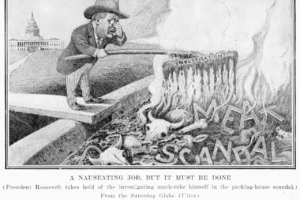
"A nauseating job, but it must be done" - a political cartoon from the Utica Saturday Globe featuring President Theodore Roosevelt
A political cartoon from the Utica Saturday Globe featuring President Theodore Roosevelt

They worked hard in the stockyards under brutal conditions. In the “chilling rooms” the men contracted rheumatism. The wool pluckers’ hands were ruined by acid. The arms of those who made the tins for canned meat became a maze of infected cuts; their illness was blood poisoning. In summer in the airless, stifling fertilizer mill, phosphates would soak into the workers’ skin, causing headache and nausea. In winter in the “killing beds” the rooms were so cold the animals’ blood froze on the flesh of the workers, who stumbled about like monsters.

There were no worker protections. Unions were shakedown operations for the city’s political machine. In mad pursuit of profits, owners sped up production lines until men broke down, then fired them and hired someone younger and stronger. The workers came to understand they weren’t working for competing companies, it was all “one great firm, the Beef Trust.”

Sinclair meant to indict capitalism’s abuse of innocent men and women who had come to America with dreams in their hearts. Those charges would have political reverberations. But when the revelations came out—advance copies of “The Jungle” had been provided to the wire services and the Hearst newspapers, which front-paged them with howling headlines—the public was most outraged by the unsanitary conditions in which their food was made. (Sinclair said wryly, “I aimed at the public’s heart, and by accident I hit it in the stomach.”)

The meatpackers “doctored” rotting meat. “It was the custom . . . whenever meat was so spoiled that it could not be used for anything else, either to can it or else to chop it up into sausage.” Tubercular steers, hogs that had died of cholera on the trains—their meat was processed and sold. There was contamination from sawdust and rat dung. Inspectors were paid off.

All this caused a sensation.

Here enters Teddy Roosevelt, in his second term as president. He’d initially resisted the book: Sinclair was a socialist and a crank. In a letter to William Allen White, TR called Sinclair “hysterical, unbalanced, and untruthful.” But Sinclair had hit a nerve, and Roosevelt conceded some “basis of truth” in the allegations. He sent investigators to Chicago. There was a government probe and report. Congress enacted landmark legislation, the Meat Inspection Act and the Pure Food and Drug Act. The latter expanded the power of a Bureau of Chemistry, which became the Food and Drug Administration.

The whole story—isn’t it something? That they got it right, that it started with a zealot who captured truths others had ignored. That journalism can work as a public benefit, and government make things better.

So now we jump to this moment. Conservatives and Republicans are, as always, impatient with governmental cost, overreach and waste, only more than usual because it’s been a while since these things were any administration’s top priority. In that time, some federal agencies, maybe many, have run wild.

But it’s good to remember now that government employs many people who help us, whom we couldn’t do without. The example always used, justly, is air-traffic controllers. They have to be cool, analytical, know their stuff, or 500 people in a jumbo jet will plunge to their deaths. Those jobs must go only to those who can take the pressure. Food inspection, obviously, is another. Seeing to the proper and safe disposal of nuclear waste. Properly coding Social Security checks.

So many crucial jobs! And it’s helpful to remember they’re usually done well. Their holders must be treated with respect as the professionals they are.

It is also true that the size and scope of government is always growing and requires sharp oversight. The arc of the moral universe is long but bends toward mischief. In our time the political left has grown adept at finding ways to support, employ and give standing to its political allies. They use government to buy off constituencies within their coalitions. That’s how you get the absurdist U.S. Agency for International Development programs Donald Trump and Elon Musk speak of so often. Their existence makes you mad. Which keeps the base stoked. And as all but children know, you can’t do nuthin’ without a stoked base.

But we have to keep our heads straight about what’s important and what’s not. And we can’t demonize government work. Some public servants really are servants.

Internationally, once we won wars and saved people. In the past half century we’ve shifted in big ways to profound generosity. We give food and bandages and help cure diseases. It matters that we are a great and generous nation, and known as such. I asked the leader of a great do-good organization if, in the clinics in South America or Africa, they showed the American flag. Yes, as do the wrappers of the food they give. That is good for us. It matters to have friends in the world. Someday we’ll be in a fix. Someday we’ll need them.

But if you are a taxpayer-funded agency or entity right now, you had better be able to say in a clear, sharp sentence what you do that helps America. Do you protect it from ptomaine poisoning? Do you enhance its reputation in the world? If you can’t produce that clear, sharp sentence, maybe you have a problem. Maybe you aren’t helping. Maybe taxpayers don’t have to pay for you.

It’s good to remember in a time of cutting that not everything is bad, that right-wing propaganda, like left-wing propaganda, often gets carried away, that the libertarian impulse is beautiful but dreamy. A libertarian would have told Upton Sinclair that the market corrects all, that a company that sells bad beef won’t survive long. That’s true. But it’s in the way of things that the rich have the resources to be discerning, and the middle careful, but the poor get sick before the butcher shop shuts down. And we have to take care of each other.

Snap Out of It, Democrats On Tuesday they looked as if they aren’t going to win for a long time. That’s dangerous for America.

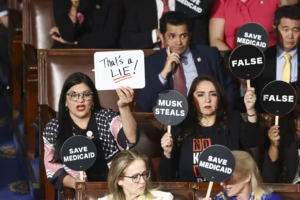
Democrats looked like fools Tuesday night. We don’t need to dwell on how they sat grim-faced, seething, or walked out while the president spoke. One stood, yelled, brandished his cane and was removed by the sergeant at arms. Others held up little paddles bearing little insults. Some wore special color-coded outfits. Almost all refused to show normal warmth or engagement. From my notes, as the camera turned and dwelled on the furious faces: “They look like the green room in hell.”

All while Donald Trump romped.

Democratic lawmakers hold up signs during President Donald Trump's address to CongressThree thoughts. One, these aren’t serious people. Two, their job was to show they are an alternative to Mr. Trump, and instead they showed why he won. Third and most important, they will continue to lose for a long time. I hadn’t known that until Tuesday.

Sometimes a party takes a concussive blow, such as the 2024 presidential loss, and you can see: They’ll shape up and come back, they’re pros, they lost an election but not their dignity. But now and then you see: No, these guys don’t know what happened, they are going to lose over and over before they get the message.

What I saw Tuesday night is that the Democratic Party in 2025, as evinced by its leaders on Capitol Hill, is too proud and stupid to change. I saw 1981. The Reagan era had begun, the Democrats had taken quite a drubbing—a landslide loss by a sitting Democratic president, and the loss of the Senate majority they had held since 1955. It was the kind of blow that reorders the mind: Democratic policies weren’t popular! They had just been massively repudiated! But the blow didn’t reorder their minds. They kept doing the same thing, as if they had a secret death wish. They lost in another landslide in 1984, and again in ’88. Finally, as 1992 approached, they realized: We need to readjust our policy stands to be more in line with those of the American people. They did, and Bill Clinton squeaked in.

We are in “Death Wish II.”

In this space we believe two strong and healthy parties vying for popular support is good for the country, and we offer advice for the Democrats.

I will start with something they won’t believe. In politics, there is bringing the love and bringing the hate. When the 13-year-old boy who had brain cancer and has always wanted to be a cop is appointed as an honorary Secret Service agent, laminated ID and all, and the child, surprised by the gesture, hugs the normally taciturn head of the Secret Service, the only thing to do, because you are human, is cheer that child. And when the president honors a young man whose late father, a veteran and policeman, had inspired his wish to serve, and dreams of attending West Point, and the president says that he has some sway in the admissions office and young man you are going to West Point—I not only got choked up when it happened I’m choked up as I write. The boy with cancer high-fives the young man, and the only response to such sweetness is tears in your eyes.

That moment is “the love.” It was showing love for regular Americans. To cheer them is to cheer us. It shows admiration for and affiliation with normal people who try, get through, endure and hold on to good hopes.

The Democrats brought the hate. They sat stone-faced, joyless and loveless. They don’t show love for Americans anymore. They look down on them, feel distance from them, instruct them, remind them to feel bad that they’re surrounded by injustice because, well, they’re unjust.

Mr. Trump says: No, man, I love you.

Which is better? Which is kinder, more generous? Which inspires? Which wins?

Democrats have to understand where they are. They have completely lost their reputation as the party of the workingman. With their bad governance of the major cities and their airy, abstract obsessions with identity politics and gender ideology, they have driven away the working class, for whom life isn’t airy or abstract. Democrats must stop listening to the left of the left of their party. It tugs them too far away from the vast majority of Americans. They have been radical on the border, on crime, on boys in the girls’ locker room. They should take those issues off the table by admitting they got them wrong.

Why do they allow the far left to punch so far above its weight? It’s not only money. “They play dirty, make threats, make people uncomfortable,” a Democratic elected official said. Normal Democrats want to dodge a fight with them. But the fight has to be had. The sooner you have it, the sooner it’s over and the party makes itself into a fighting force again.

In the near term, James Carville says the party should play possum—“roll over” and make believe they’re dead when the predator approaches. (It almost worked for Joe Biden.) I’d add play shrewd possum—align with what the Trump administration is doing that might be productive, but with a variation that shows you have a heart, you are protective of the excellent and the diligent and deserving of protection. Help Elon Musk fight waste, fraud and abuse, but make clear you are protecting essential programs and peerless professionals. Mr. Musk is going to make bad mistakes; he’s new to government and doing everything everywhere all at once. When he does, the possum should become a lion.

Know your stuff, have the data. “Trump bad” isn’t enough to win. You have to start realizing how popular he is with your own voters. He’s a masculine presence, he’s funny, and he likes Americans. Those are three powerful qualities in America right now.

Democrats on Capitol Hill are pushed to act like jerky drama queens by activists in their base. Leave that to Nancy Mace. If they need behavioral role models: Take the seriousness of John Roberts and Amy Coney Barrett, who present themselves as even-keeled adults and speak thoughtfully, and add in the public good cheer and capability of Elena Kagan. Sen. Elissa Slotkin was calm and plain-spoken in her response. Emulate her. It will help retrieve and rebuild your party’s reputation.

Taking all bait won’t work. The administration is throwing new chum in the water every day, you’ll look disorganized, insatiable and desperate if you endlessly swim to it.

Be strategic. Mr. Trump is a man who goes too far. He confuses boldness with wildness, can’t see the line. He’ll give you opportunities. Take the big ones.

Stop listening to your consultants. They know the Democratic Party but not America. They’ve always had the media in their pocket and it’s made them lazy and lacking in insight. Keep going to town halls in small and medium-size towns and listen, listen, listen.

If Democrats don’t wise up and sober up, Mr. Trump and the Republicans will know there is no major party to slow them, temper them, stop them. This wouldn’t be good. They need an opponent. The Democratic Party’s not reporting for duty is a dangerous thing.

A Stiff Drink From the Trump Fire Hose Some of his actions are exhilarating. Some of them make you ask: Are these people clinically insane?

When you think aloud for a living you’re lately getting a lot of wry comments like “It must be hard to come up with a topic with nothing going on.”

A torrent of ticker tape containing random words spewing forth from the White House and engulfing the new crews outside“It’s drinking from a fire hose,” the journalist will reply. Meanwhile, normal people are asking: He doesn’t really think he’s a king, right? I’ve grown tired of saying, “Well, that was insane,” and we’re barely a month in.

The most charitable gloss on the administration style—here we’re thinking of Defense Secretary Pete Hegseth’s blithe announcement that he wants to cut defense spending 8% a year for the next five years—is that they’re simply riding high and have grown full of themselves, as opposed to clinically insane. The other day I remembered an old story about Muhammad Ali. The great boxer was flying to a championship bout, feeling on top of the world. As the plane taxied down the runway, a dutiful stewardess kept coming by: “Sir, please fasten your seat belt.” He smiled. “Superman don’t need no seat belt.” She said, “Superman don’t need no airplane. Buckle up.” And he did.

But that wouldn’t fully explain things.

The president’s remarks on Ukraine this week were wild and destructive. He isn’t wrong to wish to end that conflict—war is brutality and waste. Everyone knew that it would end on unsatisfying terms. But Ukraine didn’t start it, Russia did, in defiance of international law. The war isn’t Volodymyr Zelensky’s fault, he isn’t a dictator, he isn’t loathed by his people—all those things President Trump said were untrue. And the vast majority of those listening to these charges know they are untrue. Asking “Why does Trump do this?” is a decade-long cliché, but really—why does he do this?

Ukraine is a sovereign nation. Its citizens put everything they had on the field to defend themselves. Mr. Zelensky entered world history with spirit and guts, refusing to flee Kyiv: “I need ammo, not a ride.” After the Cold War Ukraine agreed to relinquish the nuclear weapons housed there for a promise the U.S. would always have its back. They trusted us. Must American presidents honor the honestly made vows of their predecessors? In this case surely yes, at pain of announcing to every friend we have, “You’re on your own, Uncle Sam has left the building.” Trump supporters think they want that message sent. It is a careless and destructive one.

It isn’t bad to tell Europe’s leaders that they have lost touch with their own people and no longer seem protective of them or their nations’ longstanding political principles, as Vice President JD Vance did last week. Candor is a compliment, as they say, it implies you can take it. It isn’t bad to tell them they’ve only grudgingly paid for a fraction of their own defense and need to step up. But long history should temper your approach. We and Europe have been friends a long time. We came from them. Their blood was our starting blood. It may be quaint to note this but it’s true: We go back. You can and will have disagreements with such friends, but when you speak to them publicly it can’t be casual or without warmth. It must take the past into account, even when they don’t. Especially when they don’t.

This is a matter not only of grace but of practicality. The future will be a hard place. All the unfortunate aspects of man’s nature will be sped up and made more fateful by technology such as artificial intelligence. In that world we will need old friends. There is a speech by St. Thomas More in “A Man for All Seasons”: “Oh? And when the last law was down, and the Devil turned round on you—where would you hide, Roper, the laws all being flat? This country’s planted thick with laws . . . and if you cut them down—and you’re just the man to do it—d’you really think you could stand upright in the winds that would blow then?” Replace “law” with “friend.”

We won’t easily get through the future without them. Estranging them isn’t a safe thing to do.

On Elon Musk and the Department of Government Efficiency, anyone seeing how he’s presented himself to the public the last few years would conclude with justice that he is brilliant and impulsive, has penetrating insights and arguable judgment, seems both sincere and calculating, and is trying to create something stable while loving drama too much and exciting the audience too much.

All my adult life the answer to “let’s find waste, fraud and abuse within the federal government” has been, “Whatever you find will be a rounding error, it isn’t worth the pursuit, the money is in the entitlements and defense, all else is nonsense, don’t even try.” I never thought that true and never saw it only as a question of saving money but of assuring citizens that their government can be trusted. It is heartening to see DOGE attempt reform—exciting, actually. Mr. Musk comes in and zaps bad programs here and silly spending there and suddenly the good parts of the previously more-or-less unaccountable U.S. Agency for International Development are being blended into the State Department, and the bad parts are being shuttered. This allows citizens to feel they can direct their government. Which cheers them. They didn’t know it was possible.

But judgments about the definition of good spending seem to be up to Mr. Musk and his young men, who are assumed to know fat from muscle. Do they? We don’t know. Mr. Musk may be a freedom-loving American idealist who’s deeply grateful for what our founders created and who’d give all to protect it. But then for all I know, he could be a secret operative for a Liechtenstein-based cartel. He and his underlings are political novices. There is no one Mr. Musk need answer to but Mr. Trump, and Mr. Trump likes what’s playing well with the base but is changeable. As aides sighed of Richard Nixon when he became enraptured by an intellectual like Daniel Patrick Moynihan or was taken by lessons gleaned from Robert Blake’s biography of Disraeli, “the boss is in love again this week.”

Everyone knows DOGE will make mistakes, but that isn’t the point. You have to be a fool to think there won’t be dreadful mistakes with broad repercussions. To take on seemingly all parts of government at the same time is to unsettle and confuse the entire government at the same moment. That is dangerous. It was a mistake to announce going in that they’d find $2 trillion in savings. Now anything less and their foes will paint them as failures, so they’ll want to meet their target, which will increase the chance they make or recommend cuts that shouldn’t be made.

In a larger way, all the movement and action of the first month of the Trump administration means that every president after Mr. Trump will have to show wild boldness in pursuit of his aims or be called weak. Presidents can’t stand it when you call them weak, so they’ll be wild too. Rightists, you won’t like this when it comes from the left. We’ll veer dramatically back and forth.

Like Muhammad Ali, buckle up.

Trump, Andrew Jackson and the Politics of Crisis The 47th president says he’ll comply with court decisions. The seventh didn’t always do so.

We aren’t in a constitutional crisis. If the administration takes an action, a court holds it unconstitutional, and President Trump defies the court, then we will enter a constitutional crisis.

The president said this week he will obey all court orders as he did throughout his first administration, and appeal if necessary. But he said that Tuesday, and next week it may be different. As Mark Halperin has observed, no Trump decision is ever really made because every Trump decision may soon be reversed, by Mr. Trump.

President Donald Trump in front of a portrait of President Andrew JacksonBut if you go by two things—the temperament of this White House and the ability of its adversaries to launch innumerable cases within all levels of the judicial system—odds are good a crisis will come.

What then? A hellacious struggle. I’ve been going back to Andrew Jackson’s presidency (1829-37), which can be seen as a nonstop constitutional crisis. Trump supporters used to trace parallels between Mr. Trump and the seventh president, whose portrait the 45th president displayed in the Oval Office and the 47th brought back. Now they natter on about William McKinley. But their spirit isn’t of the placid McKinley, it is Jacksonian. They are denying their own spirit, burying it in a well-dressed, even-toned professionalism. The outsider Elon Musk in his jeans and his jacket bragging about feeding federal agencies into the wood chipper—that is Jacksonian.

Having been cheated out of the 1824 election—he really was, in grim bargaining between Secretary of State John Quincy Adams and House Speaker Henry Clay—Jackson defeated Adams four years later after an embittering campaign marked by “slander, slight and innuendo.” That is H.W. Brands in his excellent “Andrew Jackson: His Life and Times.” Jackson saw the theft of the 1824 election as “emblematic of a deeper corruption that undermined American liberty and prevented the ordinary people of America from controlling their government.”

What a showman he was. He rode a white stallion down Pennsylvania Avenue after he was sworn in. A longtime Washingtonian quoted by Mr. Brands was shocked. “Such a cortege as followed him! Country men, farmers, gentlemen, mounted and dismounted, boys, women and children, black and white.” No one called them “deplorables,” but that’s how official Washington viewed them. The White House reception was famously overwhelmed by “the rabble mob,” in the long-timer’s words. China and glass were broken, fights broke out. “Those who got in could not get out by the door again, but had to scramble out of windows.”

The nation had been a constitutional republic only 40 years. Jackson saw much that had settled in and needed undoing. His trained his fire on the federal workforce, moving against permanent tenure. “No one man has any more intrinsic right to official station than another.” He favored “rotation”—employees should work a few years and make way for new ones. Mr. Brands put the best estimate at “between one-tenth and one-fifth of federal office holders replaced during Jackson’s tenure other than by ordinary attrition.” Jackson didn’t mind that they feared being fired. Mr. Brands sums up his thinking: “A little fear would have a sobering effect on the tipsy, a vivifying effect on the lazy, a straightening effect on the wayward.” Replaced workers saw their slots filled by Jackson enthusiasts. “To the victor belongs the spoils,” Jackson is often quoted, but it was a friendly observer, Sen. William Marcy (D., N.Y.), who said it.

In Jackson’s terms there were two major clashes between the executive branch and the judiciary. The first was what came to be called the Bank War. The charter of the Bank of the U.S. was expiring in 1836. Jackson didn’t like the bank. I think as a once-impoverished frontiersman he just didn’t like banks, but his arguments came down to a populist trope: The bank favored a moneyed elite over common people. In December 1829 he informed Congress, with a faint air of menace, that not only did he oppose the bank, so did “a large portion of our fellow citizens.”

Congress voted in 1832 to recharter the bank. Jackson vetoed the bill. As a struggle ground on, he was re-elected in a landslide.

The Supreme Court had held in 1819 that the bank was constitutional, and its charter hadn’t expired. Jackson pulled all federal deposits from the bank and disbursed them to state banks. His first Treasury secretary refused to make the transfer and Jackson fired him, hiring a more compliant replacement while the Senate was in recess. Clay, by then a senator, said Jackson had no constitutional authority to do what he was doing. The Senate censured the president.

The transfer of funds went through and was followed by financial panic. Jackson claimed there was no real distress beyond that felt by speculators and fraudsters. It was bitter. The president of the bank said just because Jackson had “scalped Indians and imprisoned judges” didn’t mean he’d succeed here. Jackson said the Bank was trying to kill him, “but I will kill it!” Federal money flowed into the states, liquidity eased, and the bank was blamed for the panic. Jackson left the White House in triumph. But his successor, Martin Van Buren, buffeted by continual economic aftershocks, was thrown out after one term

Mr. Brands: “Politics in the age of Jackson wasn’t for the faint of heart and especially not for the weak of mind.” In 1835 a man aimed a pistol at Jackson’s heart from 10 feet. The gun misfired. So did a second pistol. Afterward, when police tested the pistols they fired perfectly. Jackson’s supporters came to see his survival as the work of Providence.

The other crisis revolved around the Supreme Court case Worcester v. Georgia (1832). Samuel Worcester, a white Christian missionary living in Cherokee territory, opposed Georgia’s imposition of its laws removing Cherokee control from their lands. He brought suit on their behalf. The justices found Georgia’s efforts unconstitutional because the Cherokee nation was a sovereign entity.

Jackson refused to enforce the decision. He literally ignored it, seeing it as undemocratic. He is often misquoted as saying, of the court’s chief justice, “John Marshall has made his decision; now let him enforce it.” It was New-York Tribune editor Horace Greeley who used those words to capture Jackson’s attitude. What Jackson said is that the decision “fell stillborn.” The court “cannot coerce Georgia to yield to its mandate.”

Jackson allowed Georgia to annex Cherokee lands and pursue the Cherokee, contributing to the forced relocation of the American tribes to the west of the Mississippi—the catastrophic Trail of Tears in which thousands perished from disease and exposure.

But a precedent, of sorts, had been established: The Supreme Court had limited power in enforcing its decisions without the executive branch’s support.

It was the anti-Jacksonian Sen. Daniel Webster of Massachusetts who grasped the underlying dynamic of the age. Though the Constitution specified a separation of powers, day-to-day democracy could override it. “Were it not for the fear of the outdoor popularity of General Jackson,” he wrote, “the Senate would have negatived more than half his nominations.” Congress feared or was tempered by Jackson’s support.

That is where Trumpism puts its bet, on his popularity “outside.” Though Jackson’s election victories were landslides.

Government Keeps Going Too Far The common thread that ties men on women’s sports teams and Musk’s indiscriminate cutting.

I want to talk about a simple thing. It’s a preoccupation that came again to mind as I watched President Trump sign, in an East Room ceremony on Wednesday, the executive order ending federal funding for educational programs that mandate biological males be allowed to compete on girls’ or women’s sports teams.

Elon Musk
Elon Musk

The mood in the room wasn’t triumphal or mean, but grateful and joyous. If you still seek to understand the depth of the president’s popularity with his voters, you need look no further than that ceremony, all or parts of which were on cable and broadcast news. It is still amazing to me that the Democratic Party put itself so firmly on the wrong side of this issue. I ask donors and party leaders why, and they can never say how it happened.

My simple thought: that in our politics now we consistently go too far and ask too much. It has become a major dynamic in the past 20 years or so. It manifests in a kind of ideological maximalism. You must get everything you want and grant your foe nothing. In terms of the issue above, you don’t ask society to give you something you deserve—good and just treatment of all transgender folk. Instead you insist that others see reality exactly as you do—that if a man experiences himself as a woman, then you must agree that he is a woman, and this new insight must be incorporated into all human activity, such as sports.

Reaction to the Trump executive order from those who disagree with it has been curiously absent. The reason is that they know they went too far.

The biggest and most politically consequential example of going too far, in the past generation, has been the Democratic Party and illegal immigration. Everyone knows this so I’ll say it quickly. If you deliberately allow many millions to cross the southern border illegally, thus deliberately provoking those who came here legally or were born here, Americans will become a people comfortable with—supportive of—their forced removal, certainly of those who are criminals.

America was usually pretty chill about deportations in the past: They’re not how we roll. We stubbornly admire those in our family lines who acted up when they got here, and while there’s always been a lot of finger-waving, we’ve traditionally given new immigrants wide latitude and sympathy. A century ago Irish immigrants filled the paddy wagons, which weren’t called that for nothing, and Italians imported an entire criminal organization, the Mafia. Americans have always quietly bragged about the mischief and mayhem in their families way back, but they’ve grown stricter and less reflexively sympathetic. That’s because the Biden administration went too far.

Jump to what has been going on the past few weeks in Washington, with the unelected Elon Musk reorganizing, if that’s the word, the federal agencies. Here I pick on him, in part to show fairness. He is surely a genius, a visionary, a titan, but there is something childish and primitive about him. He has wild confidence in his ability to engineer desired outcomes, but unstable elements have a way of exploding in the beaker, and like everyone else from Silicon Valley he lacks a sense of the tragic. They think human life can be rationally shaped and perfected, that every problem just needs the right wrench, and in any case they all think they’re God.

My fear, here we switch metaphors, is that Mr. Musk and his young staffers and acolytes are mad doctors who’ll put 30 chemo ports in the sick body. They’ll not only kill the cancer, they’ll kill the patient.

But they are up against, or trying to reform, a government whose agencies themselves were often maximalist and went too far.

Of all the agencies being batted about the one we will remember first when we recall this period in history is the U.S. Agency for International Development, so much of whose line-item spending was devoted to cultural imperialism. You have seen the lists. USAID produced a DEI musical in Ireland, funded LGBT activism in Guatemala. It spent $426,000 to help Indonesian coffee companies become more climate- and gender-friendly, $447,000 to promote the expansion of atheism in Nepal, and on and on.

When you look at what they were pushing on the world you think: They’re not fighting anti-American feeling, they are causing anti-American feeling.

Who is defending these USAID programs? Nobody. Obviously not Republicans, but not Democrats either. Everyone knows the agency went too far.

In the past, USAID stonewalled lawmakers when they asked for information. If it had been forthcoming, or even moderately clever, it would have allowed Congress to find, scream about and remove its zanier items and avoided being shuttered, with the job losses that will entail.

“We spent the weekend feeding USAID into the wood chipper,” Mr. Musk tweeted on Monday. Earlier, he called it “a criminal organization.” Mr. Trump called it an agency run by “radical left lunatics.” Having seen the line items, who would mourn?

In general, the public seems to be paying attention and accepting, or cheering. Natalie Allison of the Washington Post went to a diner in Plains, Pa., where she asked Tammy Malloy, a waitress who voted for Mr. Trump, how she felt about the first 10 days. Ms. Malloy said she was glad the Pentagon would move against DEI. She added: “There’s two genders. I don’t care if you identify as a monkey, you’re still either a male or female. The last four years shoved it down our throats.”

But the Trump White House had better hope there are no catastrophic effects from shuttering USAID efforts that actually help people, contribute to our safety, and enhance our standing in the world. Monitoring and studying Ebola in Africa is one example.

The White House should worry too about what is reportedly happening in other agencies, such as the FBI and the CIA. It looks like chaos, which always entails individual injustice, in this case to some of those who’ve served the U.S. well, and it will be surprising if there aren’t at least some negative national-security consequences. You can’t build the plane while flying it.

I circle back to where this column began. An odd thing is that Democratic donors, strategists and party professionals seem incapable of taking offending issues seriously. They think they’re arguments being engaged in by those who are about five status-levels below them. This shows disrespect for those who feel the victim, for the 10th-grade girl on the volleyball team who’s up against hulking guys or the woman treated roughly by the illegal immigrant with a record. It’s as if they can’t be bothered to shut down the actual radicals in their party who cause the problem. When things get like this—when the wise men and powerful women refuse to do what they must that the party would survive—parties fail.

Advice for everyone: The big domestic political lesson of the first quarter of the 21st century is “Don’t go too far.” That way lies loss, potentially of more than you can imagine.

Trump and the Collapse of the Old Order A disquieting Washington visit leaves me with a sense that America is making a big break from the past.

I would like to point out a simple fact. A major and unnoticed part of Donald Trump’s power is that 100% of Americans know who “the president” is, including children above 5 and nonnative speakers. I base this on personal interactions with strangers of all sorts. Since I made up “100%” because there’s no way to prove it, I will guess at some other numbers I believe to be true. Eighty percent know, in some broad sense, what his policies are, and more than 60% have some sense of an action he took last week: “He fired everybody.”

No modern president has achieved this level of complete cultural saturation. It gives him power in this ill-educated, broken-up, low-attention-span country. You remember “Jaywalking,” Jay Leno’s comedy bit in which he’d ask people on the street, “Who was Abe Lincoln?” (“A singer?”) When was the American Revolution? “Um, 1970?” We haven’t become more historically literate.

U.S. President Donald TrumpYou have to keep this in mind to understand the moment we’re in. Mr. Trump has pierced American consciousness in this way. He has broken through as an instantly recognizable, memeable, cartoonable figure—the hair, the red tie, the mouth—but he also provides, deliberately and not, iconic moments that connect to other iconic moments. The tech barons arrayed behind him as he was sworn in, and the White House meeting hours later in which the president promoted artificial intelligence. As I watched them at the inauguration I abstracted. It was like Elon is passing the solid gold phone to Mark Zuckerberg, who nods and passes it to Jeff Bezos, who passes it to Sam Altman, who marvels at its weight and shine.

That of course is taken from the scene in “The Godfather Part II” in which the American business behemoths sit at a conference table in the palace of Cuban President Fulgencio Batista, as he communicates they’re safe with him because he loves business. Almost every American adult has seen a “Godfather” movie. I believe that as they watch the second Trump administration they occasionally connect it to themes of that great drama. When Mr. Trump fires the inspector general, when ICE gets the illegal-immigrant child molester, when Mr. Trump tries to get rid of the federal workforce—he’s settling all family business. His second term can be understood as an attempt to change his image from Sonny to Michael.

Last week I had four days in Washington with members of both parties, many elected officials. The only subject was Mr. Trump.

Republican lawmakers, including those most supportive of the president, are beside themselves with anxiety. When you speak to them—off the record, between friendly acquaintances—and ask how it’s going, they shift, look off, shrug: You know how it’s going. A GOP senator who supports the president had a blanched look. “He doesn’t do anything to make it easy,” he shrugged.

What is the meaning of the averted eyes and anxious faces? It means Trump 2.0 isn’t better. It means for all the talk of the new professionalism in the Trump operation, they have to get used to the chaos again and ride it, tempting the gods of order and steadiness. After one week they concluded the first administration wasn’t a nervous breakdown and the second isn’t a recovery; instead, again they’re on a ship with a captain in an extended manic phase who never settles into soothing depression.

In a general way, also, there is something big I sensed. Among those who think about foreign affairs and world history, the great story of the past dozen years or so has been the collapse of the postwar international order that created systems and ways of operating whose dynamics and assumptions were clear, predictable, and kept an enduring peace. You can say the fall began when Russia invaded Georgia in 2008 or Ukraine in 2022. Take your pick, it’s over.

I saw a broad and growing sense in Washington that American domestic politics, or at least that part of its politics that comes from Washington, is at a similar inflection point. That the second rise of Donald Trump is a total break with the past—that stable order, healthy expectations, the honoring of a certain old moderation, and strict adherence to form and the law aren’t being “traduced”; they are ending. That something new has begun. People aren’t sure they’re right about this and no one has a name for the big break, but they know we have entered something different—something more emotional, more tribal and visceral.

There is the strong man, and the cult of personality, and the leg-breakers back home who keep the congressional troops in line. In 2017, a lot of people who watch closely and think deeply, thought: We’re having an odd moment, but we’ll snap back into place. Now they are thinking something new has begun. American politics was a broad avenue with opposing lanes for a very long time, at least a century, and now we have turned and are on a different avenue, on a different slope, with different shadows.

There’s a sense we’re living through times we’ll understand only in retrospect. But the collapse of the old international order and the break in America’s old domestic order are shaping this young century.

So far Mr. Trump is governing by executive order. This contributes to the uneasiness. Such orders are legitimate, sometimes necessary. Barack Obama used them heavily—“I’ve got a pen.” Mr. Trump increased their use, Joe Biden more so, and Mr. Trump is turbocharging their use. The heavy use of executive orders makes all politics personal, having to do with the man who orders and signs with a flourish. Making it personal distorts our understanding of what a leader can and should do. Executive orders ignore the branch of government called Congress and work against its authority, its role in the republican drama. They give the impression we are a government of one branch. Doing all this habituates the public to the idea of authoritarianism, of rule by the strongman. We will pick a new caudillo and he will save us with his pen! When you do away with branches and balances you cause trouble.

Has it hurt his popularity? No. People back boldness when they think a lot has gone wrong and needs righting. They’d expect a certain amount of mayhem. And with Mr. Trump, chaos is baked in.

A word to Democrats trying to figure out how to save their party. The most eloquent of them, of course, think the answer is finding the right words. We need to talk more like working people, we need Trump’s touch with popular phrasing.

The answer isn’t to talk but do. Be supple. The Trumpian policies you honestly support—endorse them, join in the credit. If you think violent illegal immigrants should be removed, then back current efforts while standing—firmly, publicly—on the side of peaceful, hardworking families doing no harm and in fact contributing. Admit what your party’s gotten wrong the past 15 years. Don’t be defensive, be humble.

Most of all, make something work. You run nearly every great city in the nation. Make one work—clean it up, control crime, smash corruption, educate the kids.

You want everyone in the country to know who you are? Save a city.

The White House ‘Wonder Horse’ Trump returns to office with a burst of energy and a flurry of actions, some sensible, some dangerous.

What is the honorable way to oppose while hoping for the best, to oppose while being as quick to recognize progress as to see failure, to oppose while appreciating any outcomes that are healthy for and helpful to the United States of America? And without forgetting why you oppose? We’ll find out. This is our goal. History is long and our moment within it short. Play it straight and say what you see.

As for the past week, where to start?

President Donald Trump signs executive orders and pardons in the Oval Office

It was another Trumpian triumph. Talk about energy in the executive. President Trump is flooding all zones, throwing whole pots of spaghetti against the wall. The spirit is Teddy Roosevelt, high dynamism and canny show business, though the new president has taken to referring to TR’s more orderly predecessor, William McKinley.

Mr. Trump successfully turned the page. He established this feeling: The past is sodden, the future electric.

As he sat at the Resolute Desk in the Oval Office Monday night, holding an impromptu news conference—this was after he gave an inaugural address, a long, ad libbed postinaugural speech to the overflow crowd, a Capitol One Arena speech accompanied by the public signing of executive orders, and before the sword dancing at the first of three inaugural balls—as he sat at the Resolute desk simultaneously taking questions and signing more executive orders—this one makes clear the United States owns Saturn—I realized three things:

I once wrote of him as Chief Crazy Horse but as he signed, I thought of . . . an old nickname for Tom Brokaw. Years ago his producers marveled at his stamina—he could sit in that anchor chair and go live all day and all night, he was indefatigable, never lost focus, he didn’t even have to use the bathroom. They called him “Duncan the Wonder Horse.” That was Mr. Trump this week.

He is going to utterly dominate our brainspace. He is a neurological imperialist, he storms in and stays. In his public self, Joe Biden asked nothing and gave nothing. Mr. Trump demands and dominates: Attention must be paid. It was said years ago that Fox News viewers were so loyal that they never changed the channel and the Fox logo burned itself into the screens. Donald Trump won’t be happy until he’s burned himself into the nation’s corneas.

He is at the top of his powers, top of his game. He used to be testy and aggrieved with reporters because he yearned for their admiration. Now he treats them with patience and calm because he doesn’t care about them. He’s got his own thing going. If they don’t like him it’s their problem, with their puny little numbers and shrinking networks.

Finally, my optimistic thought. I found myself wondering if the first Trump administration was Mr. Trump’s public nervous breakdown and his second administration will be his recovery. Is that possible? His first was chaos and fury, ending in 1/6. What we’re seeing now is a person who presents as even, collected and commanding, who isn’t wholly uninformed and has a plan. We all tell ourselves stories, and that, this week, is mine.

His inaugural address was exactly like a speech by Donald Trump. He fleetingly asserted a golden future and quickly reverted to insulting the presidents who’d shown up to maintain form, most pointedly his immediate predecessor, who listened impassively. A friend said of Mr. Biden, sweetly, “At least he won’t remember.” I include the insult because it is deserved after he pardoned his family for any crimes they might have committed. This was a scandalous act that embarrasses America in the eyes of the world—you with your moral pretensions and your skeevy elites on the take. It was the act of someone who doesn’t care anymore.

His friends were encouraged by the celebrations of Jimmy Carter when he died—“In time, history will be kind to Joe.” It will not. He took a torch to that possibility in his last official act.

Of Mr. Trump’s executive orders, some were sound, such as the crackdown on illegal immigration. But let me tell you what happens when you pardon virtually everyone who did Jan. 6: You get more Jan. 6ths. When people who commit crimes see that their punishment will be minimal they are encouraged. It was a wicked act. Conservatives are tough on crime because of the pain and disorder it causes. In that case it pained an entire nation. Jan. 6 too shamed us in the eyes of the world. This pardon was not a patriotic act.

What the president’s appointees have to balance in their minds is two opposing thoughts. One: They just won an overwhelming victory—the presidency, Congress, the popular vote—with almost all the institutions of the country arrayed against them. The other: Mr. Trump won 77 million votes and Ms. Harris 75 million. The margin of victory was 49.7% to 48.2%. We are a split country. The victors had a stunning victory but half the country opposed them. The point isn’t to advise gradualism or moderation, which in Mr. Trump’s case is absurd and already overtaken by events. It is to say: Know your position. For all the triumphalism of the moment Trump staffers shouldn’t feel impervious or unhurtable. Their position can change overnight.

An example: the tech billionaires in the front rows at the inauguration. It was a Trumpian power-flex: Look who’s on my side. But they aren’t kissing the ring, they’re tough and willful men who do what they must to get what they want. What they won was a live White House event in which the president excitedly prompted them, like a yokel, on how artificial intelligence will cure cancer. That’s not all it can do, read a little Geoffrey Hinton. AI doesn’t need a cheerleader; it needs caution and gravity. But it seems to have just won the formal imprimatur of the new administration. To be taken in like this by subtle high-class hustlers wasn’t promising and fresh but embarrassing.

Democrats so far are nonexistent as the opposition. In the long term their passivity is a strategy: Let Mr. Trump control immigration and kill woke; that will remove the issues people most hate about the Democratic Party. Once he solves them, the issues are gone. In the short term this isn’t a strategy but another indication of lostness: They don’t know what they believe in and have no leader. The idea that Barack Obama will swoop in to save them is ridiculous. That selfish man isn’t interested in a fight that would expose him to fire.

It will be interesting to see how the world arranges itself. Eight years ago when Mr. Trump rose, Europe thought it was witnessing an aberrational freak show, something visited on them like a spaceship. It would disappear in four years. The only ones who saw the implications of his rise were themselves slightly nutty, like Nigel Farage. Now they’re watching the Republicans in Washington and seeing: In four years Mr. Trump will be gone but Trumpism will stay, it is entrenched. Even rising Democrats will take cues from it. This is a new dispensation. It will be interesting to see how they adjust.

For four years it’s going to be non-stop, 24/7 rock-’em-sock-’em. God bless our beloved country. History ahead, everybody hold on tight.

You Never Forget a Fire The suffering residents of the Golden State may now force a reorientation of its ways of governance.

When I was a teenager my family’s house burned down and every possession but our car was lost. This was in Rutherford, N.J., in 1969 on a Saturday night in May. At some point before midnight a lamp without a shade fell over on a bed upstairs, and a fire started that no one saw or felt until the room was fully engulfed, as the entire house soon would be. My parents had been watching television downstairs. My sister Dorian, 6, was asleep in the bedroom she shared with Patty, 8. Our sister Kathy, 14, came into their room, they remembered this week, and said get up, put on your clothes, the house is on fire. Commotion all around. Patty and Dorian tried to put on the same robe. Dorian remembers the noise, Patty the smoke: “You couldn’t see your hand in front of your face.” They all ran downstairs and out of the house. “I just felt shock,” Dorian said.

They watched the fire from the sidewalk across the street and saw the volunteer firemen rush in.

The Eaton fire in CaliforniaNeighbors took them in for pudding and Jell-O. The next morning they walked through the debris. Dorian found only an old Barbie, singed and bent. Patty remembers the dining-room ceiling was on top of the table, and the basement was a swimming pool.

We were a family of nine, two parents and seven kids ranging in age from 6 to 21, so it was a busy place, a lot of moving parts. The afternoon before the fire I’d gone down the shore with school friends. In those pre-cellphone days no one knew where I was or how to reach me. We returned the morning after the fire. As we pulled up my father stood in the street. He leaned in the car window and said: “The house burned down last night.” I looked—the facade of the first floor was there, but there was nothing behind it.

I too went through the debris. In what remained of my room there were papers and paperbacks in a corner, nothing else.

My parents didn’t know if we had insurance, weren’t sure if they were paid up, and because it was the old days there was no way to find out until Monday morning, when offices opened. They had to wait 36 hours to find out if they’d lost everything. They finally got word—the insurance was included in the mortgage payments, we were OK. But imagine those 36 hours.

To this day we almost never talk about what happened, and if we do we call it “the fire” and not “the time the house burned down.” But all of us find ourselves thinking of it when there’s a terrible story, like California. Because you never get over a fire. It’s serious, it’s sobering. Losing what you have changes you, the precariousness and impermanence of things enters you in a new way.

And it will change California.

If your first thoughts during a catastrophe are political then maybe something in you has gotten too tight and reflexive, but if your thoughts don’t come to include the political then maybe something in you has gotten too unreflective and rote. All disasters have political reverberations. I suspect for California this will in a general way involve a new shift, a reorientation toward reality.

Government, on whatever level, exists first to keep citizens and their property safe. That’s the bottom line: keeping people and what they have in one piece. Safe from fire and from crime, safe within a criminal-justice system that works and protects people. People need an electrical grid that works, a clean water system, sufficient police. It is hard to do these primary and essential things, hard to see to them every day and improve them wherever possible. It takes concentration and focus.

In California as elsewhere ideology has allowed—and encouraged—unrealism about the essential responsibilities of government. It encourages a dispersal of forces and attention. But even though ideology and philosophy are a part of the California story, I want to focus on the practical. California’s political and governing classes have for decades been preoccupied not enough by the primary responsibilities of government and too much by unquantifiable secondary and tertiary issues—world climate change, notions of equity.

Their attention was consumed by the abstract and theoretical, not the concrete and fully present. This is true of all states and cities that don’t work well. It is reflected in their budgeting and staffing decisions.

Citizens must insist governments focus on the primary, essential things.

A one-party state will yield one-party rule that encourages sloth, carelessness and corruption. People on a team cover up for their own. Good government comes from competition. Los Angeles hasn’t elected a Republican mayor in this century. California hasn’t had a Republican governor since 2011. It is a Democratic state. But where there is no competition for excellence in which two parties attempt to gain and keep a good public reputation, there will be no freshness—just the same party drones performing the same tasks founded on the same assumptions, over and over.

You can’t govern successfully for long as a one-party state. I suspect part of the new realism will involve coming to terms with this fact.

The current facts of California were memorably reported this week by Sean McLain, Dan Frosch and Joe Flint of this newspaper. In Altadena, where the lemons hanging from trees look like lumps of coal, where almost 3,000 structures were lost, scores of residents “have defied orders to evacuate, staying behind to protect what is left of their properties from looters and more fires after losing faith in authorities.”

They have lost faith because they are realists: State and local government have proved unequal to the crisis. Residents patrol the streets and question strangers while living in “a Hobbesian world without electricity or clean drinking water.” Some are armed. The authorities may not let them return if they leave, so they arranged for friends to bring them food at checkpoints. Authorities then ordered supplies not be let through.

Nothing speaks of a failure of government like this: that citizens are forced to function as police, and when officials find out someone is doing what they’ve failed to do, they shut it down. It is an unbelievable breakdown in the right order of things.

In Pacific Palisades, according to the Journal, some neighbors hired a private water truck in case buried embers or sparks raining down start another fire. Their effort too was blocked by law-enforcement officials. The citizens were well-connected and called someone who knew the governor to ask the truck be allowed in. Apparently it was. They have been criticized for this online, unjustly. In a time of peril you use everything you have to keep things safe. Too bad the government didn’t.

When you have been through a fire it leaves you determined that things around you be sturdy and grounded. It reminds you that government must be driven by respect for one thing: reality. It must focus its greatest energies not on second- and third-tier issues but primary and essential ones.