Trump Is Coming Around on Ukraine He begins to acknowledge that Putin is a menace and ‘isolationism’ isn’t a viable strategic approach.

Isolationism is essentially emotional. You’re angry at the cost in blood and treasure of your country’s international forays and adventures and want to withdraw from the world. Emotionalism can hold sway and dominate politics for a time, even an era, but you can’t build anything on it. It doesn’t last because emotions change because facts change.

The problem is that you can quit the world but the world won’t quit you. If you tell the world, “Earlier in the century America was too uproarious and aggressive. We’ll stop now. Goodbye,” the world won’t respond by saying, “What geopolitical modesty you evince! Goodbye now, and best wishes to you.”

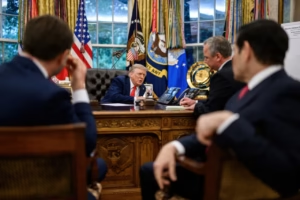
Ukraine's President Volodymyr Zelensky with U.S. President Donald Trump
Ukraine’s President Volodymyr Zelensky with U.S. President Donald Trump

The world instead will see new opportunities to continue to do what it does—harry and harass, undermine a perceived foe’s interests, provoke and prey.

China’s rulers won’t stop their mischief if America declares itself more retiring; they’ll ramp it up. They want to be the most powerful nation in the world, they believe this is their destiny, and there’s one thing standing in their way and it’s America. They’ll poke, prod and try their own adventures. Russia, of course, too. Others.

Only a fool would carelessly aggress in this world, and only a fool would think he could fully withdraw. We are enmeshed in layered financial, security and trade systems; pandemics and cyberterrorism are borderless. You can’t be reflexively “isolationist” or “internationalist” in this world; you have to hit the ball from where it lands.

But you can bring attitudes and ways of operating. Don’t look for trouble, don’t aggress, build bridges where you can. Be peaceable and prudent but have hard eyes. Don’t carry yourself forward into the world with hubris about your grand democratic system; be quietly proud and see to its wholesomeness. Be an example, a beacon. Have humility: We don’t run the world any more than we run life, and we won’t try. Use force sparingly but when used make sure it is annihilative. Keep your military not only peerless but highly professional, so accidents don’t happen. Choose your battles carefully. Know your people. Don’t announce that if Syria uses poison gas that will be crossing a red line, and then when it uses deadly gas slink away saying oh, never mind. President Obama surely thought conservatives would come to his aid and rouse public opinion for a hard line on Syria. But the right had been bruised by Iraq, and Mr. Obama hadn’t noticed. And there must be clarity. World War I broke out because leaders were unclear about their intentions and priorities. Lack of clarity kills.

Know history and be able to act on what you know from it. John F. Kennedy didn’t mean to start a land war in Asia when he sent advisers to Vietnam. But he was up soon for re-election in a country whose great 20th-century pastime after baseball was accusing its presidents of being weak, afraid of the commies, and not standing for freedom. So he sent special forces, helped our allies, and set us on a trajectory toward quagmire. His admirers are sure he would have pulled back when re-elected. We’ll never know.

So much of the history of the world is the history of unintended and unexpected consequences.

Vladimir Putin is a monster of history: We used to call him a junior monster here, but no, he’s full-size. He wants what he wants and will play a long cool game to get it, and if the game gets hot that’s fine with him too. Donald Trump has always liked him because he is drawn to powerful men, dictators, people who can drag their countries around like a robed king in procession flicking his velvet train.

But Mr. Trump has been trying to broker a peace over Ukraine, and Mr. Putin has been jerking him around since January, saying seemingly plausible things that turn out to be just another tactic in the long cool game. Or as Mr. Trump himself said on Wednesday, at his long, live cabinet meeting, “We get a lot of bulls— thrown at us by Putin,” who is “very nice all the time, but it turns out to be meaningless.” Of the war, Mr. Trump recently told the press, “I don’t think he’s looking to stop, and that’s too bad.”

Mr. Trump is renewing U.S. arms shipments to Ukraine, and he is right to do it.

It won’t be good for the world if Mr. Putin winds up taking what he wants of Eastern Europe. Ukraine is a country of courage, ingeniousness and some irritating people, including President Vladimir Zelensky. The video of him getting beaten about the head in the Oval Office in February will always be remembered as an ambush by a glowering Mr. Trump and Vice President JD Vance. I’ve watched it beginning to end half a dozen times. Mr. Zelensky provoked the argument, Mr. Trump tried to deflect it, Mr. Vance opportunistically pounced, and at the end both the Americans piled on. Mr. Zelensky was full of himself, thought he’d press his case before an admiring American media, expected to triumph and didn’t. He overplayed his hand and weakened his position.

But he is a brave man, tough and capable, and his continued resistance to Mr. Putin is good for the world.

If Mr. Putin wins, Eastern Europe will feel directly threatened: “Let’s not kid ourselves, we are all on the Eastern flank now,” said the North Atlantic Treaty Organization’s Secretary General Mark Rutte last month. They will militarize quickly in a new arms race, which will be good for arms makers but no one else. NATO might fall apart or be rendered inoperative, and the world’s rising authoritarians will conclude that the path to greatness is to build an army and take what you want. This will make for a less stable world.

The U.S. will lose more of what remains of its power to deter. Mr. Putin will spend what he likes to restore his military and pick his next target, his ambition not satisfied but stoked. China will be emboldened; Iran, currently licking its wounds, re-inspired. Again, more trouble for the world, including us.

Mr. Trump’s decision isn’t isolationist or internationalist but realistic. The question is whether he sticks with it and it’s enough.

In this decision he again moves against the feelings of his base, or rather its influencers and self-proclaimed leaders. I actually doubt his base, or his 77 million voters, are going to abandon him because he’s changing his approach on Ukraine. Walking away from Ukraine was never fully compatible with a lot of conservatives’ Born Fighting DNA. Mr. Trump has more to lose from Jeffrey Epstein, whose case is an enduring MAGA obsession.

The GOP will have to think its way through all this. “Isolationist,” “interventionist”—those labels don’t seem right for now. The party will have to decide, again, what it’s about on foreign affairs.

It started this century with nation building and snapped back, after its failure, toward isolationism. I wonder if now they’re snapping back, or starting to evolve, into something new, not halfway between isolationism and interventionism but more deeply thought through than those two impulses. Something more dry-eyed.

Trump Seeks Greatness as Mamdani Rises The Iran strikes leave the president bolder than ever. Meanwhile, can New York survive a socialist mayor?

This is how I read Donald Trump now: He’s in the greatness game. He’s already won the other games in politics. He’s established himself as the powerhouse who transformed the nature of a major political party; he’s the colossus who’s changed the direction of politics in other major democracies.

It’s big, but it isn’t all he wants. He wants to be thought of as great, not just powerful but a beneficial force. A great man of history. He wants utter defeat for his foes and critics; he wants history to bow to his brilliance and courage.

President Trump during a press conference at a NATO summit in the Hague

This is a bigger game than the one he played 2015-20. In the beginning he was shocked, bewildered and on some level grateful to become president. He is no longer those things.

He bombed Iran because he thought it was the right move, the ultimately constructive one. But it was also the brave one, the move none of the rest had the guts to make, so Kaboom! He didn’t like TACO—“Trump always chickens out.” So he bombed that too.

He took a big swing, made a big bet, and seems to have left the situation better than it was. The critics: “We don’t know if he stopped the nuclear program or just slowed it!” Either is progress. “Now the enraged Iranian government will be even more set on getting nukes.” They were already set on it, they can’t be made more so. “They’ll assume they’ve been through the worst.” They’re as likely to fear Mr. Trump will come back.

Before the U.S. strike, Iran was seen as formidable, with a dark mystique—hidden, sinister, string-pulling Iran. Now its government looks inept, enfeebled. It had powerful friends and operatives. Who the past week stood at its side? No one was for the mullahs. Now nobody fears them. He blew up their mystique.

Mr. Trump went from bombing Iran to congratulating the North Atlantic Treaty Organization allies when they bowed to his demand they increase their burden-sharing. (I’m guessing he has particular sway with at least some leaders because they see in him the kind of animal they know themselves to be.)

The likely effect on him? He has been emboldened. His confidence and trust in his gut are increased. There will be more boldness, more sparks.

On public support for Mr. Trump’s move: Early polls mean little. Public opinion will be decided by how it all plays out. If six months from now the strike seems to have produced a less menacing Iran in a less violent Mideast, or the Iranian nuclear weapons program was stopped or slowed, it will be seen as a great success. People not only will support it, they’ll say they always did. So too the split in Mr. Trump’s base: Success heals all wounds. If the sentence that comes out of the summer of 2025 is “He bombed Iran and Iran fell,” that is the end of the immediate argument between “isolationists” and “interventionists.” If the sentence is “He bombed Iran and the U.S. paid no price,” ditto. If it is “He bombed Iran, blowback was slow but fierce and the American people felt the pain,” that will be a grave defeat for Mr. Trump.

The story isn’t over, but the Iranians’ response has been tepid and wan. They haven’t caused mayhem on our soil or that of our allies. Were they a paper tiger all along? What happened in their highest councils? Journalism, please get this story.

A thing Mr. Trump doesn’t understand is that regular citizens open to his leadership and willing to judge his actions fairly never feel free to trust or praise him quickly because they fear, rightly, that he’ll do something mad, say things so stupid and destructive they’ll immediately regret their support. So they say nothing. Every time he lies, brags, accuses and acts insane, he undermines his power and jeopardizes his prospects in the greatness game. This won’t change. He’s unable to change it.

*   *   *

We jump now, quickly, to what happened in New York. It reminds me that I’ve always thought Tip O’Neill was misquoted, that what he really said was, “All politics is loco.” In my town this week we showed it.

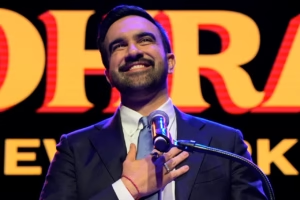
Zohran Mamdani speaking to supporters on the night of the Democratic mayoral primary election in New York

You wouldn’t think that five years after the city almost went down—after the pandemic, after a host of cultural shocks from the Black Lives Matter riots to rises in crime and homelessness, after the financial shocks (working from home means commercial real estate craters), after wealthy New Yorkers began to flee for Florida—after having survived all that and begun to come back, you wouldn’t think that New York would choose as its likely next mayor a 33-year-old who’s never really had a job in what used to be called the private sector, who hails from Manhattan’s elite cultural upper classes, who is charming, bright and warm but an ideologue, an avowed socialist, a radical leftist crusader against Israel even on Oct. 8, 2023 . . .

You just wouldn’t think this would happen. But now you must, for we are the city of dreams, of fantasias, and have our own winsome ways plus a marked tendency toward widespread sociopathy. We invented Donald Trump.

Zohran Mamdani has a Trumpian feel for politics. He doesn’t have a 10-point plan to improve public transportation, he has a vow: Buses will be free. That is his “Drill, baby, drill.” He has a natural and intuitive sense of media as fine as Trump’s but cleverer, funnier, more modern. He TikToked his way up with a fabulous team of video creators who pumped it out to Instagram, conveying a sense of dynamism and life-love. He was a fabulous candidate.

His foes say brace yourself, we have opposition research that will knock his block off. If they had killer oppo, they might have used it before he won the primary. Now his electrified supporters expect and will discount it: “The billionaires will say anything to stop this tribune of the people.” His foes hope they’ll beat him with money. But it’s how you spend money that counts, and there they are naïfs.

It looks like the race will come down, in November, to Mamdani vs. the incumbent, Eric Adams, who is running as an independent. So: Eloquent McDreamy Who’ll Kill the City versus Reigning Bum Who Won’t Destroy New York. I’m not sure who wins a battle of anxiety vs. depression. I’d bet on anxiety. We confuse it with awakeness. It keeps us afloat.

Mr. Mamdani is attractive, has an obvious sense of personal destiny, and is a talker—he loves to say words. There’s a video mash-up of him speaking, over the past few years, with different accents. He’s a hardworking Indian man, a street rapper and then a bright young businessman. At first it seems comic, then like code-switching as political strategy, but when you keep watching the tape it feels . . . somewhat sinister.

Can New York survive him? We always say we’ve survived everything. In this space we’ve long enjoyed quoting Adam Smith to the effect there’s a lot of ruin in a great nation. But after the past five years you have to wonder, has New York reached its ruin limit? We are a funny people, always poking around and trying to find where that limit is.

Iraq’s Shadow Over the Iran Debate Many Republicans felt they’d been fooled in 2003. They are far less trusting of the government today.

The fiery Tucker Carlson interview with Sen. Ted Cruz is the perfect distillation of the split among conservatives on Iran. And that split is all about the unhealed wound of Iraq.

Tucker Carlson interviewing Ted Cruz

Mr. Cruz made his personal case—it seemed to rest on his reading of the Bible—for joining the Israeli action against Iran. Mr. Carlson pushed back. It got pretty personal pretty fast. Mr. Carlson called Mr. Cruz “a sleazy feline,” Mr. Cruz accused Mr. Carlson of “reckless rhetoric.” Mr. Cruz compared Mr. Carlson’s foreign policy to Jimmy Carter’s. Mr. Carlson: “This is one of the weirdest conversations I’ve ever had.”

Everything harked back to the Iraq war. Two parts said it all. The first has been all over social media:

Mr. Carlson: “How many people live in Iran, by the way?

Mr. Cruz: “I don’t know the population.”

Mr. Carlson: “At all?”

Mr. Cruz: “No, I don’t know the population.”

Mr. Carlson: “You don’t know the population of the country you seek to topple? . . . How could you not know that?”

Mr. Cruz: “I don’t sit around memorizing population tables.”

Mr. Carlson: “Well it’s kind of relevant because you’re calling for the overthrow of the government.”

Mr. Carlson challenged Mr. Cruz on the ethnic mix of Iran. Mr. Cruz seemed uncertain.

Mr. Carlson: “You don’t know anything about Iran.”

The second part hasn’t been so noticed.

Mr. Carlson noted Mr. Cruz supports “regime change.” “What does regime change look like in Iran?

Mr. Cruz: “Somebody else in charge.”

Mr. Carlson: “How do you get there?”

Mr. Cruz: “Look, that ultimately has to be a popular uprising from the people.”

Mr. Cruz, a member of the Foreign Relations Committee, was glib, as is his way, and didn’t seem to have thought things through. Mr. Carlson was hectoring and inconsistent. But it was all about Iraq. Mr. Carlson said as much. “I am the product of the last 25 years watching carefully . . . and I see an unending string of foreign policy disasters.” “I feel very stung by what happened in Iraq, if I’m being honest.” He had supported that war, even “promoted” it. “The cost on so many levels” to the U.S. “was just so profound.”

The conversation brought me back to that epochal year 2003 and the lead-up to the Iraq war. The arguing between Republicans was bitter, though it was largely suspended when the war commenced and loyalty to the troops closed ranks. When the war began to go sideways the argument began again and has never been resolved. By 2010 or so Republicans on the ground were saying the war’s originators hadn’t known anything about Iraq, didn’t know a Shiite from a Sunni, it was all bluster. That was the context of Mr. Carlson’s questions to Mr. Cruz: You don’t know anything.

Before Iraq, local Republicans thought, in general, of the government: They know what they’re doing. The White House has more information than the rest of us—spies and overflights and aerial photos. They have expertise we don’t have, they know all about the workings of foreign governments and armies. After Iraq went bad they’d never think that again.

They didn’t just feel their trust had been misplaced, they felt they’d been fooled. There were no weapons of mass destruction; our spies had been taken in by some operator named Curveball. And they’d lost their sons, more than 4,000 of them.

It changed the party’s nature. Iraq and illegal immigration produced the conditions that made Donald Trump possible, then inevitable. Twenty-two years after the beginning of that war it continues to have profound repercussions on American thinking about the world.

One thing I came to conclude about the men and women who put that war together was that they had grown up in such a blessed, prosperous and stable country that they had a false sense of endlessly sunny skies. Personally they hadn’t been unlucky—they were at the top of the pile, had never been losers. They thought good things would follow their good efforts in the same way study had produced honors at college and discipline had produced their professional rise. They didn’t think dark because they’d never known darkness. It was a disadvantage. To make solid decisions at that scale you have to know in your gut that history’s an abattoir and the floors are slippery. The price a government or party pays for being dramatically wrong can have foreign-policy reverberations that last generations.

This is Donald Trump’s first big, immediate and urgent foreign-policy crisis of this term, maybe both. It is a time of real drama. It appears at this writing Mr. Trump has punted or is delaying a decision for two weeks.

Few normal people seem certain their view on a U.S. bombing of the Fordow nuclear installation is the wise one. Will it forestall some future horror? Will it give rise to loss of innocent life, a mess, a quagmire? At this point in the debate what you hear is “then again.” We don’t walk the world looking for monsters to destroy, but then again this is as clear a shot as we’re likely to get, so take it. Then again if the ayatollah falls the guys who replace him may be worse. Then again the death throes of the Iranian regime won’t be pretty.

If Mr. Trump moves boldly and it’s a clear success, he’s a world-class hero. Nobody loves Iran, many want to see it humbled. If he moves boldly and it yields some kind of failure, his own supporters will never feel the same about him. If he doesn’t move boldly and Tehran limps back and in time develops nuclear weapons, he will suffer with some of his base and in the eyes of the world. Presidents try hard to keep themselves from situations in which the political outcomes are so stark. They don’t like those choices—“hero,” “politically dead.”

It feels like an epochal decision because it is. In this space we’re certain of this: Congress should be involved. Reps. Thomas Massie (R., Ky.) and Ro Khanna (D., Calif.) this week introduced a War Powers Resolution to prohibit U.S. forces from engaging in hostilities against Iran without authorization from Congress. The bill will move forward or not, interestingly, in the next two weeks. The White House would be wise to support it. America would be surprised in a positive way to see Mr. Trump, professional upsetter of norms, bow to Congress’s war powers. We are not only a democracy, we are a republic; the legislative branch has a role. Restoring that norm would also shore up the president’s position. If he moves and it’s a success, he’ll still get all the credit, but if he moves and it isn’t, blame will be more dispersed.

Congress should rush to rescue its rightful constitutional role, and take a stand in the war drama as it was elected to do. But for many it’s more pleasant to complain your power has been stripped away and blame the president if things go badly.

There’s little chance it will pass but it would be a good thing if it did. In unstable times it would add a note of stability—of a nation, as opposed to one man, deciding.

America Is Losing Sight of Its Political Culture Trump holds a political rally at an Army base and takes joy in sending troops to L.A. We don’t do that.

I’m going to say something old-fashioned. It’s a thing we used to say a lot but then we got bored with it or it seemed useless. “We don’t do that.” If we don’t say it we’ll forget it, so we have to keep it front of mind.

President Trump this week gave a speech at Fort Bragg, N.C., to mark the 250th anniversary of the U.S. Army. It wasn’t like a commander in chief addressing the troops, it was more like a Trump rally. The president spoke against a backdrop of dozens of young soldiers who appeared highly enthusiastic. It was as if he was enlisting them to join Team Trump. Presidents always want to convey the impression they have a lot of military support, especially with enlisted men, but the political feel to the event was more overt than in the past. “You think this crowd would have showed up for Biden?” The audience booed the idea.

President Trump pumps his fist as he leaves the stage after a speech at Fort Bragg, N.C.The president’s language and imagery were unusually violent. For 250 years American soldiers have “smashed foreign empires . . . toppled tyrants and hunted terrorist savages through the very gates of hell.” Threaten the U.S. and “an American soldier will chase you down, crush you and cast you into oblivion.” Sometimes bragging for others is really patronizing them, and sometimes they don’t notice.

“We only have a country because we first had an army, the army was first,” the president said. No, the Continental Congress came first, authorizing the creation of the Continental Army on June 14, 1775. The next month they chose George Washington to lead it.

The president turned to Los Angeles. “Generations of Army heroes did not shed their blood on distant shores only to watch our country be destroyed by invasion and Third World lawlessness here at home like is happening in California.” “This anarchy will not stand.”

Then to the excellence of his leadership, and to the “big, beautiful bill”: “No tax on tips, think of that.” “Then we had a great election: It was amazing, too big to rig.” “Radical left lunatics.”

He was partisan in the extreme. The troops cheered. Previous presidents knew to be chary with this kind of thing, never to put members of the military in a position where they are pressed or encouraged to show allegiance to one man or party.

We don’t do that. We keep the line clear. In part from a feeling of protectiveness: When you put members of the military in the political crossfire, you lower their stature. People see them as political players, not selfless servants. It depletes the trust in which they’re held.

Earlier in the week the president had sent National Guard troops, and then U.S. Marines, to quell the anti-Immigration and Customs Enforcement lawbreaking in Los Angeles. Naturally in taking such action he’d be at pains to explain his thinking at length, to reassure his fellow citizens that he was doing this solely with the intention of a full restoration of peace to Los Angeles. He’d make clear this isn’t the beginning of, or the regularizing of, a new federal approach to local unrest. There are implications and repercussions to using the national military against Americans on the ground in America.

But there was no such lengthy explanation. The president’s remarks on Los Angeles have been as hot as the Fort Bragg speech. “When they spit, we hit,” he said. That isn’t a warning, it is an excited statement meant to excite: I can’t wait!

We don’t do that. American presidents don’t promise to bloody rioters’ heads. You’re supposed to be reluctant to use force, not eager.

President George H.W. Bush didn’t want to send in the Guard during the 1992 Los Angeles riots. The city had exploded after the acquittal of the four policemen who beat Rodney King. Police were overwhelmed; looting, arson and beatings followed. Sixty-three people were killed, 2,000 injured, 12,000 arrested. The mayor and governor asked for help, and Bush federalized the California National Guard and sent in Marines from Camp Pendleton and soldiers from Fort Ord. The riots began on April 29, and federal troops were getting it under control by May 2. Bush was careful to give a national address explaining his thinking, the facts as he saw them. You do this to show respect for people and their opinions. No one assumed he was taking his action as a first move in some larger, authoritarian plan. Because we knew: We don’t do that.

The president has called a big military parade this weekend in Washington to celebrate the Army’s 250th anniversary. It is also the president’s 79th birthday, and he enjoys parades.

Early plans speak of 6,600 soldiers across at least 11 divisions; 150 military vehicles, including 26 M1 Abrams tanks and 27 Bradley Fighting Vehicles. There will be aircraft and howitzers. It all sounds showy, militaristic and braggadocious, the kind of thing the Soviet Union did in its May Day parades, and North Korea still does.

We don’t do that. We don’t have big military parades with shining, gleaming weapons driven through the streets.

Sometimes I wonder of the people around the president: Do they know we don’t do this? Have they read any history? Are they like Silicon Valley tech bros who think history started with them?

Maybe they’re thinking that in a world full of danger it’s good to let Iran and China and the rest know what we’ve got, how our missiles gleam and our soldiers march. But that is just another form of never having read a book. If they had they’d know not only that this isn’t how we do it, but also that we don’t do it that way for a reason.

You want a real show of strength? You never stoop to impress. We are so big and strong we don’t have to show you. You don’t have to see what we’ve got, Mr. Tinpot Dictator, and we don’t have to tell you, because what we’ve got is so big—the miles of missiles, the best-trained, best-dressed troops, the tanks—that if we showed you it would crack the roadway of Constitution Avenue, the concrete would crumble under the weight of our weaponry. So we’re just going to let you imagine what we’ve got in your dreams, your nightmares.

Swaggering threats, parading your strength—we don’t do that, the other guys do that.

Bonus small history: President Bush had scheduled a trip to L.A. around the time of the ’92 riots, and a plan was being cooked up. He was going to give the Medal of Freedom, for a lifetime of entertaining and informing America, to the great and about-to-retire Johnny Carson. Live, on “The Tonight Show,” and they hoped to keep it a surprise. The riots changed the timing and tone of the trip, and Carson was given the medal in a White House ceremony months later. But what a moment that would have been for America, to see the suave and witty man surprised by an honor like that, on the set of his show, from a grateful president who’d come to deliver it personally.

That’s how we do it.

Republican Sleaze, Democratic Slump A bird’s-eye view of both parties’ struggles as we enter the first summer of the Trump administration.

I want to attempt a sort of bird’s-eye view of both parties as we enter the first summer of the Trump administration. For the Republicans, the headline is moving forward on various Trump policies (immigration, trade, budget) that, in the aggregate, have sparked neither widespread support nor overwhelming alarm. It’s all wait and see. The fate of the budget bill will seriously impact the president’s standing—“Magic Man pulled it off,” or “Whoa, he lost and is hobbled.”

Protestors holding up a sign reading "Stop Crypto Corruption"Underlying all this is an air of unusual corruption. I don’t know of any precedent. Charges of influence peddling, access peddling—$TRUMP coins, real-estate deals in foreign countries, cash for dinners with the president, a pardon process involving big fees for access to those in the president’s orbit, $28 million for the first lady to participate in a biographical documentary, the Trump sons’ plan to open a private club in Washington with a reported $500,000 membership fee—those are only some of the items currently known.

The Journal this week reported major donors to the inauguration benefiting from early government actions. In April the administration put enforcement of the Foreign Corrupt Practices Act on hold, pulling back on cases involving charges of foreign bribery, public corruption, and money laundering. “In some cases the administration is effectively redefining what business conduct constitutes a crime,” the Journal noted.

All this is establishing the character of the administration in a way Americans simply won’t respect over the long term. It will no doubt continue, grow more garish with time, and become a major national scandal.

The Republican Party also looks split on spending. This area tends to become dominated by the new war between Elon Musk and President Trump, which may be more consequential to the administration’s standing than we currently guess. But the fight highlights a policy division that will likely grow.

Until 2016, the GOP had been aligned in agreement: Spending is too high, get it down, if most of the money is in entitlements then go there. But the old agreement was blown up and replaced by the new Trumpian one: Americans on the ground are in trouble, we can’t balance the budget on the backs of workers during rolling cultural and financial crises, leave Medicare and Social Security alone.

But the size, scope and seemingly uncontainable growth of the past quarter-century’s budget deficits and debt are breaking through in some new way and leaving people anxious. The 21st century has been one long fiscal bender, for both parties. The federal budget was in surplus in 2000. In 2008 spending was half a trillion in the red, by 2020 a $3 trillion deficit, which is holding at close to $2 trillion. The national debt was $5.6 trillion in 2000, $9 trillion in 2010, $17 trillion by 2020, and the Congressional Budget Office forecasts it will be almost $30 trillion this year. In a quarter century the public debt quintupled.

A lot went into the making of this—wars, the 2008 financial crisis, the pandemic. But these numbers would give even the most blasé populist national conservative a start. Mr. Trump will likely get his budget bill, but the emerging division won’t be healed by his victory.

Add to this the likelihood of foreign-policy crises in the coming year—at least two of which (Ukraine, Taiwan) could turn grave and immediate—and the Republicans will have many challenges. Their biggest weapon is the figure of Mr. Trump, who retains a hold on the public imagination that will never be fully seen in the polls. The other day, Antoine Massey, one of the 10 prisoners who escaped in last month’s New Orleans jailbreak, made a video from wherever he was holed up asking for support. Mr. Massey then appealed for help in proving his innocence to rappers Lil Wayne and Meek Mill and Mr. Trump. Mr. Massey seemed sincere and trusting in his request. It spoke of a connection between common man and president the likes of which I don’t know we’ve ever quite seen in our national political life.

But for Republicans, everything right now is provisional. And Democrats are in a better position than they think. They’ve been badly damaged by the allegations, obviously true, that they covered up Joe Biden’s decline. It is the biggest political scandal of this century, and it will linger in history: It will be in the first paragraph of Mr. Biden’s obituary.

But as an active, on-the-ground issue its impact will thin out, just as the downsides of the reputation of the administration in power will thicken.

Democrats are doing what parties out of power do, misunderstanding their position and misinterpreting their loss. Much of the Democratic conversation about what to do—learn how to talk to young men, improve local organizing, adapt new communication methods—is off point. The idea of readjusting party attitudes toward the regulatory state to become liberals who want to build things again is constructive, but it isn’t new. Certainly it shouldn’t come with the force of revelation. The dullest conservative businessmen would have told you 40 years ago that regulation that starts in the public interest has a way of growing like kudzu and strangling all possible growth nearby. You have to keep your eye on things . . . .

The Democratic Party is struggling because of issues to which it’s attached and that it hasn’t yet faced, that it somehow can’t face. These are the progressive policies and stands having to do with various cultural obsessions, including identity politics. They need to push away from these things and turn to more traditional economic interests, and sobriety in foreign affairs.

There’s not much sign on a national level they’re doing this.

Sometimes parties go into a long losing streak. They can’t just have one presidential defeat, they have to have a few of them before they change. This was the Democratic Party from 1980 until 1992. They had to lose elections repeatedly to work the unpopular policies out of their system.

That’s what I feel the Democrats are doing now, signaling that they can’t just lose once, they’re gonna need more educatin’.

One thing they have to learn: It isn’t shameful to be popular. It isn’t an embarrassment to hold policies somewhat similar to those of your countrymen. It doesn’t mean you’re craven or unserious or inauthentic. It doesn’t mean you lack guts or are insincere. It means you are capable of feeling respect for those who don’t see the world as you do. It means you are willing to make the compromises that give you a chance at being elected. If you are serious about the purposes of power and about democracy, you would want that.

There are Democratic donors now who have their eyes trained on 2026. A Democratic House is an achievable goal: It’s split almost 50/50 as it is, and midterms famously tend to go against the party in power.

It is likely the Democrats will win the House. But they can do it smart or dumb. Doing it smart means putting money, energy and focus on centrists and moderates who want to reorient the party’s reputation. Doing it dumb would be also backing progressives who, if they make it to Washington, will simply remind people every day why they lean Republican.

Memorial Day and the Best Movies of Our Lives Classic war films remind us that as long as we’re alive in America, we’re all in this together.

On Memorial Day we have a duty to remember. Part of how we remember is through film. Its makers should be thanked for capturing war’s valor and loss.

A scene from ‘The Best Years of Our Lives’ (1946).

World War II got the great movies, scores of them. There are acknowledged classics—“The Bridge on the River Kwai,” directed by David Lean, with a long-uncredited screenplay by the blacklisted Carl Foreman and Michael Wilson. “From Here to Eternity,” from the James Jones novel, directed by Fred Zinnemann. Everyone of a certain age has personal favorites. Among mine, “They Were Expendable,” produced in 1945, directed by John Ford and starring the Duke, John Wayne.

After the 50th anniversary of D-Day there was renewed interest in the Normandy invasion, and 1998 saw “Saving Private Ryan.” I went to its opening day in New York with my friend John Whitehead, who’d been in the first wave at Omaha Beach more than half a century before. As the famous first 20 minutes rolled out, John wordlessly pointed at the screen and didn’t take his hand down. I said “What?” and he said softly, with awe: “That’s exactly what it looked like.” He couldn’t believe all those years later he was seeing it again. Director Steven Spielberg gave John that moment.

Korea, the forgotten war, didn’t get what it deserved. There was one immediate classic, 1954’s “The Bridges at Toko-Ri,” directed by Mark Robson, from a novella by James Michener. The Vietnam era got at least two great films. “The Deer Hunter,” directed by Michael Cimino, was about Pittsburgh-area factory workers who fought that war. (To see it now is to think: That’s the white working-class Trump vote being born.) “Born on the Fourth of July,” directed by Oliver Stone (who also did “Platoon”) deserves rank as a classic. Sooner or later we’ll have to come to terms with Mr. Stone’s greatness as a filmmaker.

Iraq has some great films, “The Hurt Locker” and “American Sniper.” More will likely be made about the Mideast wars as America absorbs all aspects of what happened there.

But I go back to World War II for the movie that best captured veterans returning home. “The Best Years of Our Lives,” from 1946, is a movie with such rich texture it’s like entering a world.

Three men came home from war. On the journey back to fictional Midwestern Boone City, they became friends. Army Sgt. Al Stephenson was an upper-class banker going home to make loans again. Homer Parish was a middle-class sailor who lost his hands in a fire when his ship went down. Fred Derry was a working-class hero who’d experienced a status change as an Air Force captain: Now the dashing officer and gentleman was going back home to the house on the wrong side of the tracks. The movie is about their trying to become normal again, trying to be like what they were in a country that had changed. They hadn’t served limited tours, they’d been over there for the duration.

It was directed by William Wyler, who flew bombing missions in the war while making documentaries for the Air Force, and written by Robert E. Sherwood, the playwright who’d been a speechwriter for Franklin D. Roosevelt. It has one of the most gorgeous and stirring scores in movie history. Its composer, Hugo Friedhofer, studied under Max Steiner, the father of film music.

A famous scene: The three servicemen are just coming back. It’s a long flight home, a lot of stops; they fell asleep overnight in the plexiglass nose turret. As the sun rises, they come awake, the music swells.

Suddenly below they see: Boone City. Meaning: America. Its quiet dignity, its undestroyed buildings. “There’s the golf course!” “People playing golf just as if nothing had ever happened.”

But it has changed: “Hey, that must be the new airport.” “Holy smoke.” The field is full of junked bombers. “What we coulda done with those in ’43.”

The sailor with prosthetic hands was afraid to go home. They all were. They didn’t know how to present their new selves. Who were their wives and kids now?

Another famous scene: Al walks into the fancy apartment building where his family lives, rings the bell. His teenage son answers. Al puts his hand over his mouth to stop the boy shouting his name, shushes his daughter. His wife, Milly, is in the kitchen setting the table for dinner. She calls out: Who’s at the door? No answer. Who’s at the door?! And suddenly she knows, and walks into a long hallway, and she and Al walk toward each other shocked, embarrassed, full of yearning. That’s the scene they used in the commercials on TV in the 1960s. “And tonight, this special presentation . . .”

It came out a year after the war and won the major Academy Awards—best picture, adapted screenplay, actor and original score. Sam Goldwyn, the buccaneer who helped invent Hollywood, saw it as his triumph.

Everyone involved knew they’d done something beautiful. Myrna Loy, who played Milly, said in her memoir, “Being and Becoming,” that it was the best movie she’d ever been in. “Everything about it was right.” Fredric March, who played Al, said it was a privilege to be in it: “This picture tells the truth. That’s why it matters, and why people remember it.” Wyler thought it one of his most meaningful movies because it helped with the great homecoming as it happened.

There’s a subtext of class struggle—the movie literally begins with a portly, golf-playing businessman bumping a weary GI from a flight home. Ayn Rand, a brilliant idiot who had deep insight except into the essence of things, attacked it as anti-capitalist. In the film, Al, back at the bank, had taken to approving loans to veterans with insufficient collateral beyond their character. This was dangerous for investors, Rand said. But it wasn’t anticapitalist, it was pro-goodness, pro-guts.

There’s a scene in a drugstore in which a businessman shows Homer sympathy and then snarls that it’s too bad he lost his hands for nothing. It’s all in the papers, he says, Hitler and the Japs didn’t want to fight us, they just wanted to stop the commies and the Limeys. Homer gets mad and tears the American flag pin from the guy’s lapel. Fred, a soda jerk again, jumps across the counter and decks him. The dialogue—you could hear it on a podcast today.

So a Memorial Day thank you to artists who make movies.

And thank you to American technology. It’s a gift to live in a world where you can think of a movie you fell in love with 60 years ago, and in three taps of a keyboard or clicker see it again, fill your house with that music, those words. What an enrichment of life. You used to have to wait and watch the movie listings, now you go to Amazon Prime. We’re all used to this but shouldn’t forget: Holy smoke.

This movie is great because it reminds you we’re all in this together. We’re all recovering from World War II, or any war, or any era, together.

It is a communal and collective undertaking, being alive in America on any given day. It’s good to be reminded, good to see it can all work out.

Broken Windows at the White House Republicans need to address signs of disorder for their own good and the good of the country.

You know of broken-windows theory. It is the insight, promulgated by the social scientists James Q. Wilson and George Kelling in 1982, that visible signs of disorder, left untended, stimulate further disorder and crime. This was common sense presented with an academic gloss, and is exactly what your grandmother told you: If you don’t replace the window, they’ll think nobody cares. Street criminals will notice. Some night soon they’ll push in the front door and rob a first-floor apartment. The neighborhood will deteriorate, and crime will spread. That is an order of things conservatives instantly recognize because life isn’t abstract to them but real.

GOP ignoring rundown White HouseThere are a lot of broken windows in the Trump administration, and Republicans must start doing what grandma would do. She would not just look away.

We limit ourselves here to questions of personal financial gain from only the past week, as President Trump visited the Mideast.

In the Journal, reporters Annie Linskey, Jacob Gershman and Nancy A. Youseff presented information suggesting the president and his family are blurring the lines between public policy and private profit. Mr. Trump was meeting with leaders of countries where relatives are doing business. Huge Trump-branded apartment towers are going up in Saudi Arabia. An 18-hole golf course is going up in a partnership between Qatar and the Trump Organization. A United Arab Emirates fund invested $2 billion in a Trump-affiliated crypto firm. “Next week, Trump will hold a gala dinner at his golf club in Virginia for the top 220 holders of his meme coin $TRUMP.”

Earlier the Journal reported that sovereign or royal funds from the U.A.E., Saudi Arabia and Qatar “have committed more than $3.5 billion to a private-equity fund run by Jared Kushner, Trump’s son-in-law,” and that “state-backed funds from Qatar and the U.A.E. were major investors in a $6 billion fundraising round” for Elon Musk’s xAI. Mr. Musk sat behind Crown Prince Mohammed bin Salman as the president spoke at a rapturously received speech in Riyadh.

Can all this be right? Fully ethical and legal? Who is watching? Normally it would be the Justice Department and the Federal Bureau of Investigation, but Attorney General Pam Bondi has herself profited handsomely from previous lobbying work for Qatar, and Kash Patel also consulted for profit for that government before becoming FBI director. Democrats might more effectively raise alarms if they hadn’t spent five years looking past influence-peddling allegations regarding Joe Biden’s family.

Other news organizations noted the pricey private club Donald Trump Jr. and others are to open in Washington, where insiders and wealthy individuals can mix beyond the prying eyes of the public.

Tuesday in the Journal, a story by Eliza Collins, Rebecca Ballhaus and Corinne Ramey began: “Bitcoin Jesus was on the hunt for a pardon, and he was willing to pay.” It’s the story of how a wealthy cryptocurrency investor charged with mail fraud and criminal tax evasion is attempting to get a pre-emptive presidential pardon. The reporters described the Trump White House pardon apparatus as “the Wild West.” Those in the president’s “orbit,” including conservative influencers, are being offered “extravagant” monthly retainers.

There’s so much money sloshing through the pipes of this White House. And of course there is the $400 million personal gift from Qatar, a brand new Air Force One. The president has accepted and told reporters it was “just a gesture of good faith” by Qatar. “It’ll go to my library” when he’s done using it, like the plane displayed at the Reagan Library in Simi Valley, Calif.

Actually that Air Force One was used from 1973 to 2001, by every president from Richard Nixon through George W. Bush. It didn’t go on display at the library until 2005, after Reagan died. It wasn’t a gift from a foreign government, and it has been put to no use beyond pleasing kids and parents who get to walk into it and see what a traveling presidency looked like 40 years ago.

Modern Air Force Ones have not only security capabilities but also defense capabilities. Kathleen Clark, an ethics specialist at Washington University of St. Louis law school, told PBS the gift is no boon for taxpayers. The government isn’t “getting the equivalent of Air Force One for free. They’re getting an airplane frame that they will then have to—as you say—strip down and examine” for surveillance devices, then rebuild from the studs. “This is no bargain. It’s not even a corrupt bargain. It’s just corrupt.”

Is all this—the golf course, the investments, the pardons, the plane—normal political piggishness, back scratching and name buying? Is it a mirror image of the heightened piggishness of the Biden era, with the recovery bills full of money for allies and operatives, and the son on the phone to the Big Guy? Or is it of another order?

It is hard to get Trump supporters to feel alarmed at all this, even self-protectively—if the Democrats win the House the 2026, the only subject will be the Qatari plane and the Constitution’s Emoluments Clause. Four months in, the base of the base is still feeling its own special mood of triumphal bitterness: That’ll teach the swamp. They’re enjoying the comeuppance of the Democrats, and the arrival of better policies. They’re justly proud to have a president who actually does things, and is bold. And the Biden era was corrupt, they argue. How touching and antique, how fully RINO to be concerned about forms and traditions that are long gone, and with integrity and the appearance of integrity.

But a growing, miasmic mist of what seems to be corruption and rent-seeking can ruin everything for Mr. Trump’s supporters and obscure other aspects of his efforts.

I mentioned the president’s speech in Riyadh, at the Arab Islamic American Summit. He addressed leaders from more than 50 Muslim-majority countries. It was a striking speech, I think an important one. History is going to notice it. I doubt America did.

Mr. Trump revealed the essential philosophy behind his foreign-policy decisions: He hates war and loves gold. That’s it. To hear it fully, to get near its meaning and debate its sufficiency, you had to step over so much broken glass. “Flying Palace” Violates Emoluments Clause. Sons Enjoy Steep Profits From Trump Presidency.

The practice in the current GOP is to look away from these things. You see policy progress, so you give him a pass. You fear being outside the Washington circle of power, so you give him a pass. You fear being called a squish locally, so a pass.

But scandals, or a scandalous uninterest in the appearance of things, isn’t the price anyone should pay for policy achievements. The price our kids will pay is a degraded, embarrassing and yes, oligarchic government. It will be hard for them to be idealistic and brave with that around their necks.

The only thing the administration fears is the base. That’s the thing that must be kept, the only possible counter. Republicans, be like grandma. See the broken window, insist it be repaired. Or they’ll think nobody cares.

Leo XIV’s Road From Chicago to Rome There’s a deep sweetness to how the Catholics choose their leader, inviting the world.

White smoke. The cardinals moved quickly, after only four or five ballots. Is that a good sign? But the smoke is white, and people came running, and the crowd in St. Peter’s Square burst into sustained cheers, with chanting and then laughing, and the huge ancient bells began to ring.

Newly elected Pope Leo XIV

On the Vatican feed the camera panned the crowd and you could see the flags of all the different countries, and get a sense the whole world was coming, and in spite of myself I felt moved and hopeful because you never know in life, it renews itself, surprising things happen. The crowd was dominated by young people wanting something to follow, something to love. If that isn’t moving—the old church trying to renew itself—then nothing is moving. “Oh let it be a great man,” I thought, so many thought. “Let him cheer the world up.”

As I watched the networks’ live shot of the Vatican balcony, I remembered a conversation with a businessman 28 years ago. He wasn’t interested in religious things, was nominally Protestant but didn’t get a headache about it, and we stood in a friend’s kitchen as John Paul II’s last visit to America played out live on a screen in the background. He kept turning to it. “I don’t know what it is, but when I see him, I get moved,” he said. Many felt that way in those days, and it’s what I hope they’ll feel with the new pope.

I texted around to see if anyone knew anything. Nobody did.

You know, because you are an adult and not a child and have read a bit of history, that maybe the new pontiff will be a nullity, maybe a place-keeper—history has been full of such popes—maybe he’s a good man, maybe a great one, and maybe mischief from day one.

But you know this too: “And I tell you that you are Peter, and on this rock I will build my church, and the gates of hell shall not prevail against it.”

And as dusk approached, the velvet-draped balcony filled and Cardinal Dominique Mamberti proclaimed, “Habemus Papam!” We have a pope.

And he is an American.

And he will be Leo XIV.

And he has a nice smile.

Just before the “habemus” a friend had texted, “I hope it’s a big surprise—someone we’ve never heard of.” Meaning someone we’re not tired of knowing. Very soon afterward he texted, “He’s an American!!”

It has shocked the world, and it has shocked America too. There’s something moving in it, to see this suppleness in the ancient institution, to see its continued ability to surprise. The first American pope in the history of the Catholic Church.

But to those who watch the Vatican closely, the choice of Leo wasn’t a massive surprise. Cardinal Robert Francis Prevost had been on the lists of possible popes since Pope Francis died, and he’d inched up on those lists in the past week. He is an American, age 69, but is probably best understood as an international figure. He was born in Chicago, bred in the suburb of Dolton, attended parochial schools there, was an altar boy, graduated from Villanova University and received his master’s in divinity at Catholic Theological Union in Chicago in 1982. Then off to the world, in a missionary order. Most of his priestly life, with some brief stints in America, has been spent on other continents, in Peru and in Rome. This makes him something new, more a cardinal from the world than a specific place. He was made a cardinal by Pope Francis in 2023 and headed the Vatican office responsible for choosing bishops of the Latin rite. In a conclave this week where many of the cardinals didn’t know each other, they knew him.

He will be the first pope in history to speak English as his native language.

We will find in coming days what the thoughts of the members of the conclave were, and how they chose him. But it isn’t a big jump to assume part of the story is that the Vatican is in grave financial crisis, and the Roman Curia has never faced a boss who is assumed to be versed in the general principles of American management.

What is most important and revealing is the name he took: Pope Leo XIV. The name a pope chooses is a signal, always. I had been hoping he would choose Leo but didn’t expect it.

The two big Leos were Leo the Great and Leo XIII. Leo the Great, whose papacy lasted from 440 to 461, was known for a refined intelligence: He was a diplomat good at stopping trouble. This came in handy when he met, in 452, with Attila the Hun. Attila intended to take and pillage Rome. Leo persuaded him not to, and Rome was spared. In 455 Leo met with a Vandal king and negotiated to save the city’s basilicas and the many taking shelter there. He also battled back against many heresies. He was an especially capable man, was sainted, and is buried not far from St. Peter’s tomb in Rome.

Leo XIII was an equally important character, serving as pope from 1878 to 1903. He saw the church into the 20th century, and his great work was his 1891 encyclical “Rerum Novarum,” which outlined what would become Catholic social teaching, including the rights of workers (fair wages, safe conditions, a right to unionize) while blending it with support for property rights and free enterprise. They called him “the pope of the workers.”

The new Leo’s choice of his name is already considered a subtle continuation of Francis’ general leadership, and I suspect it is, but wonder if it is also more than that: Catholic social teaching is embraced by modern political categories of left, right, and center, and Leo XIV may be signaling respect for the idea of synthesis—you can feel respect for both people and systems, things don’t have to compete, they can go hand in hand.

We’ll see. Onward into history. One of our countrymen has been raised high, a Midwestern boy, a Chicago kid raised to the throne of Peter. Did you ever think you’d see a Yank there? Really?

There are words attributed to Pope Benedict XVI that seem appropriate to the moment. “The keys entrusted to the successor of Peter are his for only a speck of time, and as steward, the pope is not answerable to the here and now.” He can’t solve all the ills of the world. He can only do his very best, with the help of God.

What stays with me after this momentous Thursday of the white smoke is the kindness with which the huge crowd cheered Leo, the encouragement and ready affection they showed. Other great faiths don’t do it this way, don’t present their leaders with everyone cheering and half of them weeping and all of them together in the great square. There’s a deep sweetness to how the Catholics do it, inviting the world. It reminds me of James Joyce, and his definition of the church’s universality: “Here comes everybody.”

When Establishments Fail: Trump’s 100 Days He is what he wanted to be, a world-historic figure, and we have entered a new time. It sounds dangerous.

Donald Trump, an overview:

America continues divided into two groups. One thinks, “He is something that happened to us.” The tone is shocked, still, and bewildered: Did I live in this country all this time and not understand it? The other thinks, “He is something we did.” The tone is pride and, still, surprise: I didn’t know we could seize things back.

He happened because the American political establishment in the 21st century failed, to an epic and shattering degree—two long unwon wars, embarrassing in their execution and humiliating in their ending; the 2008 financial crisis, which no one in charge foresaw or took pains to prevent; a southern border open and overrun; and a destructive cultural revolution that seized the commanding heights of public and private institutions.

After those failures the American people stopped even pretending to respect the political, academic, media, financial and legal establishments. They saw them as self-seekers driven by no protectiveness toward the people at large or sense of responsibility for America. The nation said to its establishments: You’re fired. Mr. Trump, an outsider and rather unique individual, was both their revenge and their last attempt to right things.

This crucial beginning of the story is always in danger of being lost. Mr. Trump is so vivid he always seems the cause of things. But he came from something, and we shouldn’t forget it because it contains a lesson for all time: If you are given power, as establishments are, you must be equal to it; you must be protective, a steward, and care for the people. You can’t be selfish and look only to yourself and your glittering world, which is what our establishments did.

You know what they acted like? The new rich, that old American put-down. No one likes the new rich because they haven’t learned the lesson of the old rich, which is that you have to show responsibility for others. We put this down as “noblesse oblige.” We came to miss the idea of noble obligations.

Among Republicans, a decisive moment in the rebellion was March 18, 2013, when the GOP establishment, searching for the reason their party lost in 2012, announced in its famous “autopsy” that the party must be more liberal in its approach to illegal immigration. “And what rough beast, its hour come round at last . . .” Donald Trump slouched down the escalator a little more than two years later.

Now he has had his first hundred days in his second term. They confirm what we learned in the first administration. He goes too far. He’s a fearless man with bad judgment. He lacks internal calibration. I imagine him with an eager aide. “On this issue, Mr. President, there are two clear choices. We can make history by moving forward 6 inches, in which case we’re guaranteed to secure victory and improve America. Or we can try for 12 inches, but the opposition will be aroused, the battle long and bloody, the outcome uncertain.” Trump looks, blinks. “Twelve is bigger than 6, right? Go 12.”

He doesn’t spy what he can gain, move swiftly (silently!) and gain it. He declares war on all fronts.

He’s Berserk U.S. Grant. Gen. Grant wanted to wear down the enemy, stun them, kill them, use his armies as the steamroller that squashed them. He looked at the big maps, contemplated the field, the terrain, the gettable object (the train junction, the weapons depot) and decided to move or not move, with what divisions. What troops were rested and could get there, where the artillery was and where to place it . . .

Mr. Trump is presented the maps, he commands all forces forward and assumes the chaos will demoralize the foe, they’ll all run for the hills. This is not strategy but lack of strategy.

In many battles we haven’t yet reached the point beyond “they had it coming.” On Mr. Trump’s many fronts—against the universities, the big law firms, the illegal immigrants, old international allies, bureaucrats wasting international aid money, the tariffs, the boys on the girls’ team—he is still largely supported by regular people, who look at his foes and think, “They had it coming.” Which is why his polls, which are going down, are not really so bad. We haven’t yet reached the point of “Whoa, they didn’t have that coming.” We will. And if the tariff effort is a boomeranging disaster we will reach, “Whoa, we didn’t have it coming.” Which will be his danger area.

It is bad for Mr. Trump that he allows or encourages his cabinet members to praise him so fulsomely in public. It’s real “Dear Leader,” “Great Helmsman” stuff. It diminishes them: They look obsequious and frightened. It diminishes him: He needs the lackey’s subservience. From his cabinet secretaries at Wednesday’s meeting to mark the hundred days. “It’s been a momentous hundred days with you at the helm.” “Mr. President, your first hundred days has far exceeded that of any other presidency in this country ever, ever.” It is embarrassing. We let the world see this?

At that meeting Secretary of State Marco Rubio offered the truest summing up of the administration’s actions and intent. “This president inherited 30 years of foreign policy that was built around what was good for the world. In essence, the decisions we made as a government in trade and foreign policy was basically, ‘Is it good for the world? Is it good for the global community?’ And under President Trump, we’re making a foreign policy now that’s ‘Was it good for America?’ ”

Asking if a policy is good for the world is a very good thing, especially in the nuclear age. The administration has alienated allies while not clearly impressing competitors and foes. In the short term our old friends will step warily, in the long term they’ll wish us ill. We are ruining an international reputation that took more than a century to build: that even when wrong our intent was to do good, that we were generous, long-viewed, responsible.

This reputation was a major force in maintaining world peace after 1945. That is a long time, and it is a big thing, whatever arguments in favor, to give up. Especially by those who never showed a deep understanding of what had been its power. Mr. Rubio said the ultimate aim is to make America safer, stronger, and more prosperous. Those are necessary aims that, with creativity, heart and a sense of history, can be achieved without such damage.

Something impressive: The second term is different from the first in that it has a sense of what it’s about. The people in this White House believe in the president. They didn’t in the first term; they thought they were a political accident. This team sees itself as a political decision.

Here is the uneasiness of thoughtful people on all sides who watched things closely the past hundred days. They realize it won’t go back to normal when he is gone. Our politics won’t snap back to the olden days of carefully patrolled constitutional boundaries and expectations of right political behavior. Donald Trump is what he wanted to be, a world-historic figure, and we have entered a new time. It sounds dangerous. This is what it looks like when establishments fail.

What We Need in Pope Francis’ Successor Someone in love with Jesus, with a sense of joy reminiscent of the scholar and poet St. Philip Neri.

Pope Francis’ great contribution was to present the Catholic Church as a lover of all people. He called it “a field hospital after battle,” a refuge and place of repair. It must “go to the peripheries, which are often filled with solitude, sadness, inner wounds and loss of a zest for life.” Many saw in him humility and simplicity. The photo I’ve thought of since his death is from a general audience a few months into his papacy, when he kissed and embraced the man whose head and neck were severely deformed by the tumors of neurofibromatosis. It was beautiful because it was Christlike.

Pope Francis embracing a man with neurofibromatosis in Saint Peter's Square
Pope Francis embracing a man with neurofibromatosis in Saint Peter’s Square

It mattered a great deal that he made clear—he underscored—that if you are in trouble, if you are trapped in circumstances from which there is no escape, if you are living an irregular life, if you have been told you must feel shame and the shame leaves you feeling unworthy, then come in, come in. None are beyond the love of Christ or unwelcome in his church.

It is impossible that message didn’t spread, didn’t enter hearts, didn’t change lives. That he was generally understood, at least in time, to be of the liberal part of the church, gave cheer, after two consecutive conservative papacies, to those in liberalism’s precincts, and a sense of change and vitality to the church itself. Things, if they’re alive, go back and forth.

But if we are in mourning, it is dry-eyed. There is broad appreciation for the man and his efforts but not deep sadness at the end of his papacy. In its dozen years, Francis was often confusing, with striking impulses followed by unexplained silences, with a lack of doctrinal clarity. For me the whole blur culminated in the Synod on Synodality, essentially a conference on having conferences. His liberalism seemed uncertain except when it was aggressive, even belligerent, such as in his suppression of the Latin Mass.

It was my sense when he died that the Vatican was filling a smaller place in the world, that the papacy—damaged by the sexual scandals of the past 40 years, demystified to some degree by Pope Benedict XVI’s 2013 retirement, diminished further by Francis’ blur—had grown weaker, seemed less august and towering. Smart words came from Ross Douthat of the New York Times: Francis, like his predecessors, policed deviations from his authority, “except this time the targets were dissenting conservatives and traditionalists instead of progressives and modernizers.” Conservatives were used to being on the same side as the Vatican—“the last believers in the imperial papacy, the custodians of infallibility’s mystique.” By “stirring more of them to doubt and disobedience,” Francis “kicked away the last major prop supporting a strong papacy.” That is true.

What’s next? I find myself hopeful. When institutions weaken or recede, interesting things (some bad but some good, too) can fill suddenly freed-up space. Power blocs move.

There will soon be a new presence, and possibly a fresh voice. Something good might come this spring, something that wakes us up. “Hope springs eternal in the human heart.” Why shouldn’t it?

A great theme of the 20th- and 21st-century popes was one of grappling with modernity—not, as modernizers said, fighting modernity, resisting it, but encountering it, having a dialogue with it, coming to grips with the church’s responsibilities in the conversation, meeting people where they are. My goodness, enough. It is played out.

The world we live in is lashed by knowledge of the instability of its traditions and institutions, the inadequacy of its governments; it sees artificial intelligence coming and fears machines escaping the control of man; people see unaccountable autocrats lobbing nuclear threats; they worry for their children. More and more I think people know that no one will get through the future without deep faith in God.

The church should go back to the beginning, shift from modernity to eternity, ask the world to train its eye on Christ. Tell it what his mother said at the wedding at Cana: “Do whatever he tells you.”

This is the time for a great teaching pope whose mission is telling the world the meaning of the faith, its history, how it came to its dogma, what it believes and why. How personal faith can come and be won, and what you do to hold on to it. The church must speak to the human heart, which is always hungry.

It would be good if the soon-to-be-chosen pope could be summed up, 20 years from now, on his passing, with these words: The man who was in love with Jesus.

Connected to which: When you’re in love, you are happy. Your happiness shows. It is so important that the next pope radiate something like joy—the joy of knowing there is a God and he is good and he is always with us. Let the world look and think, “He seems happy. He must know something.” Really, they should drop the stricken look.

The coming conclave should keep in mind St. Philip Neri, patron saint of joy, sometimes called even the patron saint of laughing. Born in Florence in the 16th century, lived in Rome. A scholar and poet who studied philosophy, became a priest, founded great holy communities, fought Rome’s corruption but always with good cheer. He loved the arts, loved music. The prostitutes and street urchins to whom he ministered loved him; it wasn’t enough he converted them, he took them for picnics on the lawns of the rich and had musicians play. Rome’s royalty and elites cared for him too. His general approach: leave outward, worldly things alone, reform your own heart, this, heart by heart, leads to external reforms. He kept a distance from ecclesiastical controversies yet was somehow a force in their resolution.

“Cheerfulness strengthens the heart and makes us persevere in a good life,” he said. “The servant of God ought always to be in good spirits.”

There were stories of his lighthearted holiness: A glum young man came to him for spiritual help. Philip told him, “Sadness is no companion for the ones who wants to follow Christ. If you can’t be joyful, at least be ridiculous. God can work with that.”

A parishioner was upset at losing his hair. Did Philip know a remedy? “Be holy, then people will look at your soul and not your scalp.” Someone asked if he could perform a miracle. He said yes, “I just had a conversation with someone and didn’t interrupt them. That’ll do for today.”

He is said once to have walked through the streets of Rome with a basket of oranges on his head, whistling and making faces. He told a friend the reason was he was coming to be known as wise. “I need to remind them—and myself—that I’m not.”

Joy, to him, didn’t counter reverence, it was an expression of it.

Wouldn’t it be great if they chose “the man who was in love with Jesus,” which love brought him transparent personal joy, which he transmitted into the world? The Vatican should shake off the gloom and sideline the Church of Endless Argument.

As the nuns in America used to say, “Christ is coming—look busy.” Bring a boost to this old world.