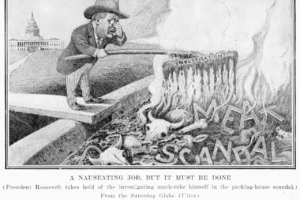
You know of broken-windows theory. It is the insight, promulgated by the social scientists James Q. Wilson and George Kelling in 1982, that visible signs of disorder, left untended, stimulate further disorder and crime. This was common sense presented with an academic gloss, and is exactly what your grandmother told you: If you don’t replace the window, they’ll think nobody cares. Street criminals will notice. Some night soon they’ll push in the front door and rob a first-floor apartment. The neighborhood will deteriorate, and crime will spread. That is an order of things conservatives instantly recognize because life isn’t abstract to them but real.
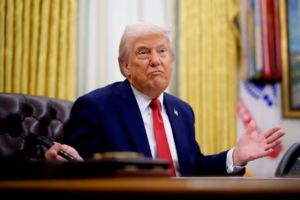
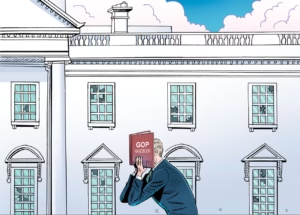 There are a lot of broken windows in the Trump administration, and Republicans must start doing what grandma would do. She would not just look away.
We limit ourselves here to questions of personal financial gain from only the past week, as President Trump visited the Mideast.
In the Journal, reporters Annie Linskey, Jacob Gershman and Nancy A. Youseff presented information suggesting the president and his family are blurring the lines between public policy and private profit. Mr. Trump was meeting with leaders of countries where relatives are doing business. Huge Trump-branded apartment towers are going up in Saudi Arabia. An 18-hole golf course is going up in a partnership between Qatar and the Trump Organization. A United Arab Emirates fund invested $2 billion in a Trump-affiliated crypto firm. “Next week, Trump will hold a gala dinner at his golf club in Virginia for the top 220 holders of his meme coin $TRUMP.”
Earlier the Journal reported that sovereign or royal funds from the U.A.E., Saudi Arabia and Qatar “have committed more than $3.5 billion to a private-equity fund run by Jared Kushner, Trump’s son-in-law,” and that “state-backed funds from Qatar and the U.A.E. were major investors in a $6 billion fundraising round” for Elon Musk’s xAI. Mr. Musk sat behind Crown Prince Mohammed bin Salman as the president spoke at a rapturously received speech in Riyadh.
Can all this be right? Fully ethical and legal? Who is watching? Normally it would be the Justice Department and the Federal Bureau of Investigation, but Attorney General Pam Bondi has herself profited handsomely from previous lobbying work for Qatar, and Kash Patel also consulted for profit for that government before becoming FBI director. Democrats might more effectively raise alarms if they hadn’t spent five years looking past influence-peddling allegations regarding Joe Biden’s family.
Other news organizations noted the pricey private club Donald Trump Jr. and others are to open in Washington, where insiders and wealthy individuals can mix beyond the prying eyes of the public.
Tuesday in the Journal, a story by Eliza Collins, Rebecca Ballhaus and Corinne Ramey began: “Bitcoin Jesus was on the hunt for a pardon, and he was willing to pay.” It’s the story of how a wealthy cryptocurrency investor charged with mail fraud and criminal tax evasion is attempting to get a pre-emptive presidential pardon. The reporters described the Trump White House pardon apparatus as “the Wild West.” Those in the president’s “orbit,” including conservative influencers, are being offered “extravagant” monthly retainers.
There’s so much money sloshing through the pipes of this White House. And of course there is the $400 million personal gift from Qatar, a brand new Air Force One. The president has accepted and told reporters it was “just a gesture of good faith” by Qatar. “It’ll go to my library” when he’s done using it, like the plane displayed at the Reagan Library in Simi Valley, Calif.
Actually that Air Force One was used from 1973 to 2001, by every president from Richard Nixon through George W. Bush. It didn’t go on display at the library until 2005, after Reagan died. It wasn’t a gift from a foreign government, and it has been put to no use beyond pleasing kids and parents who get to walk into it and see what a traveling presidency looked like 40 years ago.
Modern Air Force Ones have not only security capabilities but also defense capabilities. Kathleen Clark, an ethics specialist at Washington University of St. Louis law school, told PBS the gift is no boon for taxpayers. The government isn’t “getting the equivalent of Air Force One for free. They’re getting an airplane frame that they will then have to—as you say—strip down and examine” for surveillance devices, then rebuild from the studs. “This is no bargain. It’s not even a corrupt bargain. It’s just corrupt.”
Is all this—the golf course, the investments, the pardons, the plane—normal political piggishness, back scratching and name buying? Is it a mirror image of the heightened piggishness of the Biden era, with the recovery bills full of money for allies and operatives, and the son on the phone to the Big Guy? Or is it of another order?
It is hard to get Trump supporters to feel alarmed at all this, even self-protectively—if the Democrats win the House the 2026, the only subject will be the Qatari plane and the Constitution’s Emoluments Clause. Four months in, the base of the base is still feeling its own special mood of triumphal bitterness: That’ll teach the swamp. They’re enjoying the comeuppance of the Democrats, and the arrival of better policies. They’re justly proud to have a president who actually does things, and is bold. And the Biden era was corrupt, they argue. How touching and antique, how fully RINO to be concerned about forms and traditions that are long gone, and with integrity and the appearance of integrity.
But a growing, miasmic mist of what seems to be corruption and rent-seeking can ruin everything for Mr. Trump’s supporters and obscure other aspects of his efforts.
I mentioned the president’s speech in Riyadh, at the Arab Islamic American Summit. He addressed leaders from more than 50 Muslim-majority countries. It was a striking speech, I think an important one. History is going to notice it. I doubt America did.
Mr. Trump revealed the essential philosophy behind his foreign-policy decisions: He hates war and loves gold. That’s it. To hear it fully, to get near its meaning and debate its sufficiency, you had to step over so much broken glass. “Flying Palace” Violates Emoluments Clause. Sons Enjoy Steep Profits From Trump Presidency.
The practice in the current GOP is to look away from these things. You see policy progress, so you give him a pass. You fear being outside the Washington circle of power, so you give him a pass. You fear being called a squish locally, so a pass.
But scandals, or a scandalous uninterest in the appearance of things, isn’t the price anyone should pay for policy achievements. The price our kids will pay is a degraded, embarrassing and yes, oligarchic government. It will be hard for them to be idealistic and brave with that around their necks.
The only thing the administration fears is the base. That’s the thing that must be kept, the only possible counter. Republicans, be like grandma. See the broken window, insist it be repaired. Or they’ll think nobody cares.
 His own top staffers look as if he made them afraid in a new way. Fear doesn’t solidify relationships.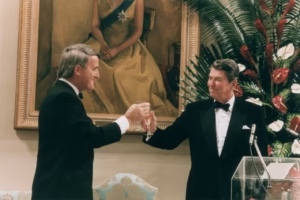
 In August the Soviets erected the Berlin Wall; a year later they put missiles in Cuba. Kennedy’s mastery in the latter crisis, in October 1962, had a reordering effect on his international reputation. Good things followed, including his American University address in which he felt free, having proved himself, having established a more grounded relationship with the Soviet government, to unveil a new plea for nuclear arms control. His speechwriter, the great Ted Sorensen, told me years later that of all the speeches they worked on—the Inaugural Address, the announcement of the missile crisis—the one at American University was the most important.