I would like to point out a simple fact. A major and unnoticed part of Donald Trump’s power is that 100% of Americans know who “the president” is, including children above 5 and nonnative speakers. I base this on personal interactions with strangers of all sorts. Since I made up “100%” because there’s no way to prove it, I will guess at some other numbers I believe to be true. Eighty percent know, in some broad sense, what his policies are, and more than 60% have some sense of an action he took last week: “He fired everybody.”
No modern president has achieved this level of complete cultural saturation. It gives him power in this ill-educated, broken-up, low-attention-span country. You remember “Jaywalking,” Jay Leno’s comedy bit in which he’d ask people on the street, “Who was Abe Lincoln?” (“A singer?”) When was the American Revolution? “Um, 1970?” We haven’t become more historically literate.
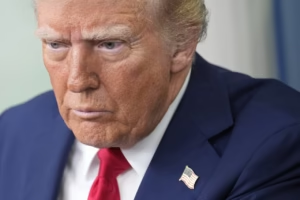 You have to keep this in mind to understand the moment we’re in. Mr. Trump has pierced American consciousness in this way. He has broken through as an instantly recognizable, memeable, cartoonable figure—the hair, the red tie, the mouth—but he also provides, deliberately and not, iconic moments that connect to other iconic moments. The tech barons arrayed behind him as he was sworn in, and the White House meeting hours later in which the president promoted artificial intelligence. As I watched them at the inauguration I abstracted. It was like Elon is passing the solid gold phone to Mark Zuckerberg, who nods and passes it to Jeff Bezos, who passes it to Sam Altman, who marvels at its weight and shine.
That of course is taken from the scene in “The Godfather Part II” in which the American business behemoths sit at a conference table in the palace of Cuban President Fulgencio Batista, as he communicates they’re safe with him because he loves business. Almost every American adult has seen a “Godfather” movie. I believe that as they watch the second Trump administration they occasionally connect it to themes of that great drama. When Mr. Trump fires the inspector general, when ICE gets the illegal-immigrant child molester, when Mr. Trump tries to get rid of the federal workforce—he’s settling all family business. His second term can be understood as an attempt to change his image from Sonny to Michael.
Last week I had four days in Washington with members of both parties, many elected officials. The only subject was Mr. Trump.
Republican lawmakers, including those most supportive of the president, are beside themselves with anxiety. When you speak to them—off the record, between friendly acquaintances—and ask how it’s going, they shift, look off, shrug: You know how it’s going. A GOP senator who supports the president had a blanched look. “He doesn’t do anything to make it easy,” he shrugged.
What is the meaning of the averted eyes and anxious faces? It means Trump 2.0 isn’t better. It means for all the talk of the new professionalism in the Trump operation, they have to get used to the chaos again and ride it, tempting the gods of order and steadiness. After one week they concluded the first administration wasn’t a nervous breakdown and the second isn’t a recovery; instead, again they’re on a ship with a captain in an extended manic phase who never settles into soothing depression.
In a general way, also, there is something big I sensed. Among those who think about foreign affairs and world history, the great story of the past dozen years or so has been the collapse of the postwar international order that created systems and ways of operating whose dynamics and assumptions were clear, predictable, and kept an enduring peace. You can say the fall began when Russia invaded Georgia in 2008 or Ukraine in 2022. Take your pick, it’s over.
I saw a broad and growing sense in Washington that American domestic politics, or at least that part of its politics that comes from Washington, is at a similar inflection point. That the second rise of Donald Trump is a total break with the past—that stable order, healthy expectations, the honoring of a certain old moderation, and strict adherence to form and the law aren’t being “traduced”; they are ending. That something new has begun. People aren’t sure they’re right about this and no one has a name for the big break, but they know we have entered something different—something more emotional, more tribal and visceral.
There is the strong man, and the cult of personality, and the leg-breakers back home who keep the congressional troops in line. In 2017, a lot of people who watch closely and think deeply, thought: We’re having an odd moment, but we’ll snap back into place. Now they are thinking something new has begun. American politics was a broad avenue with opposing lanes for a very long time, at least a century, and now we have turned and are on a different avenue, on a different slope, with different shadows.
There’s a sense we’re living through times we’ll understand only in retrospect. But the collapse of the old international order and the break in America’s old domestic order are shaping this young century.
So far Mr. Trump is governing by executive order. This contributes to the uneasiness. Such orders are legitimate, sometimes necessary. Barack Obama used them heavily—“I’ve got a pen.” Mr. Trump increased their use, Joe Biden more so, and Mr. Trump is turbocharging their use. The heavy use of executive orders makes all politics personal, having to do with the man who orders and signs with a flourish. Making it personal distorts our understanding of what a leader can and should do. Executive orders ignore the branch of government called Congress and work against its authority, its role in the republican drama. They give the impression we are a government of one branch. Doing all this habituates the public to the idea of authoritarianism, of rule by the strongman. We will pick a new caudillo and he will save us with his pen! When you do away with branches and balances you cause trouble.
Has it hurt his popularity? No. People back boldness when they think a lot has gone wrong and needs righting. They’d expect a certain amount of mayhem. And with Mr. Trump, chaos is baked in.
A word to Democrats trying to figure out how to save their party. The most eloquent of them, of course, think the answer is finding the right words. We need to talk more like working people, we need Trump’s touch with popular phrasing.
The answer isn’t to talk but do. Be supple. The Trumpian policies you honestly support—endorse them, join in the credit. If you think violent illegal immigrants should be removed, then back current efforts while standing—firmly, publicly—on the side of peaceful, hardworking families doing no harm and in fact contributing. Admit what your party’s gotten wrong the past 15 years. Don’t be defensive, be humble.
Most of all, make something work. You run nearly every great city in the nation. Make one work—clean it up, control crime, smash corruption, educate the kids.
You want everyone in the country to know who you are? Save a city.