This is how I read Donald Trump now: He’s in the greatness game. He’s already won the other games in politics. He’s established himself as the powerhouse who transformed the nature of a major political party; he’s the colossus who’s changed the direction of politics in other major democracies.
It’s big, but it isn’t all he wants. He wants to be thought of as great, not just powerful but a beneficial force. A great man of history. He wants utter defeat for his foes and critics; he wants history to bow to his brilliance and courage.
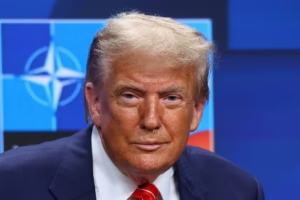
This is a bigger game than the one he played 2015-20. In the beginning he was shocked, bewildered and on some level grateful to become president. He is no longer those things.
He bombed Iran because he thought it was the right move, the ultimately constructive one. But it was also the brave one, the move none of the rest had the guts to make, so Kaboom! He didn’t like TACO—“Trump always chickens out.” So he bombed that too.
He took a big swing, made a big bet, and seems to have left the situation better than it was. The critics: “We don’t know if he stopped the nuclear program or just slowed it!” Either is progress. “Now the enraged Iranian government will be even more set on getting nukes.” They were already set on it, they can’t be made more so. “They’ll assume they’ve been through the worst.” They’re as likely to fear Mr. Trump will come back.
Before the U.S. strike, Iran was seen as formidable, with a dark mystique—hidden, sinister, string-pulling Iran. Now its government looks inept, enfeebled. It had powerful friends and operatives. Who the past week stood at its side? No one was for the mullahs. Now nobody fears them. He blew up their mystique.
Mr. Trump went from bombing Iran to congratulating the North Atlantic Treaty Organization allies when they bowed to his demand they increase their burden-sharing. (I’m guessing he has particular sway with at least some leaders because they see in him the kind of animal they know themselves to be.)
The likely effect on him? He has been emboldened. His confidence and trust in his gut are increased. There will be more boldness, more sparks.
On public support for Mr. Trump’s move: Early polls mean little. Public opinion will be decided by how it all plays out. If six months from now the strike seems to have produced a less menacing Iran in a less violent Mideast, or the Iranian nuclear weapons program was stopped or slowed, it will be seen as a great success. People not only will support it, they’ll say they always did. So too the split in Mr. Trump’s base: Success heals all wounds. If the sentence that comes out of the summer of 2025 is “He bombed Iran and Iran fell,” that is the end of the immediate argument between “isolationists” and “interventionists.” If the sentence is “He bombed Iran and the U.S. paid no price,” ditto. If it is “He bombed Iran, blowback was slow but fierce and the American people felt the pain,” that will be a grave defeat for Mr. Trump.
The story isn’t over, but the Iranians’ response has been tepid and wan. They haven’t caused mayhem on our soil or that of our allies. Were they a paper tiger all along? What happened in their highest councils? Journalism, please get this story.
A thing Mr. Trump doesn’t understand is that regular citizens open to his leadership and willing to judge his actions fairly never feel free to trust or praise him quickly because they fear, rightly, that he’ll do something mad, say things so stupid and destructive they’ll immediately regret their support. So they say nothing. Every time he lies, brags, accuses and acts insane, he undermines his power and jeopardizes his prospects in the greatness game. This won’t change. He’s unable to change it.
* * *
We jump now, quickly, to what happened in New York. It reminds me that I’ve always thought Tip O’Neill was misquoted, that what he really said was, “All politics is loco.” In my town this week we showed it.
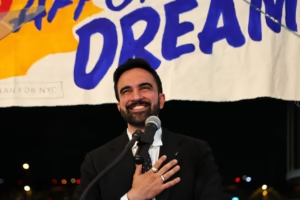
You wouldn’t think that five years after the city almost went down—after the pandemic, after a host of cultural shocks from the Black Lives Matter riots to rises in crime and homelessness, after the financial shocks (working from home means commercial real estate craters), after wealthy New Yorkers began to flee for Florida—after having survived all that and begun to come back, you wouldn’t think that New York would choose as its likely next mayor a 33-year-old who’s never really had a job in what used to be called the private sector, who hails from Manhattan’s elite cultural upper classes, who is charming, bright and warm but an ideologue, an avowed socialist, a radical leftist crusader against Israel even on Oct. 8, 2023 . . .
You just wouldn’t think this would happen. But now you must, for we are the city of dreams, of fantasias, and have our own winsome ways plus a marked tendency toward widespread sociopathy. We invented Donald Trump.
Zohran Mamdani has a Trumpian feel for politics. He doesn’t have a 10-point plan to improve public transportation, he has a vow: Buses will be free. That is his “Drill, baby, drill.” He has a natural and intuitive sense of media as fine as Trump’s but cleverer, funnier, more modern. He TikToked his way up with a fabulous team of video creators who pumped it out to Instagram, conveying a sense of dynamism and life-love. He was a fabulous candidate.
His foes say brace yourself, we have opposition research that will knock his block off. If they had killer oppo, they might have used it before he won the primary. Now his electrified supporters expect and will discount it: “The billionaires will say anything to stop this tribune of the people.” His foes hope they’ll beat him with money. But it’s how you spend money that counts, and there they are naïfs.
It looks like the race will come down, in November, to Mamdani vs. the incumbent, Eric Adams, who is running as an independent. So: Eloquent McDreamy Who’ll Kill the City versus Reigning Bum Who Won’t Destroy New York. I’m not sure who wins a battle of anxiety vs. depression. I’d bet on anxiety. We confuse it with awakeness. It keeps us afloat.
Mr. Mamdani is attractive, has an obvious sense of personal destiny, and is a talker—he loves to say words. There’s a video mash-up of him speaking, over the past few years, with different accents. He’s a hardworking Indian man, a street rapper and then a bright young businessman. At first it seems comic, then like code-switching as political strategy, but when you keep watching the tape it feels . . . somewhat sinister.
Can New York survive him? We always say we’ve survived everything. In this space we’ve long enjoyed quoting Adam Smith to the effect there’s a lot of ruin in a great nation. But after the past five years you have to wonder, has New York reached its ruin limit? We are a funny people, always poking around and trying to find where that limit is.