Some thoughts on a climbdown for the ages.
The reaction was widespread relief in America and the world. Americans want their country to be the world’s growth engine but not, as a former Reagan administration official put it, through policies “that risk the collapse of the global financial system.”
Donald Trump scared people he hadn’t scared before. He didn’t use to scare his policy allies—small-business people, workers, retirees. He did this week. Fear dampens reflexive support. Politicians need reflexive support from the bottom of their base as a platform from which to move. The president weakened his position.
It is hard to see how it helps him with Republicans in Congress. It demonstrated to them that his judgment can be wrong about big things. So he can be wrong about the “big, beautiful bill.”
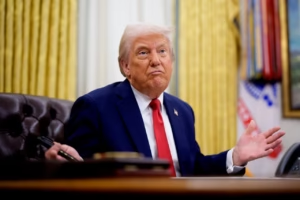 His own top staffers look as if he made them afraid in a new way. Fear doesn’t solidify relationships.
The tariff regime made the world doubt his constructiveness and good faith. It would have been understood if he’d gathered allies and taken a big swing at China. Instead he took a big swing at the world, including China. It damaged America’s credibility.
It wasn’t good to let the world know, or to remind it so vividly, that the way to get America to back off is to tank its bond market. Those bonds, as Zanny Minton Beddoes of the Economist put it, are “the ultimate faith asset.” The world has been reminded they could become the ultimate weak spot.
Administration cheerleaders say the whole drama shows yet again the president will be bold to get what he wants. Who doubted that? What the drama really showed is that Mr. Trump will blink—that when the moment is forced to its crisis, he can back off and climb down. That’s news, and takes the edge of terror off.
Possible good news: Did the American establishment just make a comeback? I think it did. Its name has been mud since the financial crisis of 2008, which it caused or allowed. But in this crisis, business, Wall Street, people in power centers such as journalism—they mounted an opposition that was more impressive for appearing not concerted but a natural organic reaction to destructive policy. An example: JPMorgan Chase CEO Jamie Dimon on Fox Business Wednesday morning said recession was the “likely outcome” of the new regime. The White House heard it. Hedge funders and historians were all over social media.
It is good for America that its business and economic establishments can still be a force for moderation and stability. May they maintain their sobriety. In any case things righted themselves, meaning our righting mechanisms still work.
The president’s overall strategy was never clear beyond “scare everybody.” Mr. Trump puts stock in the madman theory—that a leader gains an edge when foes fear he’ll do something insane. Richard Nixon sent Henry Kissinger out to be reasonable in negotiations, knowing Kissinger, on his direction, was confiding, despairingly, that Nixon might be less so: We’ve got to make a deal, this guy may get out the nukes and bomb Paris!
As China is now the main focus for the next 90 days, something Mr Trump told the Journal editorial board in an October interview seems pertinent. Candidate Trump was asked if he would use military force if China blockaded Taiwan.
“I wouldn’t have to, because [Xi Jinping] respects me and he knows I’m f— crazy. I wouldn’t have to. . . . No. I would do economic.”
Meaning what? “I would tell [him] that if you do this, I’m going to put tariffs on all of your stuff coming in and I’ll slowly, maybe quickly, stop trading with you, and they go bankrupt in two minutes. See, I can do things with tariffs. . . . I would say. ‘If you go into Taiwan, I’m sorry to do this, I’m going to tax you at 150% to 200%.’ ” He might tell China, “ ‘I will put a tariff on everything you send and I’ll even stop trading if you keep it going.’ Because stopping trading is even worse. We’ll go cold turkey.”
According to the White House, as of Thursday the tariff on Chinese imports is 145%.
Mr. Trump’s thoughts on past dealings with Mr. Xi also take on resonance:
“He’s a very fierce person,” Mr. Trump said. “I’m not allowed to say brilliant” because the press will pounce, “but of course he is brilliant.” Mr. Trump said that in his first administration, he imposed “hundreds of billions of tariffs on China” steel dumping. The result? “They stopped dumping steel.” “Hurt my relationship with Xi for about three days, then he realized Trump is smart.” Then China started selling steel through Canada. “Oh, they got more tricks, they got more tricks.”
It is generally thought that China wouldn’t move on Taiwan in a way that demands a U.S. response while trade between the U.S. and China is crucial to China’s well-being. It is reasonable to ask what would restrain Beijing if that trade relationship were blasted to bits. Might Beijing feel a need to present to its people a win as their financial position deteriorates?
* * *
Three closing thoughts:
History arises under many forces and from many causes, but the psychology of leaders has its place. Mr. Trump is a gambler by nature. He places big bets, has all his professional and political life, and the thing about gamblers, as a lifelong player once said, is that all gamblers are looking to lose. They want to win, hope to win, but need the possibility of catastrophic loss to excite them, to keep them interested in life.
Mr. Trump this week placed one of the biggest bets of his life, but it was the world’s money that was in the pot. That was some kind of ugly, reckless thing to do.
The Republican majorities in both houses of Congress have been irresponsible in relinquishing their authority on tariffs to the executive branch. It amounts to an insult to history, and even to themselves. They are a coequal branch of government, and it is their job to protect their own standing. Instead, as Jonathan Martin notes in Politico, they have reduced themselves to “doing color commentary up in the booth.” Gosh, I hope the president is right. They spoke gently of their reservations, acting like “a parent praising a toddler about what a big boy he is in hopes he won’t melt down and ruin dinner.” They should stop this. It’s embarrassing to witness.
A correspondent sent the best idea of the week. In 1993, during the debate over the North American Free Trade Agreement, Vice President Al Gore and Ross Perot, the anti-Nafta business titan, went on CNN’s “Larry King Live” to face off over the issue. It was helpful to democracy, two intelligent people duking it out on a matter of such consequence. Some cable network now should invite Vice President JD Vance and, say, Lawrence Summers to argue their sides on the efficacy of tariffs. Many thinking Americans would tune in for that, and considering public reaction to this week’s drama, there are more thinking Americans than politicians and TV producers imagine.