When I was a teenager my family’s house burned down and every possession but our car was lost. This was in Rutherford, N.J., in 1969 on a Saturday night in May. At some point before midnight a lamp without a shade fell over on a bed upstairs, and a fire started that no one saw or felt until the room was fully engulfed, as the entire house soon would be. My parents had been watching television downstairs. My sister Dorian, 6, was asleep in the bedroom she shared with Patty, 8. Our sister Kathy, 14, came into their room, they remembered this week, and said get up, put on your clothes, the house is on fire. Commotion all around. Patty and Dorian tried to put on the same robe. Dorian remembers the noise, Patty the smoke: “You couldn’t see your hand in front of your face.” They all ran downstairs and out of the house. “I just felt shock,” Dorian said.
They watched the fire from the sidewalk across the street and saw the volunteer firemen rush in.
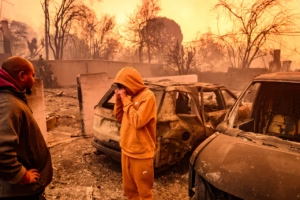 Neighbors took them in for pudding and Jell-O. The next morning they walked through the debris. Dorian found only an old Barbie, singed and bent. Patty remembers the dining-room ceiling was on top of the table, and the basement was a swimming pool.
We were a family of nine, two parents and seven kids ranging in age from 6 to 21, so it was a busy place, a lot of moving parts. The afternoon before the fire I’d gone down the shore with school friends. In those pre-cellphone days no one knew where I was or how to reach me. We returned the morning after the fire. As we pulled up my father stood in the street. He leaned in the car window and said: “The house burned down last night.” I looked—the facade of the first floor was there, but there was nothing behind it.
I too went through the debris. In what remained of my room there were papers and paperbacks in a corner, nothing else.
My parents didn’t know if we had insurance, weren’t sure if they were paid up, and because it was the old days there was no way to find out until Monday morning, when offices opened. They had to wait 36 hours to find out if they’d lost everything. They finally got word—the insurance was included in the mortgage payments, we were OK. But imagine those 36 hours.
To this day we almost never talk about what happened, and if we do we call it “the fire” and not “the time the house burned down.” But all of us find ourselves thinking of it when there’s a terrible story, like California. Because you never get over a fire. It’s serious, it’s sobering. Losing what you have changes you, the precariousness and impermanence of things enters you in a new way.
And it will change California.
If your first thoughts during a catastrophe are political then maybe something in you has gotten too tight and reflexive, but if your thoughts don’t come to include the political then maybe something in you has gotten too unreflective and rote. All disasters have political reverberations. I suspect for California this will in a general way involve a new shift, a reorientation toward reality.
Government, on whatever level, exists first to keep citizens and their property safe. That’s the bottom line: keeping people and what they have in one piece. Safe from fire and from crime, safe within a criminal-justice system that works and protects people. People need an electrical grid that works, a clean water system, sufficient police. It is hard to do these primary and essential things, hard to see to them every day and improve them wherever possible. It takes concentration and focus.
In California as elsewhere ideology has allowed—and encouraged—unrealism about the essential responsibilities of government. It encourages a dispersal of forces and attention. But even though ideology and philosophy are a part of the California story, I want to focus on the practical. California’s political and governing classes have for decades been preoccupied not enough by the primary responsibilities of government and too much by unquantifiable secondary and tertiary issues—world climate change, notions of equity.
Their attention was consumed by the abstract and theoretical, not the concrete and fully present. This is true of all states and cities that don’t work well. It is reflected in their budgeting and staffing decisions.
Citizens must insist governments focus on the primary, essential things.
A one-party state will yield one-party rule that encourages sloth, carelessness and corruption. People on a team cover up for their own. Good government comes from competition. Los Angeles hasn’t elected a Republican mayor in this century. California hasn’t had a Republican governor since 2011. It is a Democratic state. But where there is no competition for excellence in which two parties attempt to gain and keep a good public reputation, there will be no freshness—just the same party drones performing the same tasks founded on the same assumptions, over and over.
You can’t govern successfully for long as a one-party state. I suspect part of the new realism will involve coming to terms with this fact.
The current facts of California were memorably reported this week by Sean McLain, Dan Frosch and Joe Flint of this newspaper. In Altadena, where the lemons hanging from trees look like lumps of coal, where almost 3,000 structures were lost, scores of residents “have defied orders to evacuate, staying behind to protect what is left of their properties from looters and more fires after losing faith in authorities.”
They have lost faith because they are realists: State and local government have proved unequal to the crisis. Residents patrol the streets and question strangers while living in “a Hobbesian world without electricity or clean drinking water.” Some are armed. The authorities may not let them return if they leave, so they arranged for friends to bring them food at checkpoints. Authorities then ordered supplies not be let through.
Nothing speaks of a failure of government like this: that citizens are forced to function as police, and when officials find out someone is doing what they’ve failed to do, they shut it down. It is an unbelievable breakdown in the right order of things.
In Pacific Palisades, according to the Journal, some neighbors hired a private water truck in case buried embers or sparks raining down start another fire. Their effort too was blocked by law-enforcement officials. The citizens were well-connected and called someone who knew the governor to ask the truck be allowed in. Apparently it was. They have been criticized for this online, unjustly. In a time of peril you use everything you have to keep things safe. Too bad the government didn’t.
When you have been through a fire it leaves you determined that things around you be sturdy and grounded. It reminds you that government must be driven by respect for one thing: reality. It must focus its greatest energies not on second- and third-tier issues but primary and essential ones.