The first reigning pope in history to visit the U.S., Pope Paul VI, addressed the General Assembly of the United Nations on Oct. 4, 1965. The Cold War was on, India and Pakistan had just been at war, and in Vietnam the U.S. was shifting to large scale combat deployment. So the pontiff told the U.N. to do its job:
“Was not this the very end for which the United Nations came into existence: to be against war and for peace? Listen to the clear words of a great man who is no longer with us, John Kennedy, who proclaimed four years ago: ‘Mankind must put an end to war, or war will put an end to mankind.’ There is no need for a long talk to proclaim the main purpose of your institution. It is enough to recall that the blood of millions, countless unheard-of sufferings, useless massacres and frightening ruins have sanctioned the agreement that unites you with an oath that ought to change the future history of the world: Never again war, never again war! It is peace, peace, that has to guide the destiny of the nations of all mankind!”
It was electric. This was the sound of uncompromising moral seriousness.
Here is another example of rhetorical leadership at a hard moment: JFK, on Oct. 22, 1962, reporting to America on what would come to be called the Cuban Missile Crisis.
His words were direct, disciplined, spare—nothing loose or unnecessary. The text’s density established its seriousness.
“This government, as promised, has maintained the closest surveillance of the Soviet military buildup on the island of Cuba.” In the past week, “unmistakable evidence” established that a series of offensive missile sites is being prepared. “The purpose of these bases can be none other than to provide a nuclear strike capability against the Western Hemisphere.”
The evidence had been tested, a course of action chosen, and now he felt “obliged to report this new crisis to you in fullest detail.”
So he did. The U.S. had determined the presence of medium-range ballistic missiles capable of carrying a nuclear warhead more than 1,000 nautical miles. “In addition, jet bombers, capable of carrying nuclear weapons, are now being uncrated and assembled in Cuba, while the necessary air bases are being prepared.”
It had been going on for months, the Soviets had lied about it when asked, and America couldn’t accept it “if our courage and our commitments are ever to be trusted again by either friend or foe.”
“Our unswerving objective, therefore, must be to prevent the use of these missiles against this or any other country, and to secure their withdrawal or elimination from the Western Hemisphere.”
Thus the plan: The U.S. was initiating a “strict quarantine” on military equipment being shipped to Cuba. Close surveillance of the island would continue. Should the Soviets continue their installations, “further action will be justified.” U.S. armed forces were ready for “any eventualities.”
“Any nuclear missile launched from Cuba against any nation in the Western Hemisphere” would be seen by the U.S. as “requiring a full retaliatory response upon the Soviet Union.”
He called for an emergency meeting of the U.N. Security Council: “We have no wish to war with the Soviet Union—for we are a peaceful people who desire to live in peace with all other peoples.” But we’d do what needs to be done. “The greatest danger of all would be to do nothing.”
Even I, age 11, understood in a broad way what was being said. Really, we all did: We’d heard the evidence, followed the president’s thinking, chosen to trust his judgment. So he had support.
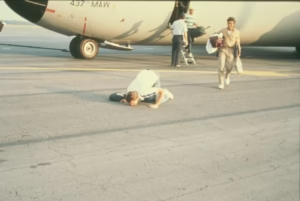
Here is Oct. 25, 1983—a lower-stakes but dramatic moment. President Ronald Reagan informed the nation from the White House Briefing Room that he had ordered U.S. troops to the Caribbean island of Grenada. Like JFK, he was careful to tell the people exactly what he was doing and why.
The democratic government of that small Caribbean island had been toppled in a Marxist coup. There were American citizens there, among them some 700 students attending St. George’s University medical school.
Reagan recounted how the prime minister of Grenada and several members of his government had been murdered. The U.S. had received “urgent” appeals for help from neighboring Caribbean states. “Early this morning, forces from six Caribbean democracies and the United States began a landing or landings on the island of Grenada in the Eastern Caribbean.”
This action was taken for three reasons: to protect American lives, to forestall further chaos, and to help restore democratic institutions. U.S. forces would withdraw as soon as the objectives were achieved. “We want to be out as quickly as possible, because our purpose in being there is only for them . . . to take over their own affairs.”
In another address to the nation a few days later, he admitted the larger context: we couldn’t allow another Cuba. Over the preceding several years, the Soviet Union and Cuba had grown involved in Grenada, building military facilities, providing arms, and building an airfield capable of handling military aircraft.
Reagan’s statements were similar to JFK’s in that they were rhetorically disciplined—no breast beating, no emotionalism, just the facts. Both made clear their actions rested on moral and strategic judgments, not national ambition or aggression.
In the end, 7,000 U.S. troops joined up with Caribbean troops, and in three days they deposed the new government, restored democracy and prevented a new Soviet-Cuban outpost.
Early U.S. press reaction to the endeavor varied from skeptical to hostile, and that might have settled in as public opinion if not for what happened when the rescued medical students returned to South Carolina’s Charleston Air Force Base. When they walked from the military transports, some of them knelt on the tarmac and kissed the ground. One told the Washington Post he’d always been “a dove” but now he wouldn’t hear a word against the U.S. military.
What are we doing here? We’re reminding how it’s done. We’re putting forward what it should look like when a president brings his nation to armed military action. He explains the history, offers the evidence, interprets its meaning, outlines the plan.
You can’t take a nation to war without this rhetorical predicate.
Mr. Trump has failed to provide it. Now and then he announces things behind a podium, and there are regular responses to questions in press gaggles, where he reacts off the cuff. But nothing thought-through, no serious document making the case. And the public is never reassured.
We don’t even know, a month into Iran, why now. Iran has been the world’s fanatic irritant for almost 50 years. What is the plan?
This absence of formal seriousness is part of why the president’s popularity is falling.
If Donald Trump can’t do this, and his vice president can’t do it sincerely, maybe the secretary of state should step in?
* * *
While we’re giving advice, one imagines the Vatican has many excitable monsignors running the pontiff’s social-media accounts, and one suspects they are hyped to show the pope is giving rizz. But homilies, speeches, papers and encyclicals are better suited to great statements at great moments than buzzy posts on X.
Don’t do it the cheap way. You are the throne of Peter. Do it the serious way.