It wasn’t good for Anthony Fauci or anybody else that he took the Fifth at his Senate hearing this week. That plus his diary may well have been a reputation-destroying event.
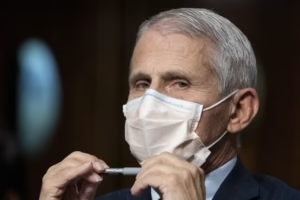
It was obviously his right as a citizen to invoke the protections of the Constitution, and he surely had his reasons, but everyone who takes the Fifth knows what it looks like: It’s the early ’60s, we’re at congressional hearings on la Cosa Nostra, and the head of one of the five families is fiddling with his diamond pinkie ring as he asserts his right not to incriminate himself.
Dr. Fauci is the man who ran the pandemic response in America. He was the face of it. When you have been appointed, in effect, to lead a nation through a disaster you owe that nation a full and frequent accounting. To seem to dodge is unbecoming. He has already been given a sweeping presidential pardon by Joe Biden; in the time after and not covered by that pardon, he owes it to the public to speak truthfully.
It would have been good to hear Dr. Fauci, now 85, distill what the entire pandemic experience was and what it did to us as a society, what could have been done to make its management better, what decisions in retrospect made it worse. Looking back, did he or others, in their newfound ascendancy, get carried away? On reflection, is there any justice to the charge they became power-drunk?
Dr. Fauci’s pandemic diary, released this week, was also damaging. When I heard of its existence, I thought: Good. What history most needs is first-person testimony, the more the better, in real time—if possible.
I thought of Samuel Pepys, a senior government administrator for the British navy in his late 20s and 30s, whose diary gave history the finest first-person reporting on two different cataclysms that hit London, the Great Fire of 1666 and the Great Plague the year before.
Pepys watched the Great Fire from the Tower of London, near where he lived, and came to grasp, with shock, the size and scale of it. In a famous passage on Sept. 2, 1666, he described seeing “poor people staying in their houses as long as till the very fire touched them, and then running into boats, or clambering from one pair of stairs by the water-side to another. And among other things, the poor pigeons, I perceive, were loth to leave their houses, but hovered about the windows and balconys till they were, some of them burned, their wings, and fell down.”
Pepys recorded all the chaos around him. His writing was jagged and real-time. He reported what he’d seen to King Charles II.
He was also an eyewitness to the Great Plague of 1665, which took an estimated 100,000 lives, about a fourth of London’s population, in 18 months. He records empty streets and carts collecting the dead. On June 7, 1665, Pepys passes the homes of the quarantined: “This day, much against my Will, I did in Drury-lane see two or three houses marked with a red cross upon the doors, and ‘Lord have mercy upon us’ writ there.” He was pained and frightened: He’d never seen such a thing.
With this frame, alas, I read the first five months of Dr. Fauci’s pandemic diary.
As has been reported, it isn’t about witnessing or capturing the size and scale of a crisis, or feeling shock or anxiety. It is about other things.
On Jan. 6, 2020, he goes to a “Super A list” party. At a meeting later that month, House Speaker Nancy Pelosi hugs and kisses him and tells everyone “how great I am.” At another, President Trump tells Dr. Fauci, “Lou Dobbs . . . told me that you were one of the smartest, knowledgeable and outstanding persons he knows.” Dr. Fauci was “very pleased,” others “stunned and impressed.”
Jan. 30: “All my friends kept saying I was a national hero” and that they “ ‘felt safe in my arms.’ ”
March 8: “Nice profiles of me in Politico and NY Times today.”
March 15: “I did all 5 Sunday Shows today (my 3rd ‘Fauci 5’).” Apparently this is his version of “the full Ginsburg,” named for Monica Lewinsky’s attorney, William Ginsburg, when he did five Sunday shows in one morning.
March 26: “Donuts are being named after me; T shirts have my picture on them.”
April 7: “Press still hot and heavy about me.”
May 21: “POTUS seems to be enamored of me.”
That’s before he gets to the movie star sending him flowers.
In one sense, it screams Seven Deadly Sins—he gave in to his pride. But it also makes the history in which he took such a big part look banal and inhuman: Your historic emergency is his media opportunity.
A deeper criticism is that in the diary he doesn’t seem at all humbled by the role in which he’s been cast, or by his responsibilities. I saw no deep reflection on the sufferings of his countrymen. He doesn’t see the red crosses on the door. He attaches clippings of or links to fawning newspaper profiles and columns, but not to stories about what was happening in the civilian population of his country as it went through a crisis.
The sweep and detail of Pepys’s diary captures the spirit of his age, the Restoration; let’s hope the flatness and self-adulation of Anthony Fauci’s doesn’t capture ours.
I end with a thought that may sound extreme, but I think there’s some degree of truth in it.
Looking back on the public-leadership aspect of the pandemic—while we were in the trauma and fear of the first months, while we were banging pots at 7 p.m. to thank hospital workers, and scientists were zooming to find out more about treatments and protocols, and earnest medical officials were showing up on cable explaining what they believed to be true—a lot of people tried to do a lot of good things. But it all became pretty political pretty fast, pretty insidery and groupthinky, and pretty smug as the previously obscure became famous overnight.
It all came together and yielded a little societal Chernobyl.
The reactor blew, causing a calamity. The politicians lied and couldn’t be trusted, the bureaucrats lied and couldn’t be trusted, the government scientists lied about the data in front of their eyes, the national press was a propaganda machine. As much as anything, Chernobyl contributed to the toppling of the Soviet Union.
Looking back on the Covid crisis, a lot of professionals were trusted beyond the point they deserved. So were many politicians. As people on the ground in America rose up against lockdowns, closed schools, mask mandates, closed churches, they were often unheard, or heard slowly, reluctantly and disrespectfully. The medical and scientific establishment didn’t seem to be a part of the public anymore, but handling the public.
And by the end, a lot of people thought they couldn’t trust the politicians and couldn’t trust the scientists.
My fear is that next time, and there likely will be a next time, regular people will think: There’s no one to trust. We’re on our own.
That won’t be a good thing.