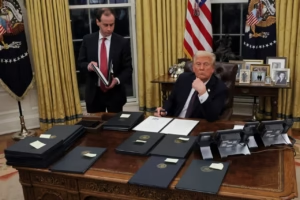
Can Trump Bring Hope, and Biden Wisdom? America needs certain things from the impending farewell speech and Inaugural Address.

Two big speeches are coming up, President-elect Trump’s Inaugural Address on Monday, Jan. 20, and President Biden’s farewell address, expected in the days just preceding.

To Mr. Trump: Turn the page on this historical moment and how people see you.

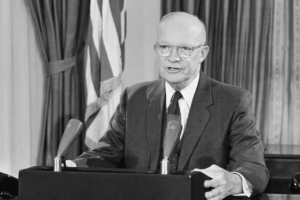
President Dwight Eisenhower delivering his farewell address in 1961

Last time you gave an inaugural address, it was grim and dark. “Mothers and children trapped in poverty in our inner cities; rusted-out factories scattered like tombstones across the landscape of our nation.” American strength and confidence had “disappeared over the horizon.” The “American carnage” must stop. It was stark, and it landed with such a jolt that a startled George W. Bush was widely reported to have turned to Hillary Clinton in the stands and shared his inner literary critic. “That was some weird s—.” It was.

There was a sense conveyed that you were grabbing corrupt political elites by the lapels and naming facts they would never name, facts they had created and actively obscured. But it rattled rather than roused, in part because you were understood to be a reality-TV star who, in some bizarre, psychedelic twist of American fortune, had become president. You are no longer understood that way. You are understood as a political phenomenon putting his mark on an age.

And O God, life is hard enough. People need hope. Five years of the pandemic, its aftermath and angers, of cultural furies, of inflation and endless politics—people feel beat, like they were through something bad and still aren’t sure what it was. Young men and women need to feel, as they enter American history, that they’re part of something rising, not falling. The latent optimism the young always feel—they need to know it’s grounded in something real. Everyone needs to feel we can come back, turn it around, light the world, be the beacon again. “Where we’re going we don’t need roads.” We’re off to Mars, gonna dig that black gold from the ground, Dow’s soaring, we’re the jobs-making machine that’s the family-making machine that’s the envy of the world.

In public appearances you sometimes refer to a “golden age.” Paint it. The country needs a mood shift. Paint a bright future that is achievable—put a name on it, a stamp on it, send it out there.

Your first inauguration was all brass. Make this one gold. Someone who works with you has said, “This is the best possible Trump.” That after almost being shot to death, after having been politically dead, too, and having roared back and risen from the ashes, that after all these near-death experiences followed by triumph, something’s shifted in you. He didn’t say “changed”—Trump doesn’t change—but it’s affected your thinking, attitude, approach.

In the speech that begins your presidency, be the best possible Trump. It will be good for the country.

As for Mr. Biden, presidential farewells are a long tradition stretching back to George Washington and a unique opportunity, while laying down power, to say what you weren’t fully able to say before—to warn, to advise, to explain a problem coming down the pike that we need to think about now. You’re leaving, you’ve got a parting gift, it’s wisdom.

Some farewells have been prophetic. Mr. President, take some time this weekend and read Dwight Eisenhower’s, which was a little masterpiece. He spoke to the nation from the Oval Office on Jan. 17, 1961, and even though he’d been president for eight years and commander of Allied forces in World War II, he spoke briefly—just under 10 minutes—and didn’t brag about anything in his personal or public history. His legacy wasn’t on his mind.

He spoke soberly, in a way that was dry but straight and clear. Each word had a reason for being there. Eisenhower had once drafted speeches for Gen. Douglas MacArthur and knew how to do it.

He called his farewell “a message of leave-taking.” He wished the President-elect John F. Kennedy “godspeed.” He said America was strong—“the most influential and most productive nation in the world.” But we faced a unique challenge in Soviet communism, which he characterized as “global in scope, atheistic in character, ruthless in purpose, and insidious in method.” He implied we’d face that problem a long time.

Now he gave the first of three warnings.

To meet the pressures of the moment, we need “not so much the emotional and transitory sacrifices of crisis” but the ability to move forward “steadily, surely, and without complaint.” For Americans, “there is a recurring temptation to feel that some spectacular and costly action could become the miraculous solution to all current difficulties.” But no, what we have to do is “maintain balance” between conflicting needs and power centers. No matter the pressure, don’t go off half-cocked.

He was warning against a kind of emotionalism in setting public policy. And it was a right warning: in the years since we have become more emotional in our politics, and not necessarily more effective or constructive.

His second warning had to do with the military. It is crucial to keeping peace. “Our arms must be mighty” lest aggressors be tempted. But something important in the military sphere has changed. Before World War II, “the United States had no armaments industry.” When war came, the producers of plowshares learned to make swords. But in the nuclear age, we can no longer risk “emergency improvisation”: “We have been compelled to create a permanent armaments industry of vast proportions.” It worried him. “This conjunction of an immense military establishment and a large arms industry is new in the American experience,” and we have to keep our eye on the implications. “We must guard against the acquisition of unwarranted influence, whether sought or unsought, by the military-industrial complex.” Only an alert citizenry “can compel the proper meshing of the huge industrial and military machinery of defense with our peaceful methods and goals.” We need security, but we can’t sacrifice liberty to get it.

Eisenhower’s third warning had to do with what he recognized as America’s technological advance. It was going forward every day, and with it came the rise of scientific research. The federal government was increasing its role in that area, directing and funding research. He was gravely concerned that with “task forces of scientists in laboratories” and universities receiving government contracts, there would be a “domination of the nation’s scholars by federal employment, project allocations, and the power of money.” “Public policy could itself become the captive of a scientific-technological elite.”

He shared that still-pertinent caution 64 years ago.

Then the 70-year-old man who’d won the war and built the highways on which America sailed thanked the public for the opportunities they had given him “for public service.”

What a speech.

Mr. Biden, be useful. You’ve been observing America up close, as a political figure, for more than half a century. Any wisdom you can give, any unknown problem you can highlight? What trouble is coming that we aren’t seeing?

Don’t brag and insist on your place. Say something deep and true that we need to hear. It will be good for the country.

Signposts on the Wisdom Trail Things I’ve learned from Lincoln, C.S. Lewis, David Foster Wallace, and my friend’s grandmother.

I start the year with some things I know because life and a few geniuses taught me. They’re things often at the back of my mind.

An Italian grandmother was stirring the sauce on the stove as I, age about 10, and my friend, her granddaughter, fantasized about how a local family must be rich, millionaires, they just bought a big car. “Don’t count other people’s money,” the grandmother said. You don’t know all the facts and it’s none of your business. “Don’t catalog other people’s sins.” That came from somebody then, and the spirit was, “You want a catalogue, go to Sears.”

Walking the Wisdom TrailIt never left me when I read Samuel Johnson’s dictum “Men more frequently require to be reminded than informed.” Don’t imagine you’re telling them big things they don’t already know, or sense.
I once read that Abraham Lincoln said if you asked most people to put all their troubles in an open sack and place it down next to their neighbors’ sacks and then everyone was told to pick one up and keep it, most people would hesitate barely a moment before they picked up their own sack and took it home. Everyone thinks they have it worse than everyone else but they don’t, and anyway their own troubles are at least familiar, and tolerable, and theirs.

Public figures often want to be understood. This is a mistake. People don’t want to understand you, they’re ornery. Do your job, that will explain you.

The only truth to tell a young couple about to get married: God is real and babies are everything. The only advice for a college graduate: Honest work makes the world go round, bring your talents to market. The important thing to tell a student entering college or high school: Read.

Reading deepens. Social media keeps you where you are. Reading makes your mind do work. You have to follow the plot, imagine what the ballroom looked like, figure the motivations of the characters—I understand what Gatsby wants! All this makes your brain and soul develop the habit of generous and imaginative thinking. Social media is passive. The pictures, reels and comments demand nothing, develop nothing. They give you sensations, but the sensations never get deeper. Social media gets you stuck in you. Reading is a rocket ship, new worlds.

A century ago in a short story, F. Scott Fitzgerald said the rich are different from you and me. Ernest Hemingway is said to have mocked him: Sure, they have more money. But Fitzgerald’s point wasn’t a romantic one. He said that something in the experience of the rich “makes them soft where we are hard” and hard where we are soft. That’s true, can be unpacked forever, and applies even to our politics. On crime and illegal immigration, the private-school-educated bail-reform scholar or the wealthy donor to nonprofits is soft where we are hard. Crime and chaos can’t hurt the rich the way they hurt others. Money changes people because it changes experience.

A paraphrase of C.S. Lewis: Empires rise and fall, great nations come and go, but the man who poured your coffee this morning is immortal, because his soul is immortal. That is a world-altering thought and one that, if you keep it in the center of your mind, will modify how you treat others.

Clichéd phrases endure for a reason. Don’t be embarrassed by them. The other night a big-brained writer texted to tell me about a packed theater as the movie neared its end. “You could’ve heard a pin drop.” Some genius made that up centuries ago, and people still use it because it says it all.

A professionally successful artist told me how he handles invitations and requests for his time. He put a Post-it on his phone: “Do I have to? Do I want to?” Is it a matter of personal or professional obligation? Would the event be a source of joy or pleasure? If either is yes, then yes. If neither, no. Oscar Hammerstein said you can’t let the nice people of the world engage in a conspiracy that keeps you from doing what you should be doing and do well.

We all assume “the professionals” are taking care of things and deep down fear they aren’t. My eyes tell me we’re suffering a decline of professionalism pretty much across the board—in our ability to execute, to keep systems up and going, even to look and act the part. We should respect our fear more here.

The key to surviving the 21st century will be religious faith—you won’t get through it without it—and situational awareness. Always know where the exit is.

From a journalist friend this week: “You are never sorry you took a walk.” Another writer told me a few weeks ago of his New England Yankee mother, who believed there are no problems that aren’t made at least slightly better by a long walk, and none that are made worse.

People listen impatiently these days. Maybe it’s the cumulative effect of the media-interview culture of the past 50 years, which convinced people you look bright and in command if you interrupt; maybe the scrolling of the present has left us less able to hear something more sustained. Whatever the cause, don’t take it personally. We’re all being taught not to take in calmly and absorb.

Often people trying to tell you something use too many words, or jam in extraneous information, or forget their point as they take side trips. A genius, in conversation, will make many edifying digressions. Most people aren’t geniuses. A story is the Mississippi River. Don’t wander off and get caught in the tributaries. Stay on the river.

“Nothing is written.” This is from Robert Bolt’s screenplay of “Lawrence of Arabia,” in which he urges Ali not to be fatalistic—nothing is predetermined, human effort can change things. You have agency; you were given a brain for a reason. Whatever you can do, or dream you can, begin it, / Boldness has genius, power and magic in it. That’s a loose translation of Goethe.

We pay too much attention to our emotions now. They are important, part of our human makeup, but at some point in the 20th century we got the balance wrong. We inspected our feelings endlessly and considered their meaning, their origin. Now I would say pay greater attention to thinking, your own and others’. When someone tells you what he really thinks—his undefended, not normally offered thoughts—that is true intimacy. What people really think and why, that’s the true heart of things.

A man in his early 80s told my friend, who was his psychotherapist, that what he really wanted to do was learn Italian, but that’s absurd, he’ll likely be dead in 10 years, what would he do with it? The therapist said, “Well, you can die knowing Italian or die not knowing Italian. Which is better?” So the old man studied Italian, happily. It’s never too late. On a piece of paper above my computer is a quote from David Foster Wallace: “Good writing isn’t a science, it’s an art, and the horizon is infinite. You can always get better.”

Go forward this year, whatever your field, like an artist.

The President Who Wasn’t There What we’re learning about the Biden White House is reminiscent of Woodrow and Edith Bolling Wilson.

We button up the astounding year with the scandal of 2024, which won’t take on its true size and historical significance until some time passes. Its facts—who did what, starting when, how it worked—will be fully reported not by journalists but by historians.

The story is the decline of Joe Biden’s mental acuity, a word we use because it sounds both clinical and polite, and by which we mean the president has been in apparent cognitive decline for some years, perhaps since before taking office, and wasn’t fully up to the job. His family and friends, top White House staff and other administration officials covered it up. Some no doubt thought his presidency was good for the country and some, perhaps, good for them.

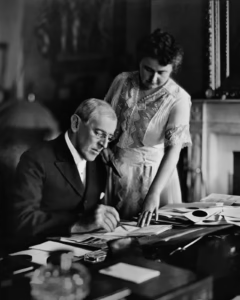
President Woodrow Wilson and Edith Bolling Wilson going over papers at his desk

In a front-page story this month, the Journal’s Annie Linskey, Rebecca Ballhaus, Emily Glazer and Siobhan Hughes spoke to nearly 50 people in and around the presidency and outlined how the White House adapted to the needs of “a diminished leader.” He met infrequently with cabinet members and congressional leaders, and the president’s staff seemed to be running things. This system “insulated him from the scrutiny of the American public.”

The whole thing came crashing down on June 27, during the presidential debate in which the country finally saw what those in the White House saw every day: Mr. Biden had lost more than a step. He was too old to function as a fully engaged and hands-on president.

This resurrected the story of Woodrow Wilson, who in 1919, almost three years into his second term, was incapacitated by what was likely a series of strokes. His wife and top aides misled the public as to his condition, which forever colored Wilson’s legacy and darkened the historical reputation of First Lady Edith Bolling Wilson.

The historian A. Scott Berg is among the biographers who trace the conspiracy to suppress accurate information to Mrs. Wilson. In his judicious and comprehensive “Wilson,” published in 2013, Mr. Berg writes that she failed to acknowledge that during the president’s illness “she executed the physical and most of the mental duties of the office.” She “enshrouded the Presidency in as much secrecy as possible.” Some of those around her assumed duties the president had once performed himself. The president grew depressed, his thinking “faintly delusional.” Some of his actions were “highly questionable.” American foreign policy grew rudderless.

Mrs. Wilson told it differently in “My Memoir,” published in 1939. The president, she reports, developed severe headaches while barnstorming the country in late September 1919 to build public support for the Versailles Treaty and the League of Nations. One night, on the train to Denver, the pain became unbearable. (It is on this journey he might have suffered a mild stroke or strokes.) The press was told he was under the weather; the presidential party raced back to Washington. In the White House, an urgent message came from an agent of the British government: he had important information for the president. Mrs. Wilson said he wasn’t feeling well, she’d take the information and tell it to the president, and later she would make his response available.

And so it began. On the morning of Oct. 2, the president collapsed unconscious in the bathroom. He’d had an ischemic stroke, a blood clot in the brain. “For days life hung in the balance,” Mrs. Wilson writes. She doesn’t say she informed the vice president. When she thought her husband out of danger she asked doctors whether he should continue as president. “Many people, among them some I had counted as friends, have written of my overwhelming ambition to act as President.” No, she says, she pressed doctors for an assessment “so as to be honest with the people.” The doctors, she writes, “all said that as the brain was as clear as ever, . . . there was every reason to think recovery possible.”

He’d need complete rest. He must be released from every disturbing problem. She says she noted that presidents by definition face disturbing problems. She puts responsibility for what followed on Francis Dercum of Philadelphia, a neurologist. She quotes him: “Madam, it is a grave situation but I think you can solve it. Have everything come to you; weigh the importance of each matter, and see if it is possible by consultation with the respective heads of the Departments to solve them without the guidance of your husband.” She says she pushed back: Shouldn’t the president resign and get “the complete rest that is so vital to his life”?

No, says the stout Dr. Dercum. “For Mr. Wilson to resign would have a bad effect on the country.” Also on his recovery: he lived for his mission. “As his mind is clear as crystal he can still do more with even a maimed body than any one else.” The president had surely discussed public affairs with her, the doctor said. She’ll be good at it.

She was quick to take his guidance. “So began my stewardship.” She studied every paper, report, communiqué, translated them into “tabloid form,” decided which should go to the president. “I, myself, never made a single decision regarding the disposition of public affairs.” (Interesting use of commas.) She decided “what was important and what was not.” The president, she says, gave her verbal replies, and she would take care of “transmitting his views” to cabinet members and lawmakers.

She closed the house and grounds to the public. She was with the president when an official was allowed in so there would be no “misunderstanding” on what was said. But a “whispering campaign” fanned by enemies never stopped. The Wilsons departed the White House on Inauguration Day, March 4, 1921. (Mrs. Wilson found Florence Harding loud and highly rouged.) Woodrow Wilson lived another three years, but the Wilsons’ historical reputation was never the same.

Nor will the Bidens’ be.

I end speculating on why the Biden White House and those close to them might have felt justified in misleading the public about the president’s true state. It isn’t only “Trump,” and “Biden’s the only one who can unite the party and beat him.” It was Ronald Reagan. It is Democratic Party gospel, their deep belief, that Reagan while president, certainly in the last years of his presidency, was neurologically damaged, that his Alzheimer’s had already begun, that he was an old man of 77 who was barely there.

Here I ask those reading online to hit on this link to Reagan’s last news conference as president. For those not online, it’s available at the Reagan Library site. Watch it.

That news conference took place on Dec. 8, 1988, six weeks before he left office. It was live, in prime time, wide-ranging, and covered the world. Compare it with what you have seen of Mr. Biden the past few years.

Political parties, like people, must beware the stories they tell themselves, the stories they weave and come to believe that just are not true. The not-true ones can get you in terrible trouble, especially the ones you use to justify your actions and that make poor personal motives seem noble.

What Is Your Attitude Toward Trump 2.0? His first victory felt like something that happened, This one was a decision. A lot depends on the confirmation hearings.

I closed the year with a book tour that ends as Christmas comes. It was sheer pleasure to talk to journalists about their preoccupations, to go to bookstores and signings and meet readers and hear what’s on their minds. When asked why I wrote the book I’d say it was because I wanted to give a second life to columns that gave me special pleasure in the writing or subject matter. But many questions reflected the political moment we’re in, and often circled back to Donald Trump.

Which was the more important election, 2016 or 2024?

Bookshelf on a writing deskAbsolutely ’24, and it felt that way even on election night. It felt fateful. The 2016 election was a Hail Mary pass, voters didn’t know if he’d catch it, weren’t even sure he knew where the end zone was. Mr. Trump had a presidency, it ended with “stop the steal” and 1/6, he was gone for four years, and finished. Then the voters take the field in ’24 and call exactly the same play, throw the long ball, but this time they know exactly who the receiver is, how he’ll catch it, how he’ll run and in what direction. Twenty sixteen always felt like something that happened. Twenty twenty-four was a decision.

Is Mr. Trump an irrevocable break with the past?

He isn’t the old-style president who allows you to say to the kids, “I’d like you to be like that man.” Jimmy Carter with his personal rectitude, Ronald Reagan and George H.W. Bush with their virtues—Mr. Trump is a break with that, and the way he spoke when he first announced in 2015 made it clear. When he spoke of Mexican immigrants as criminals and rapists, “and some, I assume, are good people,” which is a very Trumpian formulation, I thought, that’s not how presidents talk, you have to be measured, thoughtful, kindly.

I thought: That’s bad. But my sister and uncle thought it was good. They understood what he was saying and why he was saying it, they agreed with him, but they also knew he couldn’t walk it back. He couldn’t be elected and then say, “Oh, I changed my mind, on second thought we need more illegal immigration.” They felt the crudeness of his language meant that he was actually telling them the truth. It was a relief to them. “Forget eloquence, close the border!” They felt if the right policy requires a brute, get the brute.

Could a Lincoln become president today, a Reagan?

Our current politics came from extremity. Things this century seemed so extreme—the wide open borders, DEI, boys on the girls’ team. The American people would love it if in the future their top candidates classed the joint up. Mr. Trump and his generation of political followers came from broken politics and a broken culture and things not working. With all that breakage, politics got outlandish. The American people would love to see the return of a certain kind of elegance and dignity. But things would have to get more settled down first, more regular and normal.

What do you expect from Trump 2.0? Nonstop 24/7 Hellzapoppin.

What would be your advice to Republican senators in the cabinet confirmation battles?

Take it seriously. It isn’t about short term loyalty to MAGA, it’s about life-and-death appointment to such critical American agencies as defense, intelligence and health. Senators would best show loyalty to Mr. Trump by voting down those who are unsuited to various roles and would cause harm. They would best serve him by operating in a way that shows they are people of stature, not vassals. Urge him to find assistant-secretary jobs for some of those who don’t deserve confirmation.

Mr. Trump should show his new cool and calm by doing what he did when Matt Gaetz was forced to step down from his nomination: accept it as if it were nothing. He took his shot, it didn’t work, he offered a better replacement, next. In the end he looked good. But Republican senators must approach the hearings with gravity because, again, they’re life-and-death appointments. If Mr. Trump is making a mistake save him from it, as a friend would.

Advice for Democratic senators?

The confirmation hearings will be the first time people see you since the November defeat, after which you got drunk and hid behind rocks. Now you’re out in the open again, in clean shirts and leaning into a mic. You think you’ve got a bonanza—all these rich targets, all these sketchy nominees! You hope to carpet-bomb Pete Hegseth, Tulsi Gabbard, Robert F. Kennedy Jr. That would be a mistake. You’ll look obstructionist, vengeful, merely partisan. The country won’t be in the mood for it. Democrats too should be cool. Draw the nominees out with respect, get a real handle on their views, bring the research and receipts. Accept who you can, giving due deference to a new president. But again, life and death. Be serious.

The biggest threat to the coming administration? “We have a huge mandate, we can do anything!” They’re high on their own supply. It was a mandate, not an overwhelming one—popular vote carried, narrowly, both houses of Congress won. But we’re a 50/50 country, and claiming otherwise doesn’t make you look bold, it makes you look cruisin’ for a bruisin’. They are going to make bad mistakes here. They’re making them.

What’s a helpful attitude going forward?

Trump supporters should shock themselves with magnanimity. Victors should grow taller, not smaller. They shouldn’t act like losers—truculent, resentful. If that’s how you act, everyone else will think you’re just losers at heart, losers who won’t last. Accept not triumphing in some of the confirmation battles, some of those battles deserve to be lost, and if they’re not they’ll come around and bite you later, badly.

For Mr. Trump’s opposition, if you believe in democracy you accept with as much good grace as you can muster—and after more than two centuries of this you ought to be able to muster a lot—the decision the people have made. If you’re an American you wish America to prosper, and part of its prospering will involve successful presidential leadership, so you want Mr. Trump to be successful. In the Catholic faith you take a moment during Mass to pray for leaders at home and abroad. It has to be sincere when you say it or you’re messing with God. Don’t do that.

If you’re an opinion columnist you should watch for what’s good and say so, watch for what’s bad and say that, and be afraid of neither observation. If you lose your temper, lose it; if you find yourself unexpectedly moved, admit it. Keep your tools, compass and gyroscope, clean, dry and level.

Are you an optimist?

Optimists tend to think the right, nice thing will happen, and I don’t necessarily. But I have faith and I have hope. Life takes guts. Don’t let all the bad news enter you and steal your peace. Keep the large things in your head. Two millennia ago a baby was born and the whole ridiculous story—the virgin, the husband, the stable, the star—is true, and changed the world. Compared to which our current concerns are nothing.

Biden Gets Lost in Trump’s Shadow The president-elect acts as if he’s already in charge. There’s never been a transition like this before.

Like Donald Trump or dislike him, hate him or love him, doesn’t matter: You have to see that what we are witnessing right now is truly remarkable, with no precedent.

He is essentially functioning as the sitting president. In the past, a man was elected and sat in his house, met with potential cabinet members, and courteously, carefully kept out of the news except to make a statement announcing a new nominee. The incumbent was president until Inauguration Day. That’s the way it was even in 2016; Barack Obama was still seen as president after Mr. Trump was elected. All that has changed.

Mr. Trump is the locus of all eyes. He goes to Europe for the opening of Notre-Dame. “The protocols they put in place for his arrival were those of a sitting president, not an incoming one,” a Trump loyalist and former staffer said by phone. He holds formal meetings with Volodymyr Zelensky and Emmanuel Macron. There he is chatting on a couch with Prince William. Why not the prime minister? Because the British know Mr. Trump is enchanted by royalty and doesn’t want to be with some grubby Labour pol. Mr. Trump talks of new tariffs on Canada, and Prime Minister Justin Trudeau rushes down to Mar-a-Lago. After their meeting, Mr. Trump refers to him, on Truth Social, as “governor” of “the Great State of Canada.” (The Babylon Bee follows up with a headline: “Trump Tells Trudeau He Won’t Annex Canada if They Admit Their Bacon Is Just Ham.”)

The government of Syria suddenly falls and the world turns to America for its stand. Naturally it comes, quickly, from Donald Trump. “THIS IS NOT OUR FIGHT. . . . DO NOT GET INVOLVED!” The next day, Joe Biden characterizes the moment as one of “risk and uncertainty” for the region. Was there ever a moment that wasn’t one of risk and uncertainty for the region?

Mr. Trump tells Vladimir Putin that now that he’s abandoned Syria, he should make a deal to end the war in Ukraine. “I know Vladimir well. This is his time to act. China can help. The world is waiting!”

Mr. Trump’s cabinet picks—especially the highly questionable ones!—dominate the discourse in a country that hardly ever notices a cabinet nomination below that of secretary of state. His representatives, most famously Elon Musk, are greeted on Capitol Hill with a rapture comparable to past visits by heroic leaders of allied nations.

Donald Trump hasn’t overshadowed Joe Biden; he has eclipsed him. A former senior official in Mr. Trump’s first term told NBC News a few days ago that Mr. Trump “is already basically running things, and he’s not even president yet.”

To some degree the status shift is expected. Mr. Trump is the future, Mr. Biden the past; Mr. Trump wide-awake, Mr. Biden sleepy. The 46th president is a worn tire, the tread soft and indistinct. With the pardon of his son he lost stature. Also, Mr. Trump makes other leaders nervous, as he enjoys pointing out. They can neither predict him nor imitate him, so they can’t take their eyes off him. And Mr. Biden’s been rocked by something he knew in the abstract that’s become all too particular: after 50 years at the center of public life he’s been dropped, cast aside, because it was about power all along, and not about him.

A president, however, still has the machinery—the National Security Council, the State Department, the nuclear football. I can hardly believe our biggest adversaries don’t capitalize on this split presidency, this confusion. For all our woes you sometimes forget what a lucky country we are.

Volodymyr Zelensky, Emmanuel Macron and Donald Trump after their meeting in Paris

Here I mention a part of the amazing interregnum that I think is important, one that his friends and staffers speak of. Mr. Trump is calmer and more confident than he has been in the past. It is a commonplace to say that his surviving a shooting—that a bullet came within an inch or so of his brain—would change anyone, even a man in his eighth decade, even a man with fairly brittle ingrained views, even Donald Trump. But all of his friends go back to this as they speak of the Trump they’re seeing now. They think it took time for it to be absorbed and settle in. They see him as at least presenting himself in an altered way.

The former staffer said by phone, “Right now he is extremely relaxed.” It isn’t only the assassination attempt. “Everyone thought he was gonna change in a way that would be normal for most people to change—an outward reflection, more humble. I laugh when people say, ‘Normally, a president would—.’ Don’t use ‘normal’ with him.”

But, he said, after the second assassination attempt was thwarted, at Mr. Trump’s golf course, it had real impact. “Trump began to recognize, not in an unappreciative way but in a reality way, that he’d been spared. It gave him a stronger sense of confidence, some extra level of relaxation and of determination. He feels the American people are in trouble and if he can be a small part of fixing that, he must.”

The former staffer said Mr. Trump feels that “this wasn’t an election, it was a vindication.” The court cases, the indictments, the impeachments—“all these things against Donald Trump, and he doesn’t just come back, he roars back in a way that defies logic, reason and history. Few can fathom this.” He meant the history, but also its effect on Mr. Trump.

Something else, he said. When Mr. Trump was elected in 2016, his policy priorities and intentions weren’t fully clear. They are now, and have been popularized. “He knows the mission he laid out to the people—sane border policy, unleash energy, monetize ‘the liquid gold,’ make the tax cuts permanent—there’s an air of confidence about his mission now, and an understanding of the systems in place.” He is living something few get to live: “If I could do it all over again.”

A different observer, who’s seen Mr. Trump up close, said this week, “This is the best version of Donald Trump we will see.”

Back to the former staffer: “The gravity of this historic moment cannot be overstated. He has a level of swagger, a new level. People say, ‘Can I get the policy without the personality?’ No, you need a certain level of ‘I don’t give a damn.’ If you think he had it the first time, Katy bar the door.”

He had a prediction: “This has the potential to be historic in a way that only a handful of administrations have been. We remember some administrations with a level of history-altering moments. This one’s gonna have a lot.”

What about the potential for wrongdoing, such as using government to suppress or abuse foes? “He’s said a million times his revenge is going to be success. When Trump wins, he lets bygones be bygones.”

He paused. “Some of the people he’s hired aren’t that way, so there’s a chance some people may take it upon themselves to do some stuff. I don’t know.”

A Bipartisan Slippage in Standards Biden’s pardon of Hunter is as disconcerting as Trump’s more exotic administration nominees.

We’re seeing bipartisan slippage of standards.

It is embarrassing as a citizen to see the president of the United States pardon his son, and in such an all-encompassing way, for any legal transgression going back nearly 11 years, which feels like a concession to the assumption that his more interesting law-stretching or -breaking may be yet unknown. The president had promised frequently and explicitly that he wouldn’t pardon his son, that he’d play it straight and let the course of justice play out. Which means he knew it was important to people, to how they viewed him, and so he lied to reassure them. All this did what others have said: lowered trust in political leaders, made the cynical more cynical.

The nature of Hunter Biden’s bad actions is famous in the public mind because it involves videotaped depictions of decadent behavior—guns, drugs and sex, all memorialized by him and stored on his famous laptop. It became an emblem of the assumption that the elites of our nation, the people pulling the strings, are wholly decadent—dope-smoking lowlifes, abusers of others. It’s looking very Late Rome among our leadership class. Anyway, by pardoning his son the president makes himself look part of all that.

The pardon struck me as a bitter action, too. A president who cared about public opinion, or even that of his own party, wouldn’t have done it, or quite this way. It’s the president flipping the bird to an ungrateful (and also rather decadent!) nation that coldly turned on him after a single debate, and then elected that tramp Donald Trump—they deserve what they get.

Will the pardon, as some of the president’s friends say, be forgotten tomorrow? No. People still remember Bill Clinton’s late-night pardon of Marc Rich for tax evasion, wire fraud and other charges. People who like Mr. Biden and those who dislike him will always end the telling of his political story with “And then at the end he pardons his son!”

What an act of disrespect.

As to the Politico report that the White House is considering pre-emptive pardons for officials not yet even accused or convicted of breaking the law, wow. If that is true it makes you wonder. What have our leaders been up to the past four years that they require such unprecedented forgiveness? Even with fears of a vengeful Trump Justice Department, pre-emptive pardons are an excessive move.

Now to the incoming administration’s slippage of standards, the exotic cabinet picks that veer from “that’s a stretch” to “that’s insane.” The more exotic nominees—Robert F. Kennedy Jr. at Health and Human Services, Pete Hegseth at Defense, Kash Patel at the Federal Bureau of Investigation, Mehmet Oz at Medicare and Medicaid Services—don’t have backgrounds that fit the jobs. Taken together they look like people who want to blow things up.

It is one thing to look at the huge and sprawling federal government and figure out what parts need most urgently to be to be reformed and remade. The Pentagon, for instance, can’t pass an audit; no one is sure of procurement, of exactly what weapons are needed for the future; and on top of that young men don’t want to join anymore, and when they do, many can’t pass the physical and educational requirements. The Defense Department is in an ongoing crisis—as usual. So you could focus there.

But these nominees seem as if they want a demolition derby everywhere. That isn’t a plan for progress but a recipe for unproductive chaos—nonstop, systemwide, all agencies involved.

Mr. Hegseth vowed in these pages to fight on, but his nomination looks at the moment in greatest peril. His nomination by Mr. Trump was careless and could be interpreted as an act of contempt for government itself. But if it is true that the backup choice might be Florida Gov. Ron DeSantis—well, that would be brilliant. Mr. DeSantis is a brick wall; he knows how to execute, having been the successful chief executive of a major state; no one would think he doesn’t mean it when he says he opposes woke ways and regulations; and the Pentagon would be more inclined to fear him than roll him.

Also it would make Mr. Trump look generous to a vanquished foe and honestly alive to his talents. That would be refreshing.

Too many of the Trump nominees have said, one way or another, that they intend to take out the deep state, but they should start explaining exactly what they mean. The deep state isn’t really a conservative insight, and it isn’t a new one; Oliver Stone felt free to make movies about how the CIA killed John F. Kennedy 30 years ago. JFK himself thought the intelligence agencies and military brass jammed him into the Bay of Pigs. If you have a highly professionalized federal workforce of millions of people, and a score of agencies that hold huge power, you are going to build up over the years with levels and layers of entrenched mischief, with lifers and time-servers and career officials hoping to keep or create a status quo that benefits their agencies, or themselves.

It isn’t new. All modern democracies have them. J. Edgar Hoover was the deep state. He was appointed 100 years ago by Calvin Coolidge. “The building always wins” isn’t quite as true in Washington as “the house always wins” is in Vegas, but it’s close. The thing is to manage the mess by picking strong, seasoned, experienced people to lead the agencies, not hotheads but cool hands. Blow everything up and you’ll just wind up surrounded by debris.

It is strange for President-elect Trump to put forward such nominees in a party he really won and unified only in the past 12 months. Each sitting Republican senator has struggled his way through home-state party divisions over “Trump” or “Not Trump” to get elected. Now they’ll face explosive confirmation battles and have to pick their way through the question of how many crazy nominees they can reject without starting a destructive war with their own brand new White House. Two? Messrs. Hegseth and Patel? What about Tulsi Gabbard?

Senate Democrats may think they have a bonanza coming with all the explosive confirmation hearings, but it may not be that simple. They should probably keep one word in mind: backlash. Like the one that followed the past year’s court cases against Mr. Trump. Beating up nominee after nominee in hearing after hearing will leave some of the public thinking the Democrats are embarked on mere obstructionism, partisans shooting down every nominee for merely partisan reasons. Mr. Trump’s foes have a way of overreaching. It has turned out to be lucky for him. Democrats will have to choose their targets, too.

Which means some wholly unqualified people will likely get through. I guess that’s the ultimate strategic purpose of flooding the zone.

All this feels crazier than it has to.

America Has Much to Be Thankful For We are a great democratic republic, we have been through a lot, and we are still the hope of the world.

By the time Donald Trump is inaugurated president on Jan. 20, 2025, a lot of people will think he’s already been president for a year. All eyes, every day, have been on Mar-a-Lago, from which have come a constant barrage of appointments, some good, some half-mad, a few promising electrifying confirmation hearings. But that is a future story.

What am I grateful for now? I’ve felt the past few weeks how I often feel after reading the history of a war: “Well, we got through that.” We got through a contentious brawl of an election in one piece. The result was accepted by all. We’re not fighting it out in court. You can say this only happened because Mr. Trump won—if he’d lost he’d be protesting and unleashing legal challenges—and that is surely true. But democracy is in part a matter of habit and expectation, and a nation full of kids and young people just saw us model, as in the old days, how to do it. You send in your ballot or line up at the polls and then they count the votes and declare the winner. The young, after this election, will more easily believe that it still works here. They’ll bring that feeling into the future, which will be good.

President Joe Biden meeting with President-elect Donald Trump

I am grateful to see the outcome was so peacefully received. That peace is not only exhaustion. Absorbing the big news has involved thoughtfulness and reflection, or so I have observed.

I am grateful we aren’t complacent, bored, and dying of ennui. We aren’t only stuck to our screens, we are a politically engaged nation. We go to rallies and sign petitions, cheer on political figures and invest in them through donations. We may have grown more decadent in our entertainments, but we haven’t checked out. Is that a small thing to be thankful for? Yes, and I’m thankful for it.

I continue to feel thankful we’re split but not shattered. We’re more or less a 50-50 nation, with two big parties that, however they fail us, and they do, most people find themselves able to fit themselves into. This speaks of a certain stability.

I am more thankful every day for the legal immigrants to America, the many, many millions who gained citizenship after standing in line and filling out papers and meeting the requirements. I think they’ve had a balancing effect on our politics. They came here to join a country that lived in their imaginations—truth, justice, and the American way. They have put all their chips on us. They don’t want us to become absurd, corrupt, unreliable like the nations they left. I just sense they’re more protective of us than we are of ourselves—they don’t want us to waste ourselves or be torn apart. Keep your pride and keep what’s good, all the freedoms we came for. Their children will be senators. They’re bringing a lot of love to the game.

I find myself grateful that while the national winners, the Republican Party, can fairly claim a mandate—carrying both houses of Congress and the popular vote, winning in the battleground states—it is still, yet, a modest one. The margins in Congress are real but not overwhelming, the battleground states were close, the popular vote at time of writing, with some votes still being counted, is 76,883,434 for Mr. Trump and 74,406,431 for Kamala Harris. There’s something touching and impressive in the specificity there, if you needed to be reminded that every vote counts. But what we’re looking at is a clear, close margin—49.96% to 48.35%. Even with an ultimately insufficient presidential candidate, the Democrats got almost half the votes. They’re not over, but they’re wobbling, and the things they stand for aren’t popular and don’t deserve to be.

Republicans are feeling good, and should, but the age of the 20th-century landslide is long gone; it’s always a close-run thing now.

If the Democrats continue to think their problem is one of communications only, they have more losses coming. They do have a communications problem—too many of them, certainly their activists, seem to be talking down to people. But their primary problem isn’t communications, it’s content. Most of my life, regular people on the street could describe what the Democratic Party stands for. They’re for the little guy, for generous spending, and, since the 1960s and up until the 9/11 era, were antiwar. All that territory has been stolen by the Republican Party of Donald Trump. Without those issues, the Democrats appear reduced to the party that aligns with woke, and the teachers unions. That isn’t enough, not popular enough, not pertinent to ongoing crises.

They will have to find out what they believe in and stand for. They’ll likely have to have the fight they’ve been prudently dodging the past dozen years, between moderate centrists and progressives. Somebody’s going to have to win that battle.

As for the Republicans, this would be the perfect time, while the camera’s on the GOP, for some friendly persuasion, and reaching toward potential friends and waverers.

Victors always want to be bold, because boldness shows strength and impresses people. But there is a line between bold and delusional. This isn’t time to frighten the horses. That’s what the appointment of the harebrained Rep. Matt Gaetz to head the Justice Department did, and Mar-a-Lago is lucky they had enough friends in the Republican Senate to stop it.

I suspect most people are enthused about the idea of the Department of Government Efficiency to be headed up by Elon Musk and Vivek Ramaswamy. It’s the kind of thing that catches the imagination. Mr. Musk is a genius and visionary, Mr. Ramaswamey appears to be an activist with energy, and a mind full of certainties. But Mr. Musk is also an unusual fellow, unique, and Mr. Ramaswamy has zero experience in the federal government.

I’m glad they think outside the box, but the box still exists, and for reasons. If your eyes have been at all open the past quarter-century, you know the administrative state is huge, largely unaccountable, and consists at least in part of levels of waste and sloth built on previous levels of redundancy and nonsense. Federal workers the past four years have, amazingly, made themselves look unnecessary by not bothering to show up at the office, and working at home. But some federal workers are the best we have—brilliant, unheralded, doing life-and-death work, making the wheels turn.

Real reformers have to be sophisticated, orderly, unshowy. They need internal allies.

Messrs. Musk and Ramaswamy are daring and theatrical. I’d worry that early on they’ll start running around with axes, making big pronouncements, chopping holes through doors, and putting their heads through the holes and saying, “Heeeere’s . . . Johnny!’

Progress isn’t re-enacting “The Shining.” May they be steady.

And back to our beginning. If you believe in democracy, in our democratic republic, you accept, with as much peace as you can muster, democratic outcomes. You do this out of respect for America—for those who invented it and spun it into motion—and out of respect for your fellow citizens, who’ve made a decision. We just did that. And happy 161st Thanksgiving to the great and fabled nation that is still, this day, the hope of the world.

Trump Keeps Trolling as the ‘Resistance’ Fades Defense Secretary Pete Hegseth? Attorney General Matt Gaetz? He can’t be serious, can he? Meanwhile, Democrats look for new ways to cope.

The first wave of nominees to the Trump administration announced this week included normal Republicans—Susie Wiles as chief of staff, Elise Stefanik as ambassador to the United Nations, Lee Zeldin at the Environmental Protection Agency, Marco Rubio as secretary of state. All are grown-up players who have political histories that preceded Donald Trump and became fully MAGA.

But the second wave—it is impossible to tell if Mr. Trump is announcing appointments or trolling his enemies. Pete Hegseth as defense secretary? This is unserious and deeply alarming. He is a decorated military veteran with Ivy League degrees, but he has no serious governmental or managerial experience, no history of international accomplishment. The Pentagon is a mammoth bureaucracy overseeing almost three million employees, including those in the military services. The defense secretary is a world leader: If North Korea launched a nuclear missile, he would be in the room with the president, advising and counseling. In the past 10 years Mr. Hegseth has made his living as a breakfast TV host and culture warrior. This isn’t the right fit. At this point in his life, Mr. Hegseth, 44, lacks the stature and depth required of the role.

President Elect Donald J. TrumpAs for Matt Gaetz being nominated as attorney general—well, this is just straight-out trolling, right? The four-term Florida congressman has won a reputation as disruptive, divisive, aggressive, lacking in groundedness and wisdom, and dogged by ethics allegations. He seems to see politics as an offshoot of showbiz and has entertained his followers with successive attempts to take down GOP leaders in the House, on behalf of—well, it’s never quite clear. This we need in America’s top law-enforcement official?

The choice obviously isn’t meant to reassure anyone outside the MAGA base—or even those within it who are intelligent. It is an insolent appointment, guaranteed to cause trouble and meant to cause friction.

We are back to the Island of Misfit Toys. What a mistake. Mr. Trump often confuses his own antic malice for daring, his own unseriousness for boldness. How amazing that in the rosy glow of election, he will spend so much political capital and goodwill on confirmation fights he may well, and certainly deserves to, lose.

I turn now to the Democrats. Here is some advice to the party that I consider to be all wrong. It is from Elizabeth Warren in Time magazine and was published two days after the election. Her advice to her party: Back to the Future. Go back to “mass mobilization”—peaceful protests—to recharge “the resistance.” Step up oversight of Mr. Trump’s “corruption and abuses of power.” “Slow down confirmation and expose Republican extremism.” Searching for the middle ground is foolish. “Uniting against Trump’s legislative agenda is good politics because it is good policy.”

It is also a recipe for unending clash and political theater—Resistance Part II, take it to the streets. In the shock of 2016 it made sense that his opposition make itself heard, encourage itself, see itself. But a repeat isn’t in line with the mood of the country, which now isn’t electrified by politics but exhausted by it. And in some funny way demonstrations especially would make the Democratic Party look weaker. As if it has no other moves. As if it’s trying to avoid something, a sober look inward, and trying to cover it up by chanting.

It looks to me as if the rising argument in the party is for a left-wing populism, but it’s not certain what that would look like. Ms. Warren said the system is “rigged,” giant corporations get tax breaks and billionaires pay nothing. The job of the Democratic Party is to “unrig the economy.”

A few days later, in a Twitter thread, Sen. Chris Murphy of Connecticut said, “Time to rebuild the left.” “We are beyond small fixes.” The economic policies of the past 50 years have left places hollowed out. “Rapacious profit seeking” destroyed “the common good.” Unchecked new technologies were allowed to “separate and isolate us.” In response, the left has offered only “uninspiring solutions.” “The right regularly picks fights with elites—Hollywood, higher ed, etc.” Why doesn’t the left fight with billionaires and corporations? “Real economic populism” should be the Democrats’ purpose. But it must change its ways: “Our tent is too small.” Don’t keep out those who don’t agree on every social issue. “Build a big tent. Be less judgmental.” It tells you a lot about the party’s problems that that last part had to be said.

As to the resistance, Conor Friedersdorf in the Atlantic offered what seemed to me wisdom. After 2016, “a large faction of Americans declined to treat Trump as a president with democratic legitimacy.” He’d lost the popular vote, invited foreign actors to interfere in the election. “So they fancied themselves members of the ‘resistance,’ or waged lawfare, or urged the invocation of the Twenty-Fifth Amendment. Immediately after Trump’s inauguration, liberal groups started to push for his impeachment and removal from office.”

Now Mr. Trump returns under different circumstances. He received some three million more votes than Kamala Harris. “No one believes that a foreign nation was responsible for his victory. . . . No one alleges illegality in this campaign.” A 2016-style resistance to Trump is “untenable.”

“As a Never Trump voter who thought January 6 was disqualifying but who respects the results of this election,” Mr. Friedersdorf writes, “I urge this from fellow Trump skeptics: Stop indulging the fantasy that outrage, social stigma, language policing, a special counsel, the Twenty-Fifth Amendment, or impeachment will disappear him. And stop talking as if normal political opposition is capitulation.”

“Unaligned Americans who don’t even like Trump are tired of being browbeaten for not hating him enough.” If voters have made a terrible mistake, “that’s a risk of democracy, so we must live with it.” Mr. Friedersdorf himself doubts Mr. Trump’s character, judgment and respect for the Constitution. He fears recklessness in some areas and cruelty in others. What he urges toward Mr. Trump is in line with our past: “normal political opposition,” which is “more likely to yield good civic results.” “Our constitutional and civic checks on executive power are formidable, frustrating every administration.”

“Until 2028, normal checks can constrain Trump.”

These are wise words.

I close with this. People say they fear authoritarianism from Mr. Trump, latent or overt fascism, a reign of intolerance. My fears are in the area of foreign policy. Mr. Trump no doubt believes he’s ready for a major foreign crisis, but he’s never had one. I mean not something like the pandemic, a crisis with foreign-affairs aspects that rolled out over a matter of months and years, but a sharp and immediate crisis, a big and crucial one. He tends to think foreign affairs comes down to personal relationships, but it doesn’t. Xi Jinping, “Little Rocket Man”—he had them all wary in his first term. Who is this guy? Better not push him. But now they know him—how he operates, what he wants.

He isn’t a mystery to them anymore. He isn’t a mystery to anyone. That will have some impact on things going forward.

A Triumph for Trump’s Republicans America, after its long journey through the 2010s and ’20s, is becoming more conservative again.

It is worth being moved that in our huge, restive, cynical and yearning nation we peacefully, and with complete public acceptance of the outcome, made a dramatic national judgment this week. Just about every adult citizen took part and took it seriously. All together they produced something we needed: a clear outcome, one delivered without charges of large-scale chicanery or even small-scale so far as we know. There will be a peaceful transfer of power. A lot of people had to do a lot of things right to make this happen.

Trump supporters celebrating his victoryIt was a triumph for the Republican Party—a sweep, a rout—and a disaster for the Democrats. Much has been written about the demographic facts but when a single candidate increases his totals in almost every group but one, white women, something big happened. Donald Trump will likely receive a majority of the popular vote—the first Republican to do so since 2004. Republicans handily won the Senate and appear poised to take the House. This amounts to a legitimately claimed mandate.

Mr. Trump’s is the biggest political comeback since Richard Nixon, whose career flat-lined in embarrassment in 1962, after a failed gubernatorial race and stumbling news conference—“You won’t have Nixon to kick around anymore”—only to roar back to the presidency in 1968. It isn’t enough said that Mr. Trump did this while enduring a shooting, a second, thwarted assassination attempt, and credible intelligence reports that Iran was trying to kill him. He went into all his rallies knowing that. He showed a lot of guts. Mass media didn’t dwell on this, but regular people did.

As for Kamala Harris, Mr. Trump in 2020 lost the Catholic vote. This year he carried it with a healthy 56%. That’ll teach her to blow off the Al Smith dinner.

What did it all mean? The people did what they wished. They revolted. They looked at the past four years of Washington and said no. They said “Goodbye to all that,” to the years 2020-24—to the pandemic, to the pain and damage of that era, which affected every part of our lives. That is the real turning of the page I think, from a time they hated that made them view their government as bullying and not that bright. In terms of issues it was illegal immigration, inflation and a rejection of the deterioration all around them—of drugstores locking up the shampoo and the beleaguered Walgreens employee late with the key to the cabinet and in a bad mood because he’s afraid of thieves and crazy people and it’s wearing him down. It was the woke regime, which people have come to experience as an invading force in their lives. It was Afghanistan, and other wars, and the sense Washington isn’t getting foreign policy right and perhaps barely thinking about it. They just seem to be staggering through each day. The country’s been waiting for years to hear from its leaders: What are America’s interests?

In September, pondering the race, I wrote: “This will be a path election, not a person election.” Once we chose a shining John F. Kennedy, who would choose the path. You chose dazzling Ronald Reagan, and he’d cut a path through the forest. This year I felt people would be choosing a path, not a person. “And I’m not sure they want to go down the Blue Path any deeper than they already have.”

I think that’s what happened. Tens of millions of people who didn’t like Donald Trump voted for the path he promised.

America, after its long journey through the 2010s and ’20s, is becoming more conservative again.

This was all much bigger than “what Kamala Harris got wrong.” We know what she got wrong. She was a poor candidate chosen in mysterious circumstances who, like her running mate, was a strong regional and local talent but not a national one. She was a California progressive who came to be perceived as such.

The Democratic Party just took it full in the face—rejected and rebuked. That party needs an intellectual autopsy, an audit of its beliefs; it needs a rising moderating force such as the Democratic Leadership Council of the 1980s and ’90s, which got the party off McGovernism and its losses and on to Clintonism and its victories.

What are the Democrats? What’s that party for? When I was a kid they were the party of the working man, the little guy. That’s the Trumpian GOP now. When I was a young woman they were the antiwar party. That’s the Trumpian GOP. The party of generous spending? The Trumpian party says hold my beer. What belief do the Democrats hold that distinguishes them? LGBTQ, woke, gender theory, teachers unions, higher taxes? Why not throw in cholera and chlamydia?

The party has lost its specific character and nature; it’s no longer a thing you can name. Democrats have to sit down with a yellow legal pad and figure themselves out. All defeat carries a gift: You get to figure out what you’re getting wrong.

As for the Republicans, we always feel now we’re picking a government to manage our decline. But when Mr. Trump met with the Journal’s editors last month, he spoke for a moment with excitement about how America “can be so rich and so successful.” He described watching the arms come out and catch the SpaceX rocket. “It was good old Elon. It was him, he’s amazing.”

That chord he was trying to hit—and tried to hit in late rallies—is one America yearns to hear. They want the old sense that their kids are being launched into a society and culture that’s healthy and vital. Exuberance, expansion, Musk to Mars, drill, baby, drill—we’re going to be exciting again! Then Mr. Trump would revert to American carnage. But in a funny way, almost in spite of himself, I think he communicated what he meant, I think he got the Dream Big vote, and he should continue it as a centerpiece.

As for me, I don’t like the SOB, I think him a bad man who’ll cause and bungle crises almost from day one, but he’ll be the American president, and we all deserve grace. I will pray for him, support what I think constructive and oppose what I think destructive, call it straight as I can and take whatever follows. As someone once said, the real story of American life is where you stand and the price you’ll pay to stand there.

I like what Liz Cheney tweeted Wednesday: “Our nation’s democratic system functioned last night and we have a new President-elect. All Americans are bound, whether we like the outcome or not, to accept the results.” We also have a responsibility as members of “the greatest nation on earth” to “support and defend our Constitution, preserve the rule of law, and ensure that our institutions hold over these coming four years.” She singled out the courts, the press, “and those serving in our federal, state and local governments” to be “the guardrails of democracy.”

Just so. God bless America. Onward into the mess and clamor.

A Great Democracy Faces a Bad Choice Trump and Harris both have obvious flaws, but there’s no reason for us to give up on one another.

I can’t shake a feeling of peace. As I said, we’ll get through it. No one knows what’s going to happen Tuesday and Wednesday, or what will follow a close election in the weeks and months to come. But yes, I believe our institutions will see us through, not because they are strong—they’re battered old things shot through with ideology and self-seeking—but because they’re strong enough for the moment. Our courts, our laws, the free press, the academy, the military—all have taken hits the past decade, many self-inflicted. But they stand, and can do the job. Many unsung heroes see to this each day. There’s more health in our sick structures than we can see.

Kamala Harris speaks during a campaign rally in Madison, Wis., Oct. 30

Here is an institution we helped this year—unknowingly, without really meaning to. In this messy monster of a campaign we enlivened and perhaps even revitalized democracy. It’s the big story underneath the big story.

This campaign with the preening billionaires and the billions raised, with the proud lawn signs and the canvassers, with the old folks online donating money they don’t have to a candidate who might keep the kids safe in the future, with the volunteer door-knockers taking time off and spending weeks going door-to-door in Pennsylvania and having conversations, long ones, sometimes heartfelt, with whoever answers. A friend, a Harris supporter, wrote 2,000 handwritten letters—2,000!—during the past few months. The fundraisers, the rallies, the appropriate grinding-it-out of both campaigns at the end, the tens of thousands at the outdoor Trump rally, the tens of thousands on the Ellipse.

Do we understand what we’re saying here? We are saying we believe in democracy. Everyone, both sides, all ages, all the kids, all the old coots, all classes and colors. We are saying we are personally invested in it and implying we will continue it because it’s what we do and how we roll. We are telling 18- and 24-year-olds, who are understandably skeptical about our system, and often feel alienated from it, that they believe in it too, but actually we don’t have to tell them because they’re taking part too.

It’s a spectacular gesture of commitment. At bottom what it means is: Through all our history we have never given up on each other, and we still haven’t. There was something heartening in this fight.

For our summation of where things are we go to a highly accomplished and rather brilliant veteran of Democratic politics. Anyone who claims to know what’s going to happen is lying, he says. But people wish they had a better choice. “They don’t want him in there, and can’t see her there.” That’s why it’s close.

Donald Trump speaks during a campaign event in Green Bay, Wis., Oct. 30

I found myself this week going back to the hokey and fabulous campaign metaphors of the great Dan Rather. It’s tight as a tick, hotter than a Laredo parking lot. “Are your fingernails starting to sweat?”

Is anyone undecided at this point? I think it more likely they’re just undeclared. They know where they’re going and for whatever reason don’t want to announce it, to themselves or others. I am where I was in 2016 and 2020, and where I said I’d be this summer, writing in. It feels boorish to repeat why. He’s too crazy for me, they’re too extreme. He’s mad, bad and dangerous to know. She and her party continue to move too damagingly to the left. I haven’t felt free to vote for a major-party candidate since 2012, Mitt Romney. I long for the day I can again.

There are for me two Kamala Harris mysteries. The first is why she didn’t give Republicans and conservatives any serious reassurance in terms of policy. I suppose I mean anything at all on cultural issues. She was a California progressive and was part of an administration that frequently bowed to progressives; in a special way it was on her to show to potential supporters some alignment of sympathies. There are many possible examples, but here are six words suburban mothers would have been satisfied to hear: No boys on the girls team. They’re with Ms. Harris on abortion and other issues, but they’ve got seventh-grade girls coming up on the swimming and running teams and they don’t want boys competing with their daughters or in the locker room. Because boys and girls aren’t the same and aren’t built the same. So find a new and humane arrangement. The answer to questions on this is not “I’ll follow the law,” it is, “Believe me, I think we get too extreme sometimes and I’ll push against this.”

The other speaks of something that confuses me as I look at Ms. Harris as a public figure. She slew Donald Trump in debate, live, in front of 67 million people. It was just her, the untried candidate, on a stage with Man Mountain Dean, and she betrayed no fear or tremor. This is someone who can take pressure! Who can think on her feet! If she could do that, why couldn’t she sit down and give an honest, forthright interview, or field questions thoughtfully in a way that coheres, in a live town hall? Why couldn’t she let people in on her real thinking? I don’t recall a single interview she did that didn’t seem full of doubletalk and evasion. When that’s what you give people they assume you’re hiding something. It makes them think, “Maybe stick with the devil I know.”

She veered from simplicity and struggled to answer simple questions. If asked, “Do you like to walk on the street on a sunny day?” She could not say, “Yes, I do.” Instead, she’d answer it in a way she thought a smart person would answer it, full of odd roundabouts and clauses.

“Do you like to walk on the street on a sunny day?”

“I will say that within the general context of weather, and added to that the strolling ability, whether to choose to or not, and reflecting the reality of precipitation, that such strolls, and I’ve always made this clear, are quite possible.”

She’s smart. She’s accomplished. If she loses, her not seeing the needs of potential supporters and not sharing her real thoughts will be part of why.

*   *   *

We’ll know more soon. I close with the peace I can’t shake.

This week, my own October surprise. A text message, a hospital, a baby due in November decides he wants in on the action now. The family grows, a grandson comes. I hold him for the first time and I hum to him chords and he looks at me with huge-pupiled infant eyes and the chords come from my chest and throat. They are of a song I haven’t thought of in years, “My Cup Runneth Over.”

A friend of decades calls. We started out together, were young together, and he’s just seen on his phone the picture of the baby. There are tears in his voice. “In all the chaos, all the noise, something splendid God has done.” Amen.

It’s what we all know is the real news, always: life happening.

Let’s all make it through. We’ve never given up on each other, ever, let’s not start now. Can’t let the grandkids down.