Trump Keeps Trolling as the ‘Resistance’ Fades Defense Secretary Pete Hegseth? Attorney General Matt Gaetz? He can’t be serious, can he? Meanwhile, Democrats look for new ways to cope.

The first wave of nominees to the Trump administration announced this week included normal Republicans—Susie Wiles as chief of staff, Elise Stefanik as ambassador to the United Nations, Lee Zeldin at the Environmental Protection Agency, Marco Rubio as secretary of state. All are grown-up players who have political histories that preceded Donald Trump and became fully MAGA.

But the second wave—it is impossible to tell if Mr. Trump is announcing appointments or trolling his enemies. Pete Hegseth as defense secretary? This is unserious and deeply alarming. He is a decorated military veteran with Ivy League degrees, but he has no serious governmental or managerial experience, no history of international accomplishment. The Pentagon is a mammoth bureaucracy overseeing almost three million employees, including those in the military services. The defense secretary is a world leader: If North Korea launched a nuclear missile, he would be in the room with the president, advising and counseling. In the past 10 years Mr. Hegseth has made his living as a breakfast TV host and culture warrior. This isn’t the right fit. At this point in his life, Mr. Hegseth, 44, lacks the stature and depth required of the role.

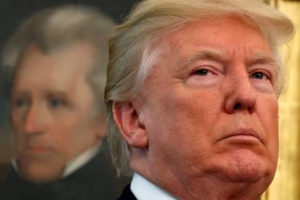
President Elect Donald J. TrumpAs for Matt Gaetz being nominated as attorney general—well, this is just straight-out trolling, right? The four-term Florida congressman has won a reputation as disruptive, divisive, aggressive, lacking in groundedness and wisdom, and dogged by ethics allegations. He seems to see politics as an offshoot of showbiz and has entertained his followers with successive attempts to take down GOP leaders in the House, on behalf of—well, it’s never quite clear. This we need in America’s top law-enforcement official?

The choice obviously isn’t meant to reassure anyone outside the MAGA base—or even those within it who are intelligent. It is an insolent appointment, guaranteed to cause trouble and meant to cause friction.

We are back to the Island of Misfit Toys. What a mistake. Mr. Trump often confuses his own antic malice for daring, his own unseriousness for boldness. How amazing that in the rosy glow of election, he will spend so much political capital and goodwill on confirmation fights he may well, and certainly deserves to, lose.

I turn now to the Democrats. Here is some advice to the party that I consider to be all wrong. It is from Elizabeth Warren in Time magazine and was published two days after the election. Her advice to her party: Back to the Future. Go back to “mass mobilization”—peaceful protests—to recharge “the resistance.” Step up oversight of Mr. Trump’s “corruption and abuses of power.” “Slow down confirmation and expose Republican extremism.” Searching for the middle ground is foolish. “Uniting against Trump’s legislative agenda is good politics because it is good policy.”

It is also a recipe for unending clash and political theater—Resistance Part II, take it to the streets. In the shock of 2016 it made sense that his opposition make itself heard, encourage itself, see itself. But a repeat isn’t in line with the mood of the country, which now isn’t electrified by politics but exhausted by it. And in some funny way demonstrations especially would make the Democratic Party look weaker. As if it has no other moves. As if it’s trying to avoid something, a sober look inward, and trying to cover it up by chanting.

It looks to me as if the rising argument in the party is for a left-wing populism, but it’s not certain what that would look like. Ms. Warren said the system is “rigged,” giant corporations get tax breaks and billionaires pay nothing. The job of the Democratic Party is to “unrig the economy.”

A few days later, in a Twitter thread, Sen. Chris Murphy of Connecticut said, “Time to rebuild the left.” “We are beyond small fixes.” The economic policies of the past 50 years have left places hollowed out. “Rapacious profit seeking” destroyed “the common good.” Unchecked new technologies were allowed to “separate and isolate us.” In response, the left has offered only “uninspiring solutions.” “The right regularly picks fights with elites—Hollywood, higher ed, etc.” Why doesn’t the left fight with billionaires and corporations? “Real economic populism” should be the Democrats’ purpose. But it must change its ways: “Our tent is too small.” Don’t keep out those who don’t agree on every social issue. “Build a big tent. Be less judgmental.” It tells you a lot about the party’s problems that that last part had to be said.

As to the resistance, Conor Friedersdorf in the Atlantic offered what seemed to me wisdom. After 2016, “a large faction of Americans declined to treat Trump as a president with democratic legitimacy.” He’d lost the popular vote, invited foreign actors to interfere in the election. “So they fancied themselves members of the ‘resistance,’ or waged lawfare, or urged the invocation of the Twenty-Fifth Amendment. Immediately after Trump’s inauguration, liberal groups started to push for his impeachment and removal from office.”

Now Mr. Trump returns under different circumstances. He received some three million more votes than Kamala Harris. “No one believes that a foreign nation was responsible for his victory. . . . No one alleges illegality in this campaign.” A 2016-style resistance to Trump is “untenable.”

“As a Never Trump voter who thought January 6 was disqualifying but who respects the results of this election,” Mr. Friedersdorf writes, “I urge this from fellow Trump skeptics: Stop indulging the fantasy that outrage, social stigma, language policing, a special counsel, the Twenty-Fifth Amendment, or impeachment will disappear him. And stop talking as if normal political opposition is capitulation.”

“Unaligned Americans who don’t even like Trump are tired of being browbeaten for not hating him enough.” If voters have made a terrible mistake, “that’s a risk of democracy, so we must live with it.” Mr. Friedersdorf himself doubts Mr. Trump’s character, judgment and respect for the Constitution. He fears recklessness in some areas and cruelty in others. What he urges toward Mr. Trump is in line with our past: “normal political opposition,” which is “more likely to yield good civic results.” “Our constitutional and civic checks on executive power are formidable, frustrating every administration.”

“Until 2028, normal checks can constrain Trump.”

These are wise words.

I close with this. People say they fear authoritarianism from Mr. Trump, latent or overt fascism, a reign of intolerance. My fears are in the area of foreign policy. Mr. Trump no doubt believes he’s ready for a major foreign crisis, but he’s never had one. I mean not something like the pandemic, a crisis with foreign-affairs aspects that rolled out over a matter of months and years, but a sharp and immediate crisis, a big and crucial one. He tends to think foreign affairs comes down to personal relationships, but it doesn’t. Xi Jinping, “Little Rocket Man”—he had them all wary in his first term. Who is this guy? Better not push him. But now they know him—how he operates, what he wants.

He isn’t a mystery to them anymore. He isn’t a mystery to anyone. That will have some impact on things going forward.

A Triumph for Trump’s Republicans America, after its long journey through the 2010s and ’20s, is becoming more conservative again.

It is worth being moved that in our huge, restive, cynical and yearning nation we peacefully, and with complete public acceptance of the outcome, made a dramatic national judgment this week. Just about every adult citizen took part and took it seriously. All together they produced something we needed: a clear outcome, one delivered without charges of large-scale chicanery or even small-scale so far as we know. There will be a peaceful transfer of power. A lot of people had to do a lot of things right to make this happen.

Trump supporters celebrating his victoryIt was a triumph for the Republican Party—a sweep, a rout—and a disaster for the Democrats. Much has been written about the demographic facts but when a single candidate increases his totals in almost every group but one, white women, something big happened. Donald Trump will likely receive a majority of the popular vote—the first Republican to do so since 2004. Republicans handily won the Senate and appear poised to take the House. This amounts to a legitimately claimed mandate.

Mr. Trump’s is the biggest political comeback since Richard Nixon, whose career flat-lined in embarrassment in 1962, after a failed gubernatorial race and stumbling news conference—“You won’t have Nixon to kick around anymore”—only to roar back to the presidency in 1968. It isn’t enough said that Mr. Trump did this while enduring a shooting, a second, thwarted assassination attempt, and credible intelligence reports that Iran was trying to kill him. He went into all his rallies knowing that. He showed a lot of guts. Mass media didn’t dwell on this, but regular people did.

As for Kamala Harris, Mr. Trump in 2020 lost the Catholic vote. This year he carried it with a healthy 56%. That’ll teach her to blow off the Al Smith dinner.

What did it all mean? The people did what they wished. They revolted. They looked at the past four years of Washington and said no. They said “Goodbye to all that,” to the years 2020-24—to the pandemic, to the pain and damage of that era, which affected every part of our lives. That is the real turning of the page I think, from a time they hated that made them view their government as bullying and not that bright. In terms of issues it was illegal immigration, inflation and a rejection of the deterioration all around them—of drugstores locking up the shampoo and the beleaguered Walgreens employee late with the key to the cabinet and in a bad mood because he’s afraid of thieves and crazy people and it’s wearing him down. It was the woke regime, which people have come to experience as an invading force in their lives. It was Afghanistan, and other wars, and the sense Washington isn’t getting foreign policy right and perhaps barely thinking about it. They just seem to be staggering through each day. The country’s been waiting for years to hear from its leaders: What are America’s interests?

In September, pondering the race, I wrote: “This will be a path election, not a person election.” Once we chose a shining John F. Kennedy, who would choose the path. You chose dazzling Ronald Reagan, and he’d cut a path through the forest. This year I felt people would be choosing a path, not a person. “And I’m not sure they want to go down the Blue Path any deeper than they already have.”

I think that’s what happened. Tens of millions of people who didn’t like Donald Trump voted for the path he promised.

America, after its long journey through the 2010s and ’20s, is becoming more conservative again.

This was all much bigger than “what Kamala Harris got wrong.” We know what she got wrong. She was a poor candidate chosen in mysterious circumstances who, like her running mate, was a strong regional and local talent but not a national one. She was a California progressive who came to be perceived as such.

The Democratic Party just took it full in the face—rejected and rebuked. That party needs an intellectual autopsy, an audit of its beliefs; it needs a rising moderating force such as the Democratic Leadership Council of the 1980s and ’90s, which got the party off McGovernism and its losses and on to Clintonism and its victories.

What are the Democrats? What’s that party for? When I was a kid they were the party of the working man, the little guy. That’s the Trumpian GOP now. When I was a young woman they were the antiwar party. That’s the Trumpian GOP. The party of generous spending? The Trumpian party says hold my beer. What belief do the Democrats hold that distinguishes them? LGBTQ, woke, gender theory, teachers unions, higher taxes? Why not throw in cholera and chlamydia?

The party has lost its specific character and nature; it’s no longer a thing you can name. Democrats have to sit down with a yellow legal pad and figure themselves out. All defeat carries a gift: You get to figure out what you’re getting wrong.

As for the Republicans, we always feel now we’re picking a government to manage our decline. But when Mr. Trump met with the Journal’s editors last month, he spoke for a moment with excitement about how America “can be so rich and so successful.” He described watching the arms come out and catch the SpaceX rocket. “It was good old Elon. It was him, he’s amazing.”

That chord he was trying to hit—and tried to hit in late rallies—is one America yearns to hear. They want the old sense that their kids are being launched into a society and culture that’s healthy and vital. Exuberance, expansion, Musk to Mars, drill, baby, drill—we’re going to be exciting again! Then Mr. Trump would revert to American carnage. But in a funny way, almost in spite of himself, I think he communicated what he meant, I think he got the Dream Big vote, and he should continue it as a centerpiece.

As for me, I don’t like the SOB, I think him a bad man who’ll cause and bungle crises almost from day one, but he’ll be the American president, and we all deserve grace. I will pray for him, support what I think constructive and oppose what I think destructive, call it straight as I can and take whatever follows. As someone once said, the real story of American life is where you stand and the price you’ll pay to stand there.

I like what Liz Cheney tweeted Wednesday: “Our nation’s democratic system functioned last night and we have a new President-elect. All Americans are bound, whether we like the outcome or not, to accept the results.” We also have a responsibility as members of “the greatest nation on earth” to “support and defend our Constitution, preserve the rule of law, and ensure that our institutions hold over these coming four years.” She singled out the courts, the press, “and those serving in our federal, state and local governments” to be “the guardrails of democracy.”

Just so. God bless America. Onward into the mess and clamor.

A Great Democracy Faces a Bad Choice Trump and Harris both have obvious flaws, but there’s no reason for us to give up on one another.

I can’t shake a feeling of peace. As I said, we’ll get through it. No one knows what’s going to happen Tuesday and Wednesday, or what will follow a close election in the weeks and months to come. But yes, I believe our institutions will see us through, not because they are strong—they’re battered old things shot through with ideology and self-seeking—but because they’re strong enough for the moment. Our courts, our laws, the free press, the academy, the military—all have taken hits the past decade, many self-inflicted. But they stand, and can do the job. Many unsung heroes see to this each day. There’s more health in our sick structures than we can see.

Kamala Harris speaks during a campaign rally in Madison, Wis., Oct. 30

Here is an institution we helped this year—unknowingly, without really meaning to. In this messy monster of a campaign we enlivened and perhaps even revitalized democracy. It’s the big story underneath the big story.

This campaign with the preening billionaires and the billions raised, with the proud lawn signs and the canvassers, with the old folks online donating money they don’t have to a candidate who might keep the kids safe in the future, with the volunteer door-knockers taking time off and spending weeks going door-to-door in Pennsylvania and having conversations, long ones, sometimes heartfelt, with whoever answers. A friend, a Harris supporter, wrote 2,000 handwritten letters—2,000!—during the past few months. The fundraisers, the rallies, the appropriate grinding-it-out of both campaigns at the end, the tens of thousands at the outdoor Trump rally, the tens of thousands on the Ellipse.

Do we understand what we’re saying here? We are saying we believe in democracy. Everyone, both sides, all ages, all the kids, all the old coots, all classes and colors. We are saying we are personally invested in it and implying we will continue it because it’s what we do and how we roll. We are telling 18- and 24-year-olds, who are understandably skeptical about our system, and often feel alienated from it, that they believe in it too, but actually we don’t have to tell them because they’re taking part too.

It’s a spectacular gesture of commitment. At bottom what it means is: Through all our history we have never given up on each other, and we still haven’t. There was something heartening in this fight.

For our summation of where things are we go to a highly accomplished and rather brilliant veteran of Democratic politics. Anyone who claims to know what’s going to happen is lying, he says. But people wish they had a better choice. “They don’t want him in there, and can’t see her there.” That’s why it’s close.

Donald Trump speaks during a campaign event in Green Bay, Wis., Oct. 30

I found myself this week going back to the hokey and fabulous campaign metaphors of the great Dan Rather. It’s tight as a tick, hotter than a Laredo parking lot. “Are your fingernails starting to sweat?”

Is anyone undecided at this point? I think it more likely they’re just undeclared. They know where they’re going and for whatever reason don’t want to announce it, to themselves or others. I am where I was in 2016 and 2020, and where I said I’d be this summer, writing in. It feels boorish to repeat why. He’s too crazy for me, they’re too extreme. He’s mad, bad and dangerous to know. She and her party continue to move too damagingly to the left. I haven’t felt free to vote for a major-party candidate since 2012, Mitt Romney. I long for the day I can again.

There are for me two Kamala Harris mysteries. The first is why she didn’t give Republicans and conservatives any serious reassurance in terms of policy. I suppose I mean anything at all on cultural issues. She was a California progressive and was part of an administration that frequently bowed to progressives; in a special way it was on her to show to potential supporters some alignment of sympathies. There are many possible examples, but here are six words suburban mothers would have been satisfied to hear: No boys on the girls team. They’re with Ms. Harris on abortion and other issues, but they’ve got seventh-grade girls coming up on the swimming and running teams and they don’t want boys competing with their daughters or in the locker room. Because boys and girls aren’t the same and aren’t built the same. So find a new and humane arrangement. The answer to questions on this is not “I’ll follow the law,” it is, “Believe me, I think we get too extreme sometimes and I’ll push against this.”

The other speaks of something that confuses me as I look at Ms. Harris as a public figure. She slew Donald Trump in debate, live, in front of 67 million people. It was just her, the untried candidate, on a stage with Man Mountain Dean, and she betrayed no fear or tremor. This is someone who can take pressure! Who can think on her feet! If she could do that, why couldn’t she sit down and give an honest, forthright interview, or field questions thoughtfully in a way that coheres, in a live town hall? Why couldn’t she let people in on her real thinking? I don’t recall a single interview she did that didn’t seem full of doubletalk and evasion. When that’s what you give people they assume you’re hiding something. It makes them think, “Maybe stick with the devil I know.”

She veered from simplicity and struggled to answer simple questions. If asked, “Do you like to walk on the street on a sunny day?” She could not say, “Yes, I do.” Instead, she’d answer it in a way she thought a smart person would answer it, full of odd roundabouts and clauses.

“Do you like to walk on the street on a sunny day?”

“I will say that within the general context of weather, and added to that the strolling ability, whether to choose to or not, and reflecting the reality of precipitation, that such strolls, and I’ve always made this clear, are quite possible.”

She’s smart. She’s accomplished. If she loses, her not seeing the needs of potential supporters and not sharing her real thoughts will be part of why.

*   *   *

We’ll know more soon. I close with the peace I can’t shake.

This week, my own October surprise. A text message, a hospital, a baby due in November decides he wants in on the action now. The family grows, a grandson comes. I hold him for the first time and I hum to him chords and he looks at me with huge-pupiled infant eyes and the chords come from my chest and throat. They are of a song I haven’t thought of in years, “My Cup Runneth Over.”

A friend of decades calls. We started out together, were young together, and he’s just seen on his phone the picture of the baby. There are tears in his voice. “In all the chaos, all the noise, something splendid God has done.” Amen.

It’s what we all know is the real news, always: life happening.

Let’s all make it through. We’ve never given up on each other, ever, let’s not start now. Can’t let the grandkids down.

The U.S. Can Take a Tough Election This intense season will pass, the losers will feel crushed, and we will forge our way through.

It’s exciting out there but enervating. People are spun up, nerves at a breaking point, and there’s an undercurrent.

Whatever the outcome of the election, at least half the country will feel crushed. Voters feel they are faced with a bad choice, and many millions will vote against, not for. Everyone is afraid the other side will destroy the country. If it turns out as close as the polls say, we fear a harrowing postelection time marked by accusations and aggression, with nothing clear and everything bitter.

Early voting in Black Mountain, N.C.

My mind goes to something that I hope doesn’t sound facile because I don’t mean it in a rote, small way. But this country has gotten through a lot. It can take a lot of tension. It was born in it and is used to it. We made it through Shay’s Rebellion and Vietnam, the McCarthy era and the 1960s. We made it through the Civil War, and we will make it through this. We are practiced at withstanding trials. We have a way of forging through. We should take inspiration from this.

I reached for wisdom to the author Yuval Levin of the American Enterprise Institute. He reached back to the 1830s, and Alexis de Tocqueville’s “Democracy in America.” “He wrote that every presidential election is a kind of national crisis that drives people crazy, but that the madness dissipates when the election ends,” Mr. Levin says.

That last part seems less true in our times, but it’s still important to remember. “A second point is that while close elections drive us more crazy and feel more intense, close elections actually tend to be less consequential than landslides. They produce presidents with narrow congressional majorities at most, and without much of a mandate, and our system is built to restrain narrow majorities. So whoever wins is probably going to spend the next four years pretty frustrated, as our last few presidents have.” If you’re worried that the other party will transform the country in ways you hate, “you’re very likely wrong.”

He added: “America has real problems now, as always. But it still works. It’s an amazing society. And one of the reasons it works is that who our president is at any given time is generally not the most important thing to know about us. There are exceptions: We could find ourselves in a world-historical crisis, or one of these candidates really could try to break the system. But we need to see that that’s not the likeliest outcome by any stretch. This is an election between the sitting vice president and a guy who already served a full term as president. Most elections actually involve much more of the unknown than that.”

A note on something that I find ironically reassuring. We rightly decry our polarization—the distance between the edges of both parties is considerable. But this close election puts sharp focus on the fact that while we’re split, we’re split in two. It speaks of some rough health that we mostly all can still, in the end, support one party or the other, that we’re not a nation of four or seven parties, that we’re split but not shattered. Neither of these parties is worthy of us; both this year failed us. Yet their existence speaks of a continuing ability within each to be flexible, to build coalitions, to govern, however imperfectly. This suggests a stability we don’t much note.

When I speak to the young, my mind goes to basics. If your side loses, recommit to it and see that it wins next time. There’s comfort in knowing not everything’s “right now,” that the most meaningful struggles are long-term.

This intense season will pass, and when it does you might, as an individual, take your eye somewhat away from outer events and train it more toward inner events and what you can do to make your own life better.

Americans do a lot of displacement. We always have. We love to talk about outer things in part so we can ignore inner things. That’s how we got through life in desolate wilderness towns, standing on the tree stump that functioned as the town square to argue about the state legislature’s latest sins, so we didn’t have to go home and fix the lonely cabin’s roof. Americans uniquely and from the beginning used politics to avoid loneliness, and to be part of something: “I hold with the Whig faction.” Lonely Abe Lincoln did that as a young man. We use politics to solve not only public dilemmas but personal ones.

When Lincoln first ran for local office he passionately supported “internal improvements”—state and national efforts to build roads, rail lines and canals. This would increase commerce, advance the spread of knowledge, help the country know itself. But a lifetime reading his life tells me Lincoln was pushed forward, also, by something else. Those roads, those canals—they would get Lincoln out of the wilderness and to a town, a city, where what he had a feeling was his genius might be recognized. As it was.

Americans and politics—we work out a lot on that field. It’s good to remember this.

I end with a thought from Jonathan Haidt, the social psychologist at New York University’s Stern School and author of “The Righteous Mind”:

“It’s always been wrong to bet against America, and it’s probably wrong now,” he says by phone. But it would benefit our politics if we would start to fear each other less. “What I’ve observed in studying our culture is that the great majority of people are sane and decent. What has changed is that technology has amplified extremists on left and right. They have become louder, and intimidate moderates.” But they are making the statements of the fringe, they don’t represent “the other side,” which hasn’t endorsed them, and they have been sent to you by algorithms which chose them for their offensiveness. All this has created “a political optical illusion.” We are better and steadier than we think.

I close with my immediate hope, that the outcome of the election, however close, is also clear. That the battleground states won’t be won with 0.008 margins but a few points this direction or that. I hope whoever wins the presidency, at least one house of Congress is of the other party. A Democratic House or Senate will tamp down Trumpian excitements and hem in enthusiasms. A Republican House or Senate will be a coolant on Democratic attempts at court packing or doing away with the filibuster.

You say this is a recipe for “nothing gets done.” Those three words are, occasionally, balm to the conservative soul. A situation in which neither Matt Gaetz nor AOC can destabilize anything isn’t a bad situation. But also, no: Divided government will mean anything that gets done will involve winning over the opposition. Good. We’ve got to get back to persuasion, to politics as the art of the possible. That’s an old tradition too.

Meantime onward, do what you think right, feel appropriate anxiety but no crippling fear. Shoulders back. We’re the U.S.-blinkin’-A., baby, and we make our way through.

The Oprah Phase and the Trump Danger Kamala Harris focuses on gifts for voters and should take more seriously the threat to the Constitution.

‘Let us go forth to lead the land we love . . . knowing that here on earth God’s work must truly be our own.” Those are the last words of John F. Kennedy’s Inaugural Address. To me they mean do your very best within your area to make things better.

Vice President Kamala Harris and former President Donald Trump speak at campaign events

My world has turned intense, yours too. Nobody knows what’s going to happen, everyone’s nervous, whatever latest information just showed a tick up or down, it’s neck and neck, and those who tell you to ignore the polls are right. Only later, when it doesn’t matter, will you know which ones were right. Meantime, in the aggregate, they instill a kind of fatalism. Still and always the great advice for those fully immersed in their times is in Robert Bolt’s screenplay of “Lawrence of Arabia”: “Nothing is written.” Today might change everything.

My anecdotal observation on the state of the race is this. Trump supporters are confident: They think they are more than half the country. Harris supporters are anxious: They fear they are less.

Yet since June political data men and women have told me everything will come down to each party’s ability to get out the vote, which means everything comes down to each party’s ground game. For weeks political observers have told me the Democrats have the advantage there. So that, and not the latest interview, could be the ballgame.

The other day someone said the campaign has reached its Oprah phase, where she’d have her big annual show and give gifts to everyone in the audience: “And you get a car, and you get a car!” Both candidates are promising to give money to whatever group whose love is immediately needed. This week Kamala Harris offered $20,000 forgivable loans for “Black entrepreneurs and others.”

Bloomberg editor in chief John Micklethwait brought the question to Donald Trump in their interview at the Chicago Economic Club. “You’re flooding the thing with giveaways,” Mr. Micklethwait charged bluntly. Mr. Trump, blithely: “But we’re going to grow.”

That charge and response haven’t changed in a century. It’s OK what we do, the money will always flood in endlessly!

We’ll get back to that in a moment and turn to another big interview this week, Kamala Harris on Fox News. Good for Fox—it got almost half an hour, it would be the first sustained grilling Ms. Harris faced since the campaign began, they’d have to get a lot in—and good for Ms. Harris for being game. Her campaign has clearly decided her safe-spaces strategy wasn’t working. She should have braved tough interviews months ago, she’d be a pro now. She should do more.

She was looking for a big moment—Kamala in the lion’s den facing down the foe. Anchor Bret Baier was looking to force her off her talking points and practiced answers to get to something deeper and more revealing. It was hot, sparky, fiery, she was sometimes defensive (immigration) and combative (on when she first observed a decline in Joe Biden’s mental acuity) but also scored points on the nature of Mr. Trump.

People will say it was too tough—Fox, partisan aggression. No. She is running for president, it is a tough job, she is a tough woman. It gave viewers a deeper sense of who she is. Mr. Baier showed himself, again, one of the great television news professionals of his generation.

Back to Messrs. Trump and Micklethwait. That interview too was smart and full of pushback. The subject was the economy, and you could see that whatever Mr. Trump’s economic policies are, economic issues are central to his thinking because he’s spent his life thinking about money. Mr. Micklethwait brought the courteous skepticism of the journalist who knows more economic history than his subject.

He quoted a survey of economists report: If you add up all the promises Mr. Trump is making, in terms of taxes and spending, it would add at least $7.5 trillion to the debt—and that’s twice as much as Ms. Harris’s promises. Why should business leaders trust you?

Mr. Trump: “We’re all about growth.” He’ll bring manufacturing back, protect U.S. companies with “strong tariffs.” He’ll put 100% or 200% tariffs on imports. Mr. Micklethwait pushed back. The impact of a tariff war would be “massive” since “40 million [American] jobs rely on trade.” Tariffs would push up costs and function “like a national sales tax” on U.S. consumers.

Trump’s response came down to “China thinks we’re a stupid country,” “I was always very good at mathematics,” and The Wall Street Journal has “been wrong on everything,” as has Mr. Micklethwait: “You’ve been wrong all your life on this stuff.”

In Trumpworld all debate, no matter how crucial, descends into ad hominem. And yet Mr. Trump was compelling. His stories, his anecdotes, have a constant subtext. World issues can be handled just by making Emmanuel Macron of France cry like a girl when you tell him you’re going to tax champagne. Kim Jong Un of North Korea is quieted by love letters. It’s all easy in Mr. Trump’s brain because it’s all personal, and his supporters hear this with relief. The world’s problems aren’t maddeningly complex, you just need the right application of personal force.

Some advice for Ms. Harris. If this is a close election and Mr. Trump loses he will likely reject the outcome. He won’t accept a result he doesn’t like, and he will likely push against democracy’s peaceful processes because he is angry and resentful and his feelings are hurt.

Ms. Harris should be describing all this more seriously, at greater length, with greater thoughtfulness. On Jan. 6 the Capitol was seized by an armed and angry crowd to stop a constitutionally mandated action. The president sat in his office and watched. Did he like what he saw? Why? That Constitution has kept us together for nearly 250 years, through thick and thin. He didn’t move quickly to protect it that day, and if he doesn’t accept the Nov. 5 outcome he will be failing to be protective again. If Ms. Harris thinks Mr. Trump is a danger to the Constitution then this is more than an election, it is a national emergency. In an emergency you put your own ideological purity and pride aside.

I don’t understand why Ms. Harris hasn’t made concessions to the moderates, Republicans and conservatives whose votes she needs. Why not tell them she knows their stands and views and is willing to concede to the need for a greater centrism, especially on issues where the political and cultural left have demanded too much and alienated regular Americans?

Why should Republicans who vote for her—and whom she needs to win—be the only ones bending? Why not make it easier for them? Why not say she sees them, and understands they’ve given up long-held views? Why not say she’ll give them more than a temporary home, she’ll do everything to make them comfortable there?

If she were fully sincere about the threat Mr. Trump poses, wouldn’t she have pulled the cord of the compromise alarm by now? Her party would let her—they’re desperate to win. And it would convey that she has some mastery over them.

As each day passes more eyes train on the race. You can say big things at the end.

What a Deadly Flood Revealed About America In 1889, Johnstown, Pa., witnessed extraordinary heroism, managerial genius and deep endurance.

We have been thinking about disasters, about Hurricane Helene and North Carolina, about Milton and Florida. It sent me back to the great classic on American disaster, “The Johnstown Flood” by David McCullough, published in 1968. I hadn’t remembered it contains information pertinent to the current moment.

Johnstown, Pa., in the western part of the state and the heart of the Allegheny Mountains, was a growing, thriving steel-mill and factory town in 1889, one of a string of such towns in a deep valley that McCullough likened to “an enormous hole in the Alleghenies.” The Cambria Iron Co. had giant converters going there, making steel for rails and plowshares. The place was alive.

Johnstown, Pa., after the flood of May 31, 1889.

Twenty-three thousand people lived in the valley, 15,000 of them in Johnstown, of all types, sorts and classes—doctors and lawyers, laborers and factory workers, small-business men and steel executives. There was just about every ethnicity too—Italians, Poles, Hungarians and Russians, though the majority of the population were Irish, Scots-Irish, German and Welsh. There were blacks—Johnstown had been a stop on the Underground Railroad—and Jewish merchants.

The mood of the town was the mood of the country, aspirational. There was a busy library and an opera house, and people worked hard, “not only because that was how life was then, but because people had the feeling they were getting somewhere. The country seemed hell bent for a glorious new age.”

Johnstown was built at the confluence of two rivers. Above the town was a reservoir, whose formal name was Lake Conemaugh but which everyone called the South Fork Dam. There had long been worries about that dam. It was controlled by a powerful trust whose leaders hadn’t always been interested in warnings from townspeople that it wasn’t sturdy enough or maintained. The lake was about 2 miles long, a mile wide, and in some places 10 feet deep. It was a fearsome body of water to have up there on a mountain over a town.

There had been heavy rains through the spring of 1889, and on Memorial Day more storms came in. The rivers ran high. The lake rose. On Friday the dam was breached. Then its center collapsed, and the lake fell down into the valley, and Johnstown was drowned.

Within days, McCullough writes, the Johnstown flood was the greatest story since the death of Lincoln. Newspaper reporters from Pittsburgh, New York and Philadelphia struggled to the scene, taking trains until the tracks washed out, then horses and mules, and finally slogging through seas of mud.

One by one they got there and saw: devastation.

The heart of the town was empty spaces, “an unbroken swath of destruction.” Landmarks were gone. Huge trees, whole houses, dead livestock and barns had been plunged into a huge wall of water. When the water came into sight, an eyewitness said, “It just seemed like a mountain coming.” Most of the people of Johnstown never saw it coming, “they only heard it; and those who lived to tell about it would for years after try to describe the sound of the thing as it rushed on them.” It was a deep, steady rumble, a roar like thunder, like the rush of an oncoming train.

The drowning of the city took about 10 minutes. Well over 2,000 were killed, but hundreds unaccounted for would never be found. The flood killed just about 1 person in 10 in the valley, 1 in 9 in Johnstown.

Word of what had happened electrified the nation and ignited the biggest humanitarian response America had ever seen. Within days food, water, clothing and blankets poured in. Even Clara Barton came with her newly organized group, the Red Cross. It was their first real disaster. Barton vowed, as she threw up hospital tents, to be “the last to leave the field.” She stayed five months, never left once, and when she departed the people of Johnstown cheered with tears in their eyes and gave her a golden locket. Johnstown made the Red Cross.

Newsmen spread other stories, too. Within days of the flood came reports that bands of “Hunkies”—local Hungarian laborers—were robbing, raping and pillaging. It wasn’t true but caused plenty of trouble, and it turned out the rumors were started by a local lawyer who’d lost his wife and children and gone off his head.

There were true tales of heroism. Seventeen-year-old Bill Heppenstall was at the water’s edge when a small house in the swift current lodged, for a moment, in a clump of trees. He heard a baby crying, but the house was too far to reach. He got a bell cord from a railcar, tied it around his waist, swam to the house, and came back with the child. Witnesses cheered. He’d seen a mother in the house and went back for her too, and as they reached shore together the house was torn from the trees and spun madly downstream.

Also, unbelievably, survivors organized almost immediately. They formed citizen committees to establish morgues, improvise housing, see to unclaimed children. They appointed policemen, who cut tin stars from tomato cans found in the wreckage.

The inventive rigged up rope bridges; the brave crossed them to find survivors.

What are our thoughts from this?

In great disasters rumors spread quick as fire. When you’re in one you must take this into account.

When you’ve got a feeling about something, when your mind keeps going to it, unbidden—I don’t trust that dam—listen to it, even if you don’t understand it. Act on it. Premonitions have to be followed by action or they’re just something that keeps you up at night.

We have always been a clever people but in the past we were clever not only with our heads but our hands. We made things, knew how to work wood and metal, and in a physical crisis we knew how to rig up the rope ladder and build a raft, quickly. When we lost the mills and factories we lost jobs, yes, but we also saw the lessening of a capability, a broad ability to handle the physical world when that world turns dark. We need to pay more attention to this.

History reminds us: America is and always has been a freak show. We should accept this in ourselves more, that it is in our nature as a people. When the floodwaters receded and camp towns sprang up, the region’s prostitutes came in, followed by the ladies of the Christian Temperance Union. We are cantankerous. When strangers who had survived overnight in an attic saw that a stone church next door had broken the wall of water, someone said, “The Methodist church saved us.” Within seconds a voice shot out: “Only the Catholic Church can save!”

We did something nobody ever tried before, to fill a continent with people from every country in the world, and ask them to come, build something, get along, and invent an arrangement of rules and rights by which they could operate together. It produced a dazzling, strange and gifted nation, a freak show, and a fabulous one.

To read our history is to say, “We got through that.”

We’ve got through a lot. Whatever’s coming, immediately and further out, we’ll likely get through that, too.

Who’s Afraid of the Al Smith Dinner? Kamala Harris says she won’t go. Reversing that decision is the smartest thing she can do.

For the love of God, Madam Vice President, reverse your decision and come to the Archdiocese of New York’s Al Smith dinner. There’s still time, schedules free up, and announcing you’ll speak will make you look both humble (“on second thought”) and heroic (into the lion’s den).

Why would she snub the famous, ancestral, bipartisan dinner, which has taken place every third Thursday in October since 1945 (virtually in 2020), that Theodore White lauded as an irreplaceable ritual of every presidential year?

It couldn’t be disdain for institutional Catholicism. The dinner exists to raise money to feed the hungry, teach the child, heal the sick, house the immigrant.

Barack Obama, Timothy Dolan and Mitt Romney at the 67th Annual Alfred E. Smith Memorial Foundation Dinner

It couldn’t be antipathy for Catholics themselves. They’re 70 million strong and the famous deciders of national politics, backing Joe Biden in 2020 and Donald Trump in 2016. They pick the winner!

It couldn’t be insensitivity toward Latinos, who compose an estimated one-third to half of the Archdiocese’s parishioners, who are its growing presence and its loving future.

It would be wrong to suggest every Catholic in America sits around thinking about who goes to the big Catholic dinner, and yet we . . . notice such things. Every four years it’s news. A simple refusal—I don’t have time—could be misinterpreted as disrespect for Catholics in general. Pennsylvania’s population is roughly a quarter Catholic. It would be sad if some of them misunderstood.

It couldn’t be fear of the audience. More than half are Democrats. The dais is the top officials of New York state, all of whom are Democrats.

It couldn’t be dislike of the archbishop—everyone likes Cardinal Timothy Dolan and he likes everyone back.

And it couldn’t be that the dinner is old. It is, but its age is its virtue. It’s stood the test of time, lasted in this world where nothing lasts.

It must be something else—a simple mistake, the kind made by fast-moving campaign advisers who have no time to reflect.

That’s what jolly Archbishop Dolan thinks. He was in Yonkers after the announcement, visiting a children’s hospital supported by the church. Pressed for a response, he said he was disappointed of course but it must be an error; Ms. Harris has always spoken so well and warmly of healing our divisions. “This hasn’t happened in 40 years,” he said, referring to Walter Mondale, the Democrats’ 1984 nominee, who declined the dinner. The cardinal helpfully recalled the outcome: “He lost 49 out of 50 states. I don’t wanna say there’s a direct connection.”

Ms. Harris’s staffers likely think she can’t be in nailed-down New York near the end of a close race, she’s got to be in the battlegrounds.

But an elegant man in a tough race of his own gave the best answer to that thinking. President Barack Obama took the podium of the 2012 Al Smith and said, “In less than three weeks, voters in states like Ohio and Virginia and Florida will decide this incredibly important election. Which begs the question: What are we doing here?” The audience roared. We are here, Mr. Obama said, not only to honor the Catholic church. “It says something about who we are as a people that in the middle of a contentious election season, opposing candidates can share the same stage; people from both parties can come together to support a worthy cause.”

The Al Smith dinner is the only occasion each presidential year when both major-party candidates come together, sit, talk, have a drink, give dueling speeches, and give them not only with wit and humor but while radiating a deep democratic regard. It is a splendid thing. Those candidates demonstrate through the fact of their togetherness that our democratic system, which often seems so frail, so ready to give way, still holds, still endures, that it has a hidden health, a latent strength that will bear us through. Politicians speak plaintively of finding common ground. This dinner is common ground.

To be dead to this tradition, to say no to it in a way that will inevitably bring more no’s in the future—the dinner is never convenient—is to contribute to the ending of something good. In that sense it is worse than a mistake, it is a sin.

Think of the fabled tradition Ms. Harris becomes part of if she comes. In the 1960 dinner, John F. Kennedy was sly, playing “the religious issue” to his advantage. “I am glad to be here at this notable dinner once again, and I am glad that Mr. Nixon is here also. Now that Cardinal Spellman has demonstrated the proper spirit, I assume that shortly I will be invited to a Quaker dinner honoring Herbert Hoover.” Quakers were a tiny minority, Hoover the least popular recent president. Under that Harvard veneer resided a tough little Boston pol.

The 2012 dinner was a triumph for Mitt Romney, formerly of Bain Capital. He was handsome and dashing in his white tie and tails, and he brought down the house when he spoke of the “wardrobe changes” campaigning entails—jeans for one event, a suit for another. “But it’s nice to finally relax and wear what Ann and I wear around the house.” He paid tribute to Mr. Obama as a man of “many gifts.”

The 2016 dinner will never be forgotten by anyone who was there. Hillary Clinton was radiant, won the crowd and, speaking after Mr. Trump, won the night. “You know, come to think of it, it’s amazing I’m up here after Donald. I didn’t think he’d be OK with a peaceful transition of power. . . . Every year, this dinner brings together a collection of sensible, committed, mainstream Republicans—or, as we now like to call them, Hillary supporters. . . . Whoever wins this election, the outcome will be historic. We’ll either have the first female president or the first president who started a Twitter war with Cher. . . . He has no policies—I keep hearing that. I’d actually like to defend him on this. Donald has issues, serious issues.”

The applause was thunderous. Mr. Trump got off a good line: “The media is even more biased this year than ever before, ever. You want proof? Michelle Obama gives a speech and everyone loves it, it’s fantastic, they think she’s absolutely great. My wife, Melania, gave the exact same speech and people got on her case.” (Critics had noted similarities between Mrs. Trump’s 2016 convention speech and Mrs. Obama’s from 2008.) The room exploded in laughter. Then he ruined it all, attacking Mrs. Clinton as “corrupt” and saying: “Here she is tonight, in public, pretending not to hate Catholics.” He was the only speaker ever to be booed.

Here is something Ms. Harris will receive if she attends: worldwide attention in the media capital of the world as she, having finished her speech, is embraced by the laughing cardinal in a picture that will be seen everywhere, and her lines repeated everywhere.

Or she can be in some grim studio on some grim podcast reciting her latest positions in a way that will move and dazzle no one.

We are a church of miracles—the water into wine, the lame man who walked, the campaign advisers healed of their blindness. The little children of New York will no doubt be praying on coming Sundays in Mass, as they put their pennies in the collection plate, “Oh God, please change Kamala Harris’s mind, let her come to us, help the nice lady avoid the Mondale Curse. Amen.”

Do Americans Really Want a ‘Politics of Joy’? The slogan didn’t work for Hubert Humphrey in 1968. It seems tone-deaf in the troubled world of 2024.

Jump ball, deadlock, coin flip, tossup. We’re running out of election metaphors.

Everyone’s texting each other, every interaction turns quickly to “Whaddaya think, what’s gonna happen?” You feel an urgency but also a sincerity: They honestly don’t know.

Vice President Kamala Harris and Minnesota Gov. Tim Walz

Kamala Harris holds a close lead in the nationwide polls, Donald Trump in several battlegrounds. I think there’s probably still an “undercover” Trump vote; I suspect a lot of the undecided are Trump voters who can’t admit it to themselves or are waiting to see something from Ms. Harris that makes them think: her.

We’re braced for October surprises and black swans. Maybe the swans—the Mideast, deadly, historic floods in neck-and-neck North Carolina—have already swum by. Maybe not.

Still, I have a sneaking feeling maybe the table’s set more than we know, that if the nation voted today, it would produce about the same outcome we’ll see on the morning of Nov. 6. And if you could jump ahead and be told the result, you would quickly be able to explain it to yourself. “I don’t think people liked her that much.” “They just didn’t want to go back to his chaos.” “She didn’t feel like a turning of the page but more of the same.” “He seemed at the end more insane than even my husband could tolerate.”

Were I a Harris supporter I would be concerned about these things:

The first is so obvious it barely needs saying, but with a month to go should be said again. She still hasn’t given voters a satisfying sense of what she is about, what the purpose of her political career is. She hasn’t fleshed out her political intent—what she stands for, what she won’t abide, what she means to establish, what she won’t let happen.

What is her essential mission? Is it national “repair,” is it to “stabilize” an uncertain country, is it “relaunch”? Is it “more from the top for the bottom, period”? Is it “America as defender of democracy in the world”? Is it about focusing—now, first, and until something works—on the high daily cost of living? When things can’t be reduced to their essentials it’s because they’re not real, there’s nothing to reduce. She so far hasn’t conveyed a sense of intellectual grasp.

Her campaign has placed too many chips on the idea of the mood, the vibe, the picture. “She’s bringing us a politics of joy,” Gov. Tim Walz said, again, in his summation the other night in the vice-presidential debate. But look, “the politics of joy” didn’t help Hubert Humphrey when he used exactly those words in his announcement for the presidency in April 1968. The country was becoming undone by Vietnam and he was talking about . . . joy? It made no one smile or feel inspired except his opponent, Richard Nixon.

It didn’t do Mayor John Lindsay any good in 1966, in the middle of a transit strike and other municipal strikes, with crime starting to creep up, when he called New York “fun city.”

He meant to sound upbeat. It came across as cheery mindlessness, a deep cluelessness. New Yorkers resented it. Doesn’t this guy know what time it is?

Americans feel surrounded by crises—inflation, the Mideast, Vladimir Putin, AI’s gonna eat your brain and no one’s gonna stop it, China. You can see this in the right track/wrong track numbers, which continue underwater—the whole country fears we’re on a losing slide in a dangerous world.

They feel like Brad Pitt as Billy Beane in the movie “Moneyball.” The Oakland A’s have lost another one, and the manager, Beane, walks by the locker room and hears music. He walks in, the players are dancing and joking, and he slams a bat against the wall to silence them. “Is losing fun?” he asks them.

They shake their heads. “What are you having fun for?”

That’s more like how people feel. Is losing fun? Then why are you proclaiming joy and having fun?

If I were a Trump supporter I would be worried about what Trump supporters have worried about since he came down the escalator, that he is squandering it away every day. Voters and observers have spent a decade saying “he’s getting crazier,” “he’s going too far,” and they’re always right and are right now. He’s selling $100,000 watches and having Truth Social meltdowns, free-associating about movies and dribbling away arguments. Ms. Harris insists almost to the point of credibility that the Biden-Harris administration didn’t let the border be overwhelmed, the Biden-Harris administration tried to control the border and put forward the toughest bill and Donald Trump stopped it. And she’s getting away with it! With the Jan. 6 filings released this week, his focus is sure to return to the endless murk and mire of personal grievance.

What should both sides be watching now? John Ellis, in his Political News Items Substack, notes an intriguing sidebar from a recent Gallup survey. “Nearly identical percentages of US adults rate Donald Trump (46%) and Kamala Harris (44%) favorably in Gallup’s latest Sept 3-15 poll.” But both candidates have higher unfavorable ratings than favorable. Mr. Trump’s unfavorable rating is 7 points higher than his favorable—and Ms. Harris’s is 10 points higher. Her favorable numbers have “moderated” since her rise to the nomination, while Mr. Trump’s are up 5 points since last month.

Look at the numbers involving independent voters, Mr. Ellis continues. Majorities of independents view Mr. Trump and Ms. Harris unfavorably, but he holds a favorability edge over her with independents, at 44% vs. 35%. More: “Assuming the poll is accurate”—he does—“the fact that 60 percent of independents have an ‘unfavorable’ opinion of Harris is surprising.” In 2020, Joe Biden defeated Donald Trump among independents, 52% to 43%.

Back to the Harris campaign. It’s odd that some political professionals think nobody cares if she does an interview with some newspaper. When all the public sees is scripted stuff, punctuated infrequently by an interview with a highly respectful and sympathetic interviewer, they pick it up. They get a sense that something is being hidden from them. Well-produced rallies with good enough speeches and softball interviews won’t really cut it. In Hollywood they used to try to soften the picture of a star losing her luster by putting a coat of Vaseline on the camera lens, to soften the focus. The Harris campaign is using too much metaphoric Vaseline, and it feels not like an attempt to soften but to obscure.

It would be better if she’d done interview after interview from day one of her candidacy, and better if her campaign had accepted the wobbles, accepted the imperfections, gotten people rooting for her, and helped her get more at ease, more confident, and let her build. That they didn’t implies they didn’t think she could build.

Hiding in plain sight works for a while but not forever.

Is there time to make a change? There’s time to throw a long ball, and that would consist of greater exposure of their candidate. There’s a month to go. Everyone’s still watching, talking and texting.

Kamala Harris Is an Artless Dodger She evades every question of substance, leaving voters a choice between Awful and Empty.

The race is deadlocked with six weeks to go and if you’re an undecided, unsure or wavering voter it looks like Awful vs. Empty.

Kamala Harris speaks at a discussion hosted by the National Association of Black Journalists

Kamala Harris has made quite an impression. That walk is a stride, and she has appetite—she loves this thing, running for high office. She has sentiments—she loves to say what divides us isn’t as big as what unites us, which, though a dreadful cliché, is true.

But in terms of policy she is coming across as wholly without substance.

Joe Biden stepped aside, and Ms. Harris was elevated, two months ago. That is enough time at least to start making clear what she believes, wants and means to do. She hasn’t.

This week she couldn’t or wouldn’t answer a single question straight, and people could see it. She is an artless dodger.

In her unscripted 11-minute interview with ABC’s Philadelphia station on Tuesday, the reporter asked, meekly, for “one or two specific things you have in mind” to get prices down.

Mr. Harris: “Well, I’ll start with this: I grew up a middle-class kid. My mother raised my sister and me. She worked very hard. She was able to finally save up enough money to buy our first house when I was a teenager. I grew up in a community of hardworking people, you know, construction workers and nurses and teachers. And I try to explain to some people who may not have had the same experience, you know, if—but a lot of people will relate to this. You know, I grew up in a neighborhood of folks who were very proud of their lawn, you know? And I was raised to believe and to know that all people deserve dignity, and that we as Americans have a beautiful character, you know, we have ambitions and aspirations and dreams. But not everyone necessarily has access to the resources that can help them fuel those dreams and ambitions. So when I talk about building an opportunity economy, it is very much with the mind of investing in the ambitions and aspirations and the incredible work ethic of the American people . . .” On it went, with a few policy ideas tacked on at the end.

Also from the interview: “Focusing on, again, the aspirations and the dreams but also just recognizing that at this moment in time, some of the stuff we could take for granted years ago, we can’t take for granted anymore.” “And so my approach is about new ideas, new policies that are directed at the current moment, and also to be very honest with you, my focus is very much on what we need to do over the next ten, twenty years. To catch up to the 21st century around, again, capacity but also challenges.”

This is word-saying gibberish. Only when speaking of her personal biography does she seem authoritative. Otherwise she is airy, evasive, nonresponsive.

How to appeal to Trump voters who might be open to her? “I, based on experience, and a lived experience, know in my heart, I know in my soul, I know that the vast majority of us as Americans have so much more in common than what separates us. And I also believe that I am accurate in knowing that most Americans want a leader who brings us together as Americans . . .”

That isn’t the answer of a candidate trying to be forthcoming and using her limited time in an attempt to be better understood. It is the sound of someone running out the clock.

In an appearance Tuesday at the National Association of Black Journalists, Ms. Harris was asked about increasing her support among black men.

“The policies and the perspectives I have understands what we must do to recognize the needs of all communities, and I intend to be a president for all people . . .” Again, she spoke of her “economic opportunity tour.”

Why does she dodge away from clarity? Why doesn’t she take opportunities to deepen public understanding of her thinking?

Here are some guesses, one or more of which may be correct.

  • Because she’s not that interested in policy. This would be strange, because politics is the policy business; that’s what politicians make. But she forged her political life in California, where politics is an offshoot of its other great industry, show business. It is possible that she views policy as just something you have to do to advance your personal standing and enjoy being on top. It is clear she has memorized certain position points (help small businesses) that have perhaps been urged on her by professionals who do politics for a living.
  • Because she’ll figure it out later. Specificity divides while sentiment gathers.
  • Because she doesn’t want you to understand where she stands. Because she’s more progressive than she admits, and there’s no gain in telling you now.
  • Because at bottom she’s as progressive as Joe Biden, meaning as progressive as the traffic will bear. But that would mean she’s more of the same, so why talk about it?

Some supporters think she needs to be more “specific,” but it isn’t specificity per se that is the glaring omission. Her problem is not that she doesn’t say she’ll repeal section 13(c) of some regulatory act. No one knows what 13(c) is. What people want to hear, and deserve to hear, is her essential meaning and purpose as a political figure. It’s not about data points and the arcana of government; it’s about belief and the philosophical underpinnings of that belief.

What are her thoughts, right now, about illegal immigration and the border? After the past three years of a historic influx she said in the debate that she’d hire more border agents. Why? Toward what end, in pursuit of what larger goal?

Was the influx a good thing? Why? Does it constitute a national emergency? Why? What attitude does she bring to this crucial question?

Failing to speak plainly and deeply now about illegal immigration is political malpractice on a grand scale. There are other large questions. What philosophical predilection does she bring to taxing, spending, regulation, to the national debt?

She owes us these answers. It is wrong that she can’t or won’t address them. It is disrespectful to the electorate.

If voters don’t get a sense of her deeper beliefs they will think of her as a construct, something other people built so they can run the country as she does photo-ops. Half of America wonders who’s really running things as the Biden years ebb. They won’t want to wonder for another four years.

Which gets us back to Awful vs. Empty. When Americans feel that’s the choice and neither side gives them reason to believe otherwise, they’ll likely start to think in ways they believe practical. Empty means trouble, a blur when we need a rudder, a national gamble based on insufficient information. It means a policy regime that would be unpredictable, perhaps extreme. You don’t want that.

Awful is—well, awful. But he was president for four years, we didn’t all explode, institutions held, the threatened Constitution maintained. So—maybe that’s their vote. “Close your eyes and think of England.”

Unless of course in the next six weeks somebody surprises them, and impresses them.

A Decisive but Shallow Debate Win for Harris Trump showed he isn’t up to the job. But her lack of substance won’t escape the voters’ notice.

He lost, she won, full stop.

Presidential debate split screen, Donald Trump and Kamala HarrisKamala Harris is a political athlete. And she can act—the amused, skeptical squint, the laughing tilt of the head, the hand on her chin. She was more interesting than Donald Trump, not only because she conveyed a greater air of dynamism but because she seemed interested in what was going on around her.

The two major headlines: First, Ms. Harris showed what she needed to show, that she is tough enough, bright enough, quick enough. People hadn’t really seen her tested. She had been elevated with mysterious speed in a drama whose facts we still don’t fully know. In the summer she made a good early impression with strong speeches and events. But she did all that on teleprompter. In the debate she wasn’t on teleprompter. She had to stand there and do it, and she did. Did she present herself as a plausible president? Yes.

Second, the incapacity of Mr. Trump. He was famously unable to portray her as outside the mainstream, but the news is he didn’t seem to try. He couldn’t prosecute his case because his sentences collapsed. He leaves words out, and he’ll refer to “he” and “them” and you’re not sure who he’s talking about. His mind has always pinballed, but Tuesday night the pinball machine seemed broken, like the flipper button wasn’t working and the launcher was clogged. He has been spoiled by his safe space, his rallies, where his weird free associations amuse the crowd and his non sequiturs are applauded as authenticity. That doesn’t work on a debate stage. It is strange he didn’t know this. And here is the news, for me. In the past it was possible to think he might make more sense next time. But I don’t think he can do better than this. I felt a lot of his supporters would be coming to terms with a deterioration in his ability to publicly present himself.

But here is an important sub-headline. Ms. Harris won shallowly. I mean not that she won on points, or that it was close—it wasn’t, she creamed him—but that she won while using prepared feints and sallies and pieces of stump speech, not by attempting to be more substantive or revealing. When you address questions in a straightforward way and reveal your thinking, you are showing respect. You’re showing you trust people to give you a fair hearing and make a measured decision. Voters can see it, and they appreciate it. They feel the absence of these things, too, and don’t like it.

She was often evasive, and full of clever and not-so-clever dodges. Trump supporters, and not only they, perceived a disparity in how the moderators treated the candidates. So did I. When Ms. Harris didn’t fully answer—even questions of major importance, such as immigration, the Afghanistan withdrawal, and her changes in political stands—they did not follow up or press her. I don’t remember a moment when anyone—including Mr. Trump—tried to pin her down. She got away with a lot of highly rehearsed glibness and often seemed slippery. Sometimes you have to slip and slide in politics but slipperiness doesn’t wear well.

Still, if you would be a Republican and president you must know how to ride with media predilections, how to be stern with your foe when the press won’t. And it’s hard to respect Mr. Trump for not calling the moderators on it in real time and then using it afterwards, like a blubbering baby, as an excuse for his failures.

We’ll see soon in polls the impact of her victory, whether it’s small or significant, and whether it changed much in the battleground states.

What should each candidate do now? I asked some Republican veterans, almost all of whom worked on George H.W. Bush’s 1988 campaign, after the debate. One said there is nothing for either camp to do but focus on turnout. “I think we are beyond changing minds, and I doubt the ‘debate’ did much to change any minds or significantly reduce the number of undecided. I think both sides are down to the ground game.”

Another agreed, saying that experience and data had taught him the value of reaching out and knocking on doors: “The best way to get out the vote is face-to-face contact.” Another said, “‘Let Trump be Trump’ isn’t where the electorate is at, and at this point is kinda self-defeating.” Mr. Trump should make sure his base maintains its excitement: “Do as many Fox and OAN town halls as possible.” A fourth old hound said the Harris campaign “should have a full-court press to get young women to vote, starting with sororities” in North Carolina and Georgia. He was thinking of Taylor Swift’s endorsement of Ms. Harris and its potential impact.

She should also do interviews—a lot.

Should there be a second debate? Absolutely. With 7½ weeks to go there’s plenty of time, and it would serve the public in that the more information the better; the better you know them the better. It could be good for both candidates. For Ms. Harris it would be a chance to appear more substantive in terms of policy and to nail down what progress she made Tuesday night. Whatever you like or could like, she could deepen. If she wins, that deepening would help her presidency. And clearly she’s not afraid. Mr. Trump could use another debate to try to recover from whatever he just lost, and to see if he can make a coherent case against the current administration, and for change. I don’t know if he has what it takes to achieve that. (Mr. Trump said on Thursday that he will refuse a second debate, so maybe he wonders too. But he not infrequently changes his mind.)

Taylor Swift in concertFinally, yes, it is amazing that Ms. Swift’s endorsement could change the outcome of the election but: America. We’ve been in love with our entertainers and celebrities since forever. If Rudolph Valentino had come out in support of Calvin Coolidge in 1924, his landslide would have been even bigger.

Ms. Swift’s statement, released at the end of the debate, was a little master class in how to cloak a dramatic move that might invite charges of hubris in an air of velvety modesty. She urged her fans to read up on the issues and do more political research. She timed her announcement so that it came at the exact moment everyone was consumed and distracted by the debate, thus taking any hard edges off its impact. She sweetly offered that she felt she had to make her stand clear because there was an artificial-intelligence thing out there in which she appears, falsely, to be endorsing Mr. Trump, and unfortunately he posted it to his site. So she’s just trying to clear things up and correct the record. It went out to her 284 million followers on Instagram.

Ms. Swift’s a real athlete too. And there is no way, in a 50/50 race, her decision won’t have impact.