We’ve recently been touching on themes connected to personal biography and the observations of Russian diplomats. This week we go full “hoke,” in a piece about a little bit of hokiness that, 50 years ago, America saw right through and embraced to its deepest heart.
A prelude: We need more love in things. The 250th anniversary of the Declaration of Independence, a transcendent moment in the political history of man, comes in a few weeks. Do we sense the mounting excitement? I do not, not yet. But we should all be gentle about it and treat it as something with meaning, and also maybe use it as a corrective for our kids and the young people in our lives. They haven’t seen America publicly loved a lot the past few decades.
I think the right approach to this moment is a little romantic realism, and we might jump-start it by watching a movie.
As Walker Percy wrote in his 1961 novel, “The Moviegoer,” movies can reflect and express a people’s spiritual condition. His protagonist, small-town stockbroker Binx Bolling, would go to the movie house, follow the images on the silver screen, and feel he was escaping the malaise, the everydayness, of his life: “The fact is, I am quite happy in a movie, even a bad movie.” They may be artificial but they make everything seem realer. Even your own boring neighborhood feels realer if it appears in a movie, as if its existence had been confirmed. Bolling admitted his richest memories weren’t of personal milestones. “What I remember is the time John Wayne killed three men with a carbine . . . and the time the kitten found Orson Welles in the doorway in The Third Man.”
So: 50 years ago America’s Bicentennial was a giant and memorable event—the Tall Ships in New York, the tapping of the Liberty Bell in Philadelphia, the parades and fireworks. But what most captured the Spirit of ’76 wasn’t murals of Revolutionary War marchers with drums and flags or the “Bicentennial Minute” on CBS-TV.
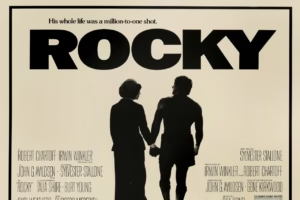
It was a movie, the biggest Hollywood grosser of the year. Everyone went. The tag line on the original poster said it all: “His whole life was a million-to-one shot.”
“Rocky” was hokey, sentimental, dealt freely in stereotypes. But it summed up, without even trying, what a spectacularly new thing in history America was, because the meaning of the movie was the American promise: Anyone can come from anywhere and become anything.
The mook from the mean streets can become a champ. That’s all. It’s the oldest story in America.
Movies, like people, have a historical context, and Rocky’s was Watergate, Vietnam, a bad economy, high inflation. People were feeling stupid to have believed all those things they believed in World War II. And the little movie came along and lifted everyone’s spirits, reminded us of the romance in the realism.
They started filming in January 1976; the no-name actor who wrote the script, Sylvester Stallone, would star. They shot it quickly and for just more than $1 million—it was rough and scrappy filmmaking, handheld cameras and insufficient permits and permissions.
Rocky Balboa is a stumblebum club fighter making $65 a fight and working on the side as collection man for small-time mobsters. He can’t pay for his locker at the gym, lives alone in a rented room with two pet turtles and a poster of Rocky Marciano on the wall. There’s a girl named Adrian who works in a pet shop. He goes by, tells her the parakeets are like “flying candy.” She’s shy, he woos her.
Rocky by his own description: “I’m a plate of leftovers.” “I’m at least half a bum.” Adrian thinks maybe she’s half a bum too.
Still, he’s a fighter, respects his craft. And she is grateful to be loved.
Here enters Apollo Creed, heavyweight champion of the world, a brilliant showman inspired by Muhammad Ali. The anniversary of 1776 is coming, and Creed wants to put on an extravaganza, a Bicentennial Super Battle, a title fight to make money. But nobody will fight him. So he comes up with an idea—a title bout in the city that started America, Philadelphia, and he’ll give some local fighter a chance, some “snow-white underdog.”
“This is the land of opportunity, right?” They choose Rocky Balboa, who calls himself the Italian Stallion. Italians discovered America, right? Creed asks. The people will love it.
Aspects of our racial theatrics were well in place, were well-worn clichés, 50 years ago.
And so Rocky begins his famous, punishing regimen—up at 4, five raw eggs for breakfast, running through the streets and up and down the steps of the grand Philadelphia Museum of Art, sparring with slabs of beef in a meat freezer.
The night before the fight he confesses to Adrian, “All I wanna do is go the distance.” If he’s still standing at the end, even if Creed has busted his head open, “I’m gonna know for the first time in my life that I weren’t just another bum from the neighborhood.”
Creed enters the arena the night of the fight dressed as George Washington, on a big white horse, throwing dollar bills at the crowd. The crowd adores him.
The first round, he toys with Rocky—stinging jabs, taunts. Rocky knocks him down. Creed has never been knocked down. His corner man tells him, “He doesn’t know it’s a show, he thinks it’s a fight!”
The next few rounds are the Battle of the Somme, endless bombardment but the battle lines don’t move. Rounds 7 through 14 are Verdun, brutal attrition, with lines collapsing and re-forming. When Creed knocks Rocky down, Rocky’s trainer desperately shouts, “Stay down!” But Rocky gets up.
Final round they’re exhausted, bloody.
The bell rings. Rocky’s still standing.
The judges call a split decision.
And here in the melee in the ring, in his great moment, Rocky doesn’t boast or dance, turns away from the mics being thrust in his face. He just stops, and bellows out the word that means most to him.
“Adrian!”
The mouse of a woman who believed in him, who helped him, a nobody just like him, mouse to his mook.
“Adrian!”
Because the point of everything is love, the central fact. Because love, for a person, a people, God, is all that matters and in the end all that’s left.
She isn’t a mouse now.
“Rocky! Rocky.”
And she fights through the crowd, through the hulking mob, to get to him.
There are finer moments in American cinema, more brilliant, more profound and poetic, but there is no greater moment in American cinema. And if you aren’t moved by it, there is something wrong and you must investigate your sodden heart.
Anyone from anywhere can become anything. Life is hope. (Let Brunson try a 3, Anunoby will tip it in!) And the most crazily hopeful of all lives are lived, still, here. Why do you think the immigrants come?
The old parchment proclaims we are all equal, free, and deserve a shot. That’s the romance of this old place, and must stay the realism. This coming big birthday let’s just remember. And remind.
“This story shall the good man teach his son . . .”