The broader subject here is getting through times of national trauma, and I’m thinking mostly of parents and young people. I have my mind on three truths. They are about personal as opposed to political behavior.
• You are the gatekeeper. Our society can’t live without wise heads who set and maintain standards. In the past week of shock and mourning people mentioned the Zapruder film. They’d all seen the terrible, immediately available, widespread video of the shooting of Charlie Kirk, and his bleeding to death. In days afterward they’d say, “That must be like the Zapruder film when JFK was shot—you all had a lot to process.”
No. We didn’t have to process it because we never saw it. The gatekeepers of the media wouldn’t let the American people see the president’s head shot off. It would be too gruesome and demoralizing, and too inspiring for the mentally ill.
A heartbroken country didn’t need that extra helping of anguish. So they spared us.
Life magazine heard about amateur photographer Abraham Zapruder’s 26-second color film of the shooting of the president, and rushed to buy it. One week after the assassination, its editors rushed out an issue including selected frames of the film, in black and white. They didn’t include the head-snapping moment of the fatal bullet, and left out other bloody parts.
Hardly anyone saw the Zapruder film until ABC showed it in 1975. Since the rise of the internet the film has been uploaded interminably, giving the impression it was always there. But the gatekeepers saw to it that it wasn’t: They didn’t want shock to become rage and rage to become more sick actions.
I should note the gatekeepers in those days were a few dozen men who ran the big newspapers, magazines and broadcast news divisions. They are fairly accused, in retrospect, of a certain cultural narrowness and too-uniform political views. But they were real patriots, sophisticated, and they’d been through World War II and Korea and knew what death was. Even when it’s common it’s a thing of awe. It’s intimate, it has to do with your personhood, and when a man dies on the field you cover him up, you shield him even in death from someone’s gross or careless gaze. You respect death.
The gatekeepers are long gone and will never return, but we can’t live as a healthy society without them. We prove this every day.
So you have to be the gatekeeper for your family. You have to be the gatekeeper for yourself. You have to hit delete as the stain tries constantly to creep in, you have to look away and guide others to look away. The school has to be a gatekeeper (removing smartphones from class is a gatekeeping action).
We are all gatekeepers now.
• Hold the line. In spite of what we are seeing all over, how inundated we feel about bad actions and bad indexes, you have to maintain faith in yourself and your neighbors. Gratitude for them too: They’re under the same cultural and societal pressure you are, and hanging in. Keep healthy those parts of life you can have a real impact on. Be a leader of your family, friends, kin and colleagues.
All week I’ve been thinking of the impromptu remarks of Gen. James Mattis, the defense secretary, in August 2017. America was erupting—the end of a hard-fought presidential election, a new presidency, Charlottesville. Gen. Mattis was travelling outside the country and met up with some U.S. troops deployed in an undisclosed location, believed to have been Jordan. “You’re a great example for our country right now that’s got some problems—you know it and I know it,” he said. In times like this, “you just hold the line, my fine young soldiers, airmen, sailors, Marines. You just hold the line until our country gets back to understanding and respecting each other and showing it—being friendly to one another.” The only way this great big experiment you and I call America is gonna survive is if we’ve got tough hombres like you.”
What a cheer they gave him. It’s good to keep your values, do your duty, protect your own compass—and to be appreciated. All parents have to be tough hombres now, and hold the line.
• Class isn’t everything but it makes everything better. Class is a word old America used in a certain way, not as we use it now, as a socioeconomic designation. In the older meaning it spoke of a quality, a style, a quiet superiority of character. It existed at a distance from wealth or circumstances of birth. It had a moral quality. If you had class you did the right thing, you behaved in a way that was generous, courteous, conveyed inner stature.
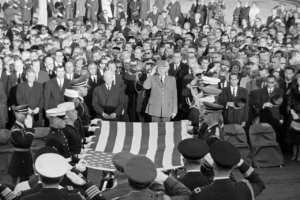
Here are examples from history of class. Lincoln filled his cabinet with critics and old foes, forgave them, and enlisted them to use their critical powers to help him govern. Jackie Kennedy, in trauma, maintained physical and emotional elegance, and form—the catafalque for her husband had to be like Lincoln’s because history itself would be a guest at that funeral. George H.W. Bush refused to embarrass the leaders of the Soviet Union when their system fell, but offered a hand to help their nation recover. Winston Churchill, when his adversary Neville Chamberlain died, eulogized him in a way that explained him better than he’d explained himself, and located him in a line of English lionhearts.
Ronald Reagan in 1984, on his way to a historic 49-state election victory, and knowing he could make it the first 50-state sweep in US history, did . . . pretty much nothing to get that 50th state. A few visits, a quick appearance at the end. He could have zeroed in. But it was the home state of his opponent, Walter Mondale, and it’s good to beat a man when the stakes are high but you leave him his pride. The painful night of his loss, Mondale won Minnesota by 3,761 votes—0.18% of the total.
That’s what class looks like. The young don’t get to see it so much on the national stage, but that’s how it looks, at least in politics.
This Sunday there will be a memorial service for Charlie Kirk in a stadium in Arizona. Grieving, heartbroken people will attend. May they have and show dignity.
I think of the mourning styles of the Kennedys and Kings—strength, quietness, stricken faces.
Because JFK was a sitting president the great leaders of the world came—Charles de Gaulle, figures like Haile Selassie, “The Lion of Judah,” and old Éamon de Valera. A television producer on Pennsylvania Avenue yelled to the control room on an audio line: “Give it to me, I’ve got a street full of kings!”
In the march behind Martin Luther King’s casket were regular people. But the same mood prevailed—maturity, dignity, an acceptance of the pain of life, which comes to all, and a knowledge that grief doesn’t wave its fist and yell, grief etches itself on a face so that when you see it you will never forget. They were so above anger.
When you have real depth in such circumstances you’re a mourner, not a manipulator, and you’re not presenting yourself as a political being, because you’re bigger than that.
You’re a person of dignity, acting as a gatekeeper, holding the line.