All media this week rang with Ted Turner’s achievements, and if you lived through his rise, the sound of his name brought a wistful smile. What a crazy, fabulous American man.
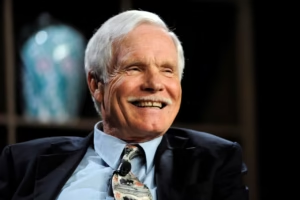
He bought MGM’s library of films and invented Turner Classic Movies to play them; he bought the Atlanta Braves, put them on his superstation and called them America’s Team. He flirted with bankruptcy, placed big bets, took big swings, captained the winning yacht in the 1977 America’s Cup and, at the end, was too drunk to finish his victory speech on live TV. The man was epic.
He told Ben Mankiewicz of TCM that he wasn’t a maverick. “I just thought a lot. I was smart enough to . . . think things through.” He knew people would want 24-hour movies, great ones, classics, but silly ones too, because silly is part of life. “People like old stuff.”
Every thought worth uttering, everything that is true, can be said in plain, clear words, and often quickly. Ted Turner spoke as if he knew that.
But it was 1980 and CNN, which he invented out of nothing, was his great achievement. His stated philosophy: The news is the star. He believed this for two reasons. One was the news was, literally, what he was selling—24/7 TV news from all over the place. The other is that the idea of a 24-hour all-news television channel was so stupid—there was no proof people wanted this!—that the only people who would work for him were guys who had crashed out of the broadcast networks, kids nobody heard of, and people who were good but hadn’t hit stardom. He didn’t have stars and made a virtue of it.
Eleven years in came the indelible event, the Gulf War. Everyone wanted to know what was happening, and CNN was on the ground in Iraq with reporters, cameras, sound crew, a bureau. The night sky, the fiery explosions in the distance, the satellite feeds straight from Baghdad, the world watching a war, live. And the correspondents—Peter Arnett, Bernard Shaw, who said, “The skies over Baghdad have been illuminated.” It moves you, the memory of the excellence of it.
They were stars now. For a long time after that, when something big happened, you’d call your friends and you didn’t say, “Put on the TV,” you said, “Put on CNN.”
Turner’s death has me thinking about the world in which he rose. He was born into a political and economic context that simply allowed him to be him. That was good because we need renegades, brigands and pirates, we want their visions and breakthroughs, we want their spirit—go for broke, trust your brain, be wild, insist, announce you are here. (How many jobs—livelihoods that allow a family to be stable and continue through time—did Ted Turner create?)
America is going to be making its decisions the next two, four and 10 years on what economic direction it wishes to go. I continue to sense a departing from past assumptions about the efficacy of economic freedom and free markets. I see a rising tide of progressive economic thought and a coming together, to some degree, of populist right and populist left. Inflation erodes confidence in the future; the psychic blow of 2008 still reverberates; young voters, especially millennials, remember those days of anxiety. Capitalism sure didn’t look good and had very few regular, articulate and compelling defenders. What I see coming is a rising thirst for safety and a kicking away from the world that made Ted Turner possible.
Things happen like this in history, countries take turns, sometimes gradual, sometimes abrupt. “The system” readjusts itself so it can always work in some rough way. Right now we should concentrate on making sure the fundamentals survive.
Here are two things that would help.
There was a legitimate and timely argument rising earlier this century that was accidentally killed off by the important person who voiced it. “If you’ve got a business—you didn’t build that. Somebody else made that happen,” said Barack Obama, campaigning for re-election in 2012. He was pilloried. It would have been political malpractice for Republicans not to pillory him. He sounded a lot like someone whose hidden resentments had found expression in sophomoric ideologies! But what he meant, it is fair to infer from the text, was that nobody builds alone.
And that is true: No one who makes it in America does it alone. Every billionaire who invented something in the garage traveled on roads the lowest-salaried taxpayers contributed to. They paid for the schools that taught that Silicon Valley work force. Taxpayers gave the tech titans an economic and political system that allowed their flourishing. That system was, literally, won and protected with the blood, sweat and valor of tens of millions of soldiers. The Mark Zuckerbergs and Bill Gateses did it with help.
And what they owe those who made them possible is loyalty. If you become Andrew Carnegie, you fill the nation with libraries so that poor kids can read. Free-market capitalism can continue only if those who have won show allegiance to their fellow citizens. Do our tech titans show this? Are you feeling the love?
Second, if you are a mighty figure in politics as opposed to business, you shouldn’t besmirch the reputation of economic freedom with crony capitalism. You make a great thing look dirty when you’re dirty.
All the winners need to clean up their act. We have to continue an economic system in which there is plenty of space for vitality, for animal spirits and wild creativity, for investments of money that are actually an investment in the future because they’re made on the assumption it will exist and be bright.
Freedom is messy and ugly, but it’s the only thing that works. It is the only condition that creates beauty. It creates the wealth that lets us push our way past our constant failures of personal compassion, sympathy and encouragement, so that those who don’t win are fed and housed and can live.
A word about this moment. Its mood is poor. We’ve gotten sodden and heavy in our thinking about our world—we live in late-stage capitalism in the postliberal order in an ever-falling Rome. Populist intellectuals have fallen half in love with death. Nukes, pandemics—we’re all just holding on. Only the greediest dullards seem to have kept their focus.
It makes everything feel sad, defeated. As a way of thinking it is understandable, but it doesn’t help us. And it’s unworthy of life.
We have to proceed with spirit, with energy, in spite of everything, an energy that amounts to a kind of love. “The lift of a driving dream,” Richard Nixon called it. We aren’t truly ourselves without it.
Once in a Playbill before seeing “Long Day’s Journey Into Night,” I read that Eugene O’Neill believed tragedy brought “an urge toward life and even more life.” Yes. Let the horror leave you hungry. Buy that team, man that station, win that race and get so drunk you can barely grip the champagne bottle to wave it in the air. It’s the only way to go, to be.