I want to mention America’s wide-openness. I don’t mean our traditional openness to foreign-born citizens, which is its own triumph, but our wide-openness to ourselves. It is unique to us, a tradition and a thing of lore.
The thought is prompted by the death this week of the movie critic Rex Reed, 87, who was the object of an affectionate appreciation by his friend Merin Curotto, who was Reed’s editor at Observer.
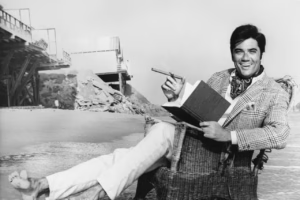
Ms. Curotto tells of a Southern boy who knew no one, had no connections in the professions to which he was drawn, entertainment and journalism, and rose to the top. Reed was born in 1938 and adopted by a family in Fort Worth, Texas, and was an only child whose family moved around a lot. He attended more than a dozen schools and found permanence “not in places or friendships, but in the movies,” which he loved from childhood. He went to Louisiana State University, studied journalism and “interviewed anyone who came South to make a movie.”
When Paul Newman, Lee Remick and Orson Welles came to Baton Rouge to film “The Long, Hot Summer” in 1957, it was big local news, and Rex showed up to cover it for the school paper. His friend Elizabeth Ann Cole begged to tag along. “She caught the acting bug so severely that she dropped out, moved to New York, changed her name to Elizabeth Ashley, and landed on the cover of Life within a year.”
Reed moved to New York, took a job in movie publicity and was laid off. “The firing liberated him.” He began freelancing show-business profiles. Ms. Curotto quotes Reed: “I took the lowest form of journalism—the celebrity interview—and did something with it. For a boy with no money who didn’t know a famous soul to come to New York and make a name in journalism, that was no small achievement.”
He wanted to live in the famous Dakota and bought an apartment there before he had furniture. His first night the doorbell rang. It was the celebrated film actor Robert Ryan, head of the co-op building’s board, welcoming him. Talk about dreams come true. Reed went on to write, act, and become a quirky and incisive film critic. He was operating at the top of the celebrity world as America was becoming Celebrity Nation.
But the important part is he knew nobody, had no connections, no family ties, no history, and the whole system was wide open to him.
It’s very open here. It still is—you can zoom up to the top and the top will accept you and say “Hello, whattaya got?” It’s an attitude of spaciousness built into a system of economic freedom, and we don’t want to lose it.
You can think, within two seconds, of stories of nobodies who became somebodies. In business you can go from before Andrew Carnegie to after Steve Jobs. Beyond business you’ll think: Lincoln in the dirt-floor log cabin becomes president, Oprah Winfrey of rural Mississippi hardship invents a media empire. You could think of Yip Harburg of Manhattan’s Lower East Side, whose father worked in a sweatshop and who went on to write “Over the Rainbow” and “Brother, Can You Spare a Dime” and became a reigning Broadway presence. Jay-Z, from public housing in Brooklyn, became a cultural powerhouse, and a wealthy man.
The wide-openness of the system in which they rose has always distinguished America—it’s part of our mythos, our ethos, our style. And it’s no accident.
All this is so obvious it feels embarrassing to talk about. But I continue to think about the political challenges to our traditional ideas of economic freedom that will be coming the next few years. We will be grappling with fundamental questions. How to approach the idea that a lot of capitalism has devolved into some kind of financialism in which people who are good with numbers move them around and get rich? How to solve the problem of a tech universe that produces wild and awesome wealth, the concentration of which seems weird, unnatural? And what about artificial intelligence? All that is going to be decided by voters in the next decade or so.
But the answer isn’t socialism, the old idea that is rising again. Free-market capitalism is a vast, imperfect mess of a system but it was created and evolved with wisdom. In America, new wealth and success wouldn’t be tolerated by establishments so much as taken as proof that America got the economic end of things right. There would be no unseen ceilings, no sense you don’t go beyond your station, as there was in old Europe.
And things were set up so you could rise quickly—you could go from Irish peasant to American working-class family, then to division manager, Wall Street titan, Broadway producer. Because it could happen so quickly, it was witnessed. When you witness something you believe in it. Clarence Thomas and Sonia Sotomayor came from little in a material sense, he from tiny Pin Point, Ga., she from a Bronx tenement and later a housing project. They are now on the Supreme Court. Did that little boy and that little girl understand who they’d be in history? Well, they’d probably seen others rise. They’d been witnesses too.
This faith that you can change and improve your circumstances—it has a powerful effect on a country’s temperament.
Is it unbelievably corny and retro to say free-market capitalism was built for the little guy? Let’s be corny and retro. In Europe the bankers backed people they knew socially, those with a name. In hungry America investors would back people with no name but a brilliant idea. That could be anybody. It could be young, deaf Thomas Edison.
Private property, the rule of law—in the American system common people could make binding agreements, own property, open businesses. You didn’t have to be fancy to own something. Bankruptcy laws helped, by making failure survivable. You fail and try again without being destroyed.
None of it is perfect, it was never perfect. Other systems have geniuses too, but America like no country before it offered its geniuses a stage and a chance to star in the show.
State socialism has always been constrictive, heavy, static. It has trouble creating anything, it isn’t fizzy and alive. What it does is allocate. But allocators always and inevitably favor their own interests and networks. In the Soviet Union the governing class, those who held the party posts—there’s always someone in power, in every system—tended to be mediocre and hackish at best, utterly corrupt at worst. Their system didn’t work and couldn’t grow, and the geniuses were denied a stage.
American free-market capitalism generates—it allows things to be brought to life. Socialism merely distributes what is. And in the end it always relies on lies, the first of which is always that it works.
Our way of doing things is unpredictable, chaotic, and can break your heart. People compete, and competition can be painful. People lose. But our system was invented to grow, to throw off wealth and energy, and make room for you. That’s what we have to make sure continues, its fantastic wide-openness.