Epstein Is a Failure of the 21st-Century Elites What the story is really about is unloved girls, let down by parents and ‘the people who run things.’

We are thinking still about Jeffrey Epstein. I first wrote of him in these pages days after his death on Aug. 10, 2019. Why does his story have such a hold on America’s consciousness?

To state the obvious, it is a moral horror show. From the federal indictment released on his arrest on sex-trafficking charges on July 6, 2019: “Epstein sexually exploited and abused dozens of underage girls by enticing them to engage in sex acts with him in exchange for money.” They “were as young as 14 when he abused them and were, for various reasons, often particularly vulnerable to exploitation.” Some “expressly told him they were underage.”

There is the conspiracy aspect: His background was known by the most powerful people in America, many of whom seemed to protect him with their presence.

Abuse survivor Lisa Phillips at a press conference

There are the mysteries, only one of which is how he died. He was on suicide watch in a special cell, a high-value prisoner, internationally famous. But the guards somehow weren’t watching, the cameras not functioning. His death occurred in the middle of the night on a high-summer weekend, with Manhattan a ghost town. Meaning, essentially, that no one who was experienced and accomplished was on duty anywhere—on the news desks, at the jail. Exactly when a professional killer might kill someone. A suicide is usually a person in emotional extremis. A professional would game it all out.

It is a mystery why President Trump changed course and tried to thwart disclosure of information. Is it that his name was all over the files? But people would expect that, he was longtime friends with Epstein, everyone’s seen the pictures. His own reputation with women has always been gutterish. A scandal is when people are surprised. Is he afraid of the press, of the Democrats? Since when, that’s all factored in. An occasional aide to the president told me with no humor in his voice that Mr. Trump fears releasing all documents might reveal judicial proceedings such as grand-jury testimony, and Mr. Trump doesn’t want to appear to be usurping the judiciary. Oh please, I said, he has zero history of fearing to usurp judicial authority.

Mr. Trump doesn’t normally fear being bold—tariffs on everyone! Why no boldness here? I am making these files public, and doing it against my own interests, knowing my enemies will use it against me. But the truth matters more! Then go to Uzbekistan and solve a war. That’s a Trump move, not this stupid dragging stuff he’s done.

But I think the story stays for a deeper reason, something that pings on the national conscience—something barely articulable that’s just there, like a cloud we all operate in.

What the Epstein story is really about is unloved girls. It’s about the children in this country who aren’t taken care of, who are left to the mercy of the world. It’s about teenagers who come from a place where no one cared enough, was capable enough, was responsible and watched out for them. That’s how most of those girls wound up in a room with Jeffrey Epstein.

Here is what sexual abusers of children know: Nobody has this kid’s back. Mom’s distracted or does drugs, dad isn’t on the scene or doesn’t care. The kids are on their own. Predators can smell this, the undefended nature of their prey.

It’s what the Epstein indictment meant when it called the children “particularly vulnerable.”

It’s what Virginia Giuffre reports in her posthumously published memoir, “Nobody’s Girl.” She says she was sexually abused by her father starting at age 7, that she was later molested by a friend of her parents. She was a runaway at 14, lived on the streets and with foster families. You know who she says drove her to her first appointment with Epstein? Her father. (Giuffre’s collaborator reports in the memoir that Giuffre’s father “strenuously” denied her claims.)

You could see this kind of pain in the tears of Epstein’s victims on Tuesday morning on Capitol Hill, as they held up pictures of themselves at 15 and 16—how they looked when they were caught in Epstein’s net.

By coincidence the New York Times recently reported on newly released court documents containing new information about the girl involved in allegations against former Florida Rep. Matt Gaetz. Reporter Michael Schmidt’s lead: “She was 17 and a high school junior in Florida. She was working at McDonald’s. And she was living in and out of a homeless shelter.” Hoping to buy braces to fix her teeth, she went on a “companionship” website, lied about her age, and, it is alleged, in time met up with Mr. Gaetz at a party. The House Ethics Committee determined there was substantial evidence Mr. Gaetz had sex with the girl. He denies it, and denied it again to the Times. He went on to be chosen by Mr. Trump to be attorney general, and dropped out of Congress in the furor that ensued. The girl dropped out of high school and moved.

Regular, beat-up people know all this in the particular, the wealthy and successful only in the abstract. Even the worst of the latter who don’t have it in them to be good parents have the resources to erect protections around their children—therapists, counselors, nannies, trainers of all sorts. But those without resources give their children no structures or protections.

You know who they rely on to protect their kids, in a funny way? “The people who run things.” Schools, the businesspeople, “the establishment” that sees to society’s order. But in the past few decades those people have become embarrassed by the idea of moral authority, or that they should wield it. They no longer respect their own authority. Nobody wants to be the old guy saying, “What’s going on in that house with the teenage girls going in and out?” Nobody wants to be a Karen. Nobody wants to be unsophisticated, or a prude. So everybody looked away. They were busy, distracted, packing for a trip on Epstein’s plane.

The part of the story about the celebrities is that they weren’t just celebrities. They were the most powerful and successful people in America. And they maintained their friendship and association with him after June 30, 2008, when he first pleaded guilty, in Florida, to charges of solicitation of minors for prostitution. Before that date he was “millionaire playboy Jeffrey Epstein.” After that date he was a criminal who preyed on children.

You couldn’t know him, because if you are one of the most successful people in America it is your job to shun those who behave criminally against its children, not to add to his power: “There’s Bill Gates,” “That’s Bill Clinton.” “Jeffrey knows all the big people, there’s no escaping him.”

Part of what’s driving this story isn’t “conspiracism” or “mystery,” it’s a feeling of betrayal. “America gave you everything and you can’t even imitate standards that might protect our kids?”

The Epstein story was another failure of the 21st-century elite. It wasn’t Iraq or the 2008 economic crash or open borders, but it was of a piece, and it packs a cultural wallop we’ll continue to feel for years.

What Do Mainstream Democrats Stand For? Kamala Harris’s memoir gives you little idea of what she believes. John Fetterman’s is better.

Earlier this week everyone piled on congressional Democrats, or furiously defended them, over the government shutdown and its end. It was the longest in U.S. history, 43 days, and utterly pointless. When it was called I thought of Albert Brooks in “Broadcast News,” who asked, of a different predicament, “Does anybody ever win one of these things?” No, not the administration, not its opponents, not federal employees, not the country. Shutdowns are a trauma without meaning.

All this had me thinking about an aspect of the Democratic Party’s recent divisions. Its main split isn’t only between left and way-left but between those who don’t seem to know why they’re in politics and those who do. The latter are often socialists, who have the advantage of an articulable belief and are driven by it.

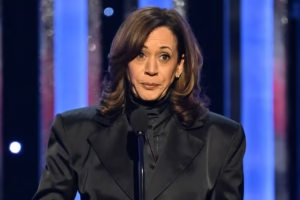
Former Vice President Kamala Harris

I spent the week reading two memoirs. Kamala Harris’s “107 Days” is about her 2024 presidential campaign. Its title is her defense: She only had 107 days to win, and it wasn’t enough, so she lost. John Fetterman’s “Unfettered,” is about his political life so far. They are strange books in different ways.

In Ms. Harris’s memoir any guiding political philosophy is absent, which is odd in someone who wished to occupy the nation’s highest political office. You should at least go through the motions. Mr. Fetterman does come alive on the subject, but mostly when he’s talking about Republican stands he agrees with.

Ms. Harris’s book is insistently shallow, almost as if that were a virtue, a sign of authenticity. The epigrams she presents at the beginning are weird. There is a quote from an Italian software engineer named Alberto Brandolini: “The amount of energy necessary to refute bull— is an order of magnitude bigger than to produce it.” The next is from a Kendrick Lamar lyric: “I got loyalty, got royalty inside my DNA.” The former is bitter, the latter bragging, and it’s a rather bitter, bragging book. I think she was trying to signal there will be no intellectual heavy lifting, but do readers need that warning?

She comes alive only over tactics, strategy, how something plays. “The Trump team announced that he would be on the Joe Rogan Experience podcast.” She is interested in media, in how the shot looks and the interview is spun. Her days on the trail begin with “a fifteen-minute briefing on how the campaign was landing in the news.”

She has to “read through important briefing papers before going onstage right after Grammy winner Cardi B.” She worries an election night statement “didn’t have a feel-good line.”

When Joe Biden called to tell her he was dropping out, she pressed for his immediate endorsement. Her argument: She was “the most qualified and ready. The highest name recognition. A powerful donor base.” Also she wouldn’t betray him. She lists no other, more national concerns.

The closest she comes to a political philosophy, a driving force that explains her career, is “I want to keep people safe and help them thrive.” But few enter politics to see constituents endangered and withering. She sees herself as generous in her concern for others—“I’ve always been a protector”—and, again, loyal. But these are personal qualities, not beliefs.

Without realizing it she comes close to a reason for her loss when speaking of illegal immigration. She refuses to call it that, insisting instead on “irregular migration.” She thought new investments south of the border by U.S. companies would stop it.

A revealing anecdote. Shortly before her crucial debate with Donald Trump, Mr. Biden called, she assumed to wish her well. She was in curlers and makeup. He told her some “real powerbrokers in Philly” had told his brother that they weren’t supporting her because she’d been saying “bad things” about the president. He “rattled on”; they rang off. “I just couldn’t understand why he would call me, right now, and make it all about himself. Distracting me with worry about hostile powerbrokers in the biggest city of the most important swing state.” He does seem faintly impaired, or at least like a mean old man.

The head of a party, its presidential candidate, should, in a book, be able to explain her own philosophical beginning points. That she couldn’t or wouldn’t speaks of some of why she lost. But this is also a flaw now with many Democratic office holders of the nonsocialist left.

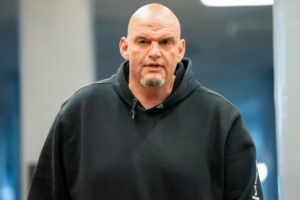
Senator John Fetterman

In John Fetterman’s “Unfettered” you have to infer his political philosophy but he doesn’t make it hard for you. America is a “contradiction,” a place of haves and have-nots; he wants the “struggling” to know they have “an authentic advocate.” He began his political career as a mayor in Western Pennsylvania steel country, with closed-down steel mills and boarded-up Main Streets. He says that since childhood he felt like a loser and became a loner and is drawn to those on the losing end. Government can play a role in helping destroyed small towns come back. He goes deep on his personal experience of depression following a life-threatening stroke and just after his election to the Senate. His portrait of his breakdown is harrowing and believable.

He wanted Bernie Sanders’s endorsement for Senate—“I never shared his support for socialism,” but they “shared some values.” He’s pretty angry. He’s still mad at Mehmet Oz, his Senate opponent, and takes a hard poke at journalists in general and a few in particular. He says he dresses the way he does because he looked like Andre the Giant as a kid, always had trouble finding the right clothes, hates to remember it and now only wears things that are comfortable. This is believable but insufficient: Being grown up carries a price, and part of it is looking like one.

He doesn’t mind talking about where he stands and why, isn’t afraid of big issues, and is most animated when speaking of his nonprogressive views. He stands with Israel, marshals his arguments, smacks those who imply that it “has to do with impaired mental health.”

“I don’t take positions for my own self-interest,” he writes. “I take positions based on what I believe is right.” His stand on Israel has cost him support “from a significant part of my base, and I’m well aware it may cost me my seat. I’m completely at peace with that.”

He broke with Democrats on illegal immigration. “Some in our party assert that an open border is a compassionate policy but I don’t agree. An open border . . . is chaos, both for those immigrants and for those citizens impacted by the overwhelming number of people coming in who need assistance.” At its Biden-era height 300,000 foreigners entered the U.S. illegally in a single month, he says. “That is effectively the city of Pittsburgh showing up every thirty days.”

The Democratic Party, he says, knowingly lied that the border was secure. He believes this was the deciding factor in the 2024 election.

It’s a relief to hear a major political figure speak of at least some of his beliefs and why he holds them. Moderate Democrats should do this more.

Zohran Mamdani knows exactly what he stands for. They’d better, too.

Take Mamdani Seriously and Literally In 1932 and 1980, major ideological shifts lasted for a while. This century we swerve back and forth.

What happened Tuesday is serious and big, but I start in a roundabout way. Throughout the 20th century it was the general way in American politics that when you made a lurch—1932 was a lurch left, from the presidency on down, 1980 a lurch right—you stuck with the lurch a while until you moved on, usually toward the center. In this century we lurch around more. This might suggest an enduring dynamism (strong people don’t fear new directions) or a constant fevered state (the weak thrash about). Whichever, we’re lurching, and afterward trying to understand our own logic.

An aspect of the modern conservative disposition is that we like the arts, culture and technology to be interesting and exciting, but we prefer government be boring, a stabilizing force while we act up in other areas. But it’s never boring now and likely won’t be in this century. Too bad.

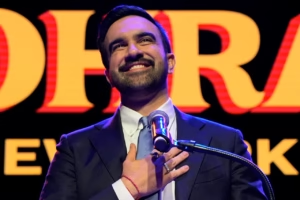
New York City Mayor Elect Zohran Mamdani

So, on to Tuesday night’s returns and the Democratic sweep.

Yes, it was Donald Trump (both his substance and style) because everything is. We warned here that his workplace immigration raids would offend even his supporters; Hispanics, who’d been trending right, snapped back left across the board.

But it was also, obviously, what used to be called the high cost of everything, and a sense the government isn’t doing much in that area. And I believe it was that so many people feel that what stability they have is provisional and temporary. Artificial intelligence is coming to eat your job, you better have a thick social safety net when it does.

I want to focus on New York, which did the biggest lurch. In 2021 it elected the most conservative Democrat for mayor. This time it chose the socialist.

Zohran Mamdani got the mandate he wanted, and it was big. He broke past 50% in a three-man race as a declared, not hidden, socialist, the first such mayor in New York. He did this at 34, with no real résumé, and as a Muslim, again a first. It is a most extraordinary achievement.

And he didn’t come to do nothing. Alexandria Ocasio-Cortez was elected to Congress in 2018 and went to Washington, where she posed for magazine covers and did TikTok rants. She didn’t accomplish much after she ran into a little iceberg named Nancy Pelosi.

Mr. Mamdani won’t take a page from that book. He’s as serious as a heart attack. He told us in his victory speech. This is a man who six months ago was unknown to the vast majority of New Yorkers and 10 months ago was polling at 1%.

Was he humbled by New York’s open-minded, open-hearted embrace? Not in the least. He delivered a declaration of dominance: “To get to any of us, you will have to get through all of us.” Billionaires “can play by the same rules as the rest of us.” “We have toppled a political dynasty.” “We will put an end to the culture of corruption.” “We will prove that there is no problem too large for government to solve, and no concern too small for it to care about.” He declared a “new age.”

He made Barack Obama look modest and self-effacing.

Van Jones, watching it live on CNN, said, “I felt like it was a little bit of a character switch here.” During the campaign Mr. Mamdani was the warm, embracing fellow with the dimpled smile who loved everyone with an undifferentiated warmth. The night he won, he showed who he was: a serious ideologue who means it.

In a day-after interview in the New York Times he spoke of the size of his win: “It is a mandate to deliver on the agenda that we ran on.” The conversation turned to his plan to raise taxes on the wealthy. In the past he had implied there might be other ways to raise funds for his programs, but not now. “I think that our tax system is an example of the many ways in which working people have been betrayed.” The Times headline: “An Emboldened Mamdani Sheds Conciliatory Tone.”

A good guess: He won’t start out “moderate” but he will be clever, because he is. He’ll focus first on city services such as garbage collection, knowing he can lose it all if he shows incompetence on the basics. He won’t quickly impose the Democratic Socialists of America criminal-justice agenda and allow crime to spike. He won’t wear down popular and respected Police Commissioner Jessica Tisch right away—he’ll wait. But as months go by he’ll be an inch-by-inch bulldozer.

His economic agenda is to hike taxes on millionaires, billionaires and corporations. Nobody minds if he gets another $5 million a year out of a billionaire; even the billionaire will hardly notice. I wonder if the Mamdani administration is going to find out that billionaires and corporations have many legal ways to protect their wealth and profits, but high-salary “millionaires”—people who own a $1.4 million apartment and earn a joint $600,000 a year and have two kids in Catholic school, each with tuition, and are highly taxed (federal, state, city, property and sales taxes) already—are going to get clobbered. I wonder if socialists care about these fine points or just want to raise taxes on “the rich,” any rich, and get the credit with their followers. I suspect the latter. I suspect they think: Why should anyone have a million-dollar apartment when the homeless sleep in the streets?

There will be some interesting aspects of his rule. Mr. Mamdani didn’t just have a million votes; he had 100,000 volunteers. The young who supported him won’t disappear; they’ll do everything they can to help him. Many are underemployed, for many reasons. They’ll volunteer at the public grocery stores. They’ll make lettuce chic. They’ll haul sacks of sweet potatoes through Park Slope, and their hedge-fund fathers will say, “I sent him to Brown for this?” But a lot of us will be moved and cheer them on.

Republicans should understand Mr. Mamdani isn’t your bogeyman to use for your electoral amusement. You think you’re going to make him “the face of the Democratic Party,” in that stupid phrase, and everyone will hate Democrats and you’ll profit without even trying. But he’s cleverer than you, he understands the world of right now better, and in any case he has an ideology he swallowed whole, at father’s knee, with mother’s milk, and has fully absorbed and digested. He thinks he knows his historical meaning. Do you?

It isn’t necessarily true that Mr. Mamdani, unless he is an utter failure, will sour those outside New York on the Democratic Party. Americans think New York is a place apart, a liberal city that will always be New York-ing. In the coming AI crisis his brand of leftism may start to look good to some people. Mr. Trump can’t moderate himself or his policies and will continue to rouse wild opposition. He’s the face of his party.

“Mamdani can’t do anything alone, he needs the governor.” Kathy Hochul is up for re-election, faces a primary challenge from the left, and is surrounded by progressive legislators. She’s your bulwark? Against him?

Take him both literally and seriously.

New York, You’ve Been Warned At the very least, don’t give Democratic Socialist Mamdani an overwhelming win he can call a mandate.

Only five years ago, in the first autumn of the pandemic, the big question was whether New York was over, finished. It was a real debate. The threatened collapse of commercial real estate, the rise of remote work and the growing knowledge you didn’t really have to be here to be at the top of your profession, the financial hit of the pandemic itself, the demonization of the police after George Floyd, the retirements and departures from the New York City Police Department, the rise in crime . . .

Democratic mayoral candidate Zohran Mamdani

We made it through that. We are up and operating again, getting our strut back. Midtown Manhattan is clogged again with impossible traffic, downtown’s booming, people are back in the office and out on the town, Broadway is back.

It didn’t happen overnight, took a lot of moxie and grit, but we made it through. And you wouldn’t think we would be on the verge of handing ourselves a brand new setback in the choice of our next mayor. But we are.

So I guess this piece goes under the heading “Often in life after a bad thing happens, those who allowed it say, ‘I’m not sure we were sufficiently warned.’ ” Here’s a warning:

New York should breathe deep, think twice, then think again before electing the socialist mayoral candidate, Zohran Mamdani. He is barely 34, has never had a real job, was elected five years ago to the state assembly, which is a badge you wear while you scrounge around for attention and connections. This isn’t the résumé of the person you want in a position to guide the future of one of the largest economies in the world.

Different things are needed at different times. With our footing just back, what the city needs is an air of energy, bounce, expansion—more enterprise, more of a welcoming attitude for the woman who wants to open a small store or new restaurant. Make it easier for her. We don’t need more of the dead hand of government; we need to return more of a sense to the young that striving is still a realistic attitude, that grieving for a system that seems broken and can’t fit you in is premature.

Mr. Mamdani’s major stands are famous and often repeated. They involve freezing rents, increasing property taxes in “richer neighborhoods,” and no-cost child care up to age 5. The platform of the Democratic Socialists of America, of which he is a longtime member, is what you would expect—tax the rich, fight police brutality and mass incarceration, free college and medical care for everyone.

How will “the rich” react? They’ll understand all this means taxes and crime will go up, so they’ll be less inclined to stay. In the pandemic we worried as billionaires fled to Florida; now I fear millionaires fleeing nearby. It’s too early to say, everything at this point is anecdotal, but the New York Post this week reported sudden bidding wars among New Yorkers on million-dollar homes in Westchester County and Connecticut: “Real-estate brokers in these suburban markets report a frenzy reminiscent of the early pandemic exodus.” At a recent open house in Scarsdale, the report went on, a real-estate agent said the SUVs were double-parked down the block. “It’s like the Knicks at the Garden right now.”

A young Zohran supporter will wave a hand: Goodbye, who needs you? But every Upper West Side family buying a $1.5 million home in Greenwich was a New York family that threw off a whole world of local jobs and spending—delis, hair salons, babysitters, dog walkers, cleaners, dentists—and every one of them paid the already-high New York City taxes that pay the bills in this town. We’re going to miss them if they leave. Left behind will be the kulaks who won’t leave even after their crops are confiscated.

Mr. Mamdani has long been accused of a deep, persistent antisemitism. I won’t quote the clips suddenly flooding social media, the apparent result of someone’s late and incompetent oppo research, of his saying things that betray to my ear an obvious animus. There is a reason more than 1,000 American rabbis have warned his victory would threaten the safety of Jews.

He closed out his campaign this week unembarrassed to manipulate, implying that if you don’t vote for him it just might be because you’re “Islamophobic.” In a speech outside the Islamic Cultural Center of the Bronx, he said: “To be Muslim in New York is to expect indignity, but indignity does not make us distinct. There are many New Yorkers who face it. It is the tolerance of that indignity that does.”

He said, “I want to speak to the memory of my aunt who stopped taking the subway after Sept. 11 because she did not feel safe in her hijab.”

Here his voice caught. It was quite something. He was talking about the city he is asking to choose him to lead, and accusing it of casual and habitual bigotry. “The dream of every Muslim is simply to be treated the same as any other New Yorker. And yet for too long we have been told to ask for less than that, and to be satisfied with whatever little we receive.” Accounts on X later found that Mr. Mamdani’s aunt doesn’t wear a head covering and apparently didn’t live in New York, and he later said he meant a cousin, who turns out, perhaps conveniently, to be no longer living.

In an embarrassingly self-valorizing way, he vowed, “I will not change who I am, I will not change how I eat, I will not change the faith that I am proud to belong to. But there is one thing I will change. I will no longer look for myself in the shadows. I will find myself in the light.”

Oh please. This man is from the top rung of New York society, his father a Columbia professor who lectures against colonialism and his mother a director whose films have had two Academy Award nominations. A place was made for him in society the day he was born.

More important, New York is such a moving and astonishing place in part because what Mr. Mamdani suggested—fierce and widespread public discrimination against Muslims after 9/11—didn’t occur, and could never have occurred because it is at odds with the city’s essential nature. We don’t like bigotry. We pride ourselves on this. Individuals do jerky things every day and everywhere, but all the messages of this city’s culture are to be open, not narrow, and fair, not unjust. He is probably our next mayor because New Yorkers are more like this than he understands.

History moves and does what it does. The polls suggest that more than half the city opposes Mr. Mamdani, but his opposition is split between Republican Curtis Sliwa, who has no chance, and former Gov. Andrew Cuomo, a Democrat running as an independent, who maybe, maybe, could squeak through if absolutely everything suddenly goes his way.

At the very least, New York, don’t give the Democratic Socialist a mandate or anything he can claim as such. Make it a close one. That might at least limit the setback for a city newly back on its feet and starting to be itself again.

A Republic, but Can We Keep It? From the military and the Justice Department to the East Wing, there’s reason to wonder and worry.

Donald Trump’s supporters are feeling satisfaction after two astonishing achievements: He is the first president this century to establish order on the southern border, and he has secured some new possibility for a Mideast settlement. These are breakthroughs even if they don’t last. But the people in this White House, with every triumph, become wilder and wilder. Their triumphalism is accelerating my now-chronic unease over the sense that the strict lines of our delicately balanced republic are being washed away.

Ben Franklin, famously asked by a woman on the street in Philadelphia what sort of government the Constitutional Convention had wrought, is reported to have said, “A republic, if you can keep it.” The reply was wry and factual but also a warning: Republics are hard to maintain.

Are we maintaining ours?

The demolition of the East Wing at the White House

Democrats worry about our democracy. Is that the area of greatest recent erosion? I doubt it. Donald Trump really won in 2016, you can trust those numbers, and he really lost in ’20, and really won in ’24. Your governor won, your congressman—you can pretty much trust the numbers even factoring in the mischief in any system built by man. When shocks happen—“I just want to find 11,780 votes”—the system has still held. The state of Georgia told the president to take a hike in 2020. If you’ve spent much of your adult life deriding the concept of states’ rights, that moment would have complicated your view.

It isn’t our democracy that I worry about, it is our republic. That’s where we’re seeing erosion, that’s the thing we could lose.

Quickly, obviously, broadly: A republic is a form of government in which power begins on the ground, with the people, and shoots (and is mediated) upward. Power doesn’t come from the top down. The people choose representatives who are protective of local interests while keeping their eye on the nation’s. The government of which they’re part is bound by laws, by a Constitution that is not only a document of enumerated laws but a mean, lean machine for preserving liberty.

The Constitution the founders devised was born of deep study of history, philosophy and human nature. Their understanding of the last was deeply conservative. “If men were angels, no government would be necessary,” James Madison said. They aren’t, so one is.

The American republic would consist of three branches, with each knowing and protecting its specific powers and duties. The legislative branch would have chambers representing the people and the states, holding the power of the purse and the power to make law. Congress would represent.

For the executive branch, the presidency. The holder of that office would be a single person elected by the nation and anticipated to be energetic. The president would act—declare a direction and lead.

The judiciary would be guardian of the Constitution and the rule of law. It would have the power to strike down laws judged unconstitutional. Alexander Hamilton: “No legislative act, therefore, contrary to the Constitution, can be valid.” An independent judiciary would judge.

All three would work together in a system of divided powers; no part would completely dominate. They’d be in constant tension with one another. Madison distilled it down: “Ambition must be made to counteract ambition.” This would tend to limit corruption and keep “eruptions of passion,” to borrow a phrase of Hamilton’s, from swaying things too immediately and dramatically. Madison especially thought pure direct democracy would prove unstable, a too-slight skiff heaved about in history’s seas. A rooted republic would be a mansion that could take heavy winds.

The republic they devised produced not efficiency but equilibrium. It established not only a system but a spirit. It has seen us through for 237 years.

Are we maintaining our republic? Is our equilibrium holding? The last nine months a lot of lines seem to have been crossed—in the use of the military, in redirecting the Justice Department to target the president’s enemies, real and perceived. There are many areas in which you’ve come to think: Isn’t the executive assuming powers of the Congress here? Why is Congress allowing this? The executive branch takes on authority to bend its foes, defeat them. You ask: Is all this constitutional? The president “jokes” that he may not accept the Constitution’s two-term presidential limit. Are you laughing?

The 250th anniversary of July 4, 1776, comes up next year, and many of us are rereading the old documents. The past week I’ve talked to two historians, one rightish, one leftish, and both conversations turned toward Thomas Jefferson’s stinging bill of particulars against King George III in the Declaration of Independence.

They resonate in unexpected ways: “For cutting off our Trade with all parts of the world.” “He has excited domestic insurrections amongst us.” “He has kept among us, in times of peace, Standing Armies without the Consent of our Legislatures.” “He has erected a multitude of New Offices, and sent hither swarms of Officers to harass our people.” “Obstructing the Laws for Naturalization of Foreigners; refusing to pass others to encourage their migration hither.”

The Founders didn’t want any of that. It’s why they created a republic.

The tearing down of the East Wing of the White House also seems, in this context of concern, disturbing. White House defenders dismiss qualms as pearl clutching—a big vital building’s gotta grow, it’s been torn down and built up before, we need more room.

But all this was done without public demand or support, and was done in a way that was abrupt, complete, unstoppable. Congress has the power of the purse for such projects but the president says no, our wonderful donors are paying for it, but the names of the donors were not quickly revealed. Your imagination was forced to go to—why? Might certain bad actors be buying influence? Crypto kings, billionaires needing agency approvals, felons buying pardons, AI chieftains on the prowl. Might the whole thing be open to corruption? Would it even have been attempted in a fully functioning, sharp and hungry republic? Or only a tired one that’s being diminished?

The photos of the tearing down of the East Wing were upsetting because they felt like a metaphor for the idea that history itself can be made to disappear.

I started with Trump supporters and end with them. They feel joy at real and recent triumphs, but deep down are rightly anxious about the world. Artificial intelligence, nukes, everything out of control, a cultural establishment that hates you. We may have to make some readjustments or revisions in our constitutional traditions, we’re in endgame time.

It all gives you a feeling of nihilism, something you’ve never felt in your entire honestly constructive life, and it’s so shocking that for a moment it leaves you giddy, and in the end, having been broken down a bit, you wind up laughing last week at a video in which an American president put a crown on his head in the cockpit of a fighter jet, flies over America, and drops human waste on it.

You just laugh, when nothing like that ever would have made you laugh before, and in fact would have hurt your heart.

Nine months in we’ve got to be thinking about these things.

Trump’s Big Beautiful Gaza Peace Plan If it strikes you as foolish, consider how well the serious people’s ideas have turned out in the Mideast.

Give it to him. Give him your applause. Sometimes pessimism reaches a point of moral error. Sometimes hope is the only realistic approach.

So give it to President Trump, whose White House has produced the first progress in the Mideast since the grave crisis of Oct. 7 began. He announced Wednesday with typically Trumpian words. He called it, “a big, big day, a beautiful day, potentially one of the great days ever in civilization.”

A billboard on a building in Hostage Square in Israel, reading "Thank you President Trump"
A billboard on a building in Hostage Square in Israel

Israel and Hamas have agreed to the first phase of a peace plan to end the Gaza war. It is a 20-point plan so a lot could go wrong, but the first phase includes a cease-fire, Israeli troop withdrawal to an agreed-on line and the freeing of the remaining hostages held by Hamas. Gaza will be governed by a Palestinian committee overseen by a marvelously named “Board of Peace,” chaired, marvelously, by Donald Trump.

When word broke in Gaza on Wednesday, they danced in the streets and chanted; they were still cheering on Thursday. In Israel they went to Hostage Square and sang.

Here any reliable pundit would counsel caution—it could all fall apart, joy may be premature. All true. But I’ll take my joy premature, bartender. If it turns out progress was illusory we will at least have reacquainted ourselves with what optimism in the Mideast feels like—it feels energetic, like something that can get you through the next day.

Sometimes you have to break away from heavy, sodden reality and go straight into joyful idiocy.

I like the Barnum & Bailey aspect of the Trump administration. Other things I don’t—chaos, vengeance, lack of thought about the deeper meaning of things. But I like the circuslike color. It’s human, and government doesn’t always seem human.

I think world leaders are still so shocked by Mr. Trump as a phenomenon that they overjudge his support, and that contributes to his power with them. He walks into the room at some Group of 20 meeting and he’s so outsize, he literally fills the doorway—big suit, big man, big tie, big hair, glower; he doesn’t even try to set his face in a smile. They look at him and think: That’s 70% of the American people. He doesn’t have that kind of support and they know it, but they can’t help thinking of him that way.

Why would a sleek and prowling operator like Bibi Netanyahu accept a deal? Because Mr. Trump scares him, because Mr. Trump is as big an animal as he is. Bigger. The president is aware of and careful with but not afraid of Bibi’s most reliable supporters in the U.S. Bibi has long thought that he essentially controlled and held all the loyalty of the biggest group of pro-Israeli Americans—evangelical Christians. But Mr. Trump, unlike his modern predecessors, has hooks into them and loyalty from them more than Bibi does, and would use it against him. Bibi respects this, being an animal.

Mr. Netanyahu was increasingly boxed in. Both of America’s great political parties are splitting over Israel, no longer in unified support. Democrats are besieged by the young and progressive, Republicans experiencing a pushing away from Israel on the right.

Bibi has a genius for politics and has lasted a long time. He’s been prime minister 17 years off and on since 1996. He knows how to survive.

As for Hamas, they are terrorists whom everyone hates but their own like-minded fanatics and young dopes in the West. They’re half-dead, their money lines less stable, their leadership gone. Time to show a little magnanimity! Of course we’ll free the hostages, we hate sadism!

But I want to pay tribute to the wonderful creative insanity Donald Trump can display on the international front. At moments when the Mideast is blowing up, American presidents always begin to ape the language, preoccupations and granular knowledge of the regional experts, some of whom follow from White House to White House. It’s always into the weeds with them. The settler issue may complicate the loan-guarantee schedule if the ’67 lines are even retrievable. It was all opaque and meaningless and meant to be.

That isn’t what Mr. Trump did in this crisis. He looked at the whole complicated picture, the long history, the writing etched on the stones of the oldest archeological sites, and said: That’s fabulous beachfront property going to waste. We can build a luxury resort with hotels, casinos, beaches, a slide for the kids, decorous bordellos with golden stairways. Actually, what he said, in February, was that Gaza could be “the Riviera of the Middle East” because it’s on the Mediterranean and has “the best weather.” He then posted on social media an AI-generated video showing a “Trump Gaza” tower.

A few days later I saw a friend who knows his foreign affairs and he said, “Do you believe the idiocy of this guy?” And I surprised him: “I kind of liked it. I think I love it.”

Because it was absurdist it changed the picture you have in your head. It was a reorienting thought. The world knows it’s ridiculous and yet—yeah, that land would come cheap, it could be a gold mine! It was so Trumpian, he thinks everything can be a big building with his name on it, but in his insane way he was saying: Imagine it differently. And for a second you did. The region is full of greedy grasping men on all sides, they feel more secure in their palaces when their people are employed, and an 18-year-old boy on the street would think, “I’d like to not live in a sand hole but wear a tuxedo in a casino with girls in sequins walking by.” Can’t we rely on simple human vice for progress anymore?

Here is something the world needs more of. It comes from the old parable of the prisoners in the cell. It has many variations.

A handful of prisoners are chained to a wall in a room and only one of them can see through the window high up. Instead of saying the truth—there’s nothing out there, just air—he describes for his cellmates beautiful scenes: people strolling on the street, a pretty girl, the sun is shining. He dies, a new prisoner is dragged in and put in his chains, he can see the window, they ask what’s outside today. He almost speaks, looks at them, realizes everything. He has a job: Give them something to live for. He looks out the window and says “There’s a parade, and a great princess is walking by in all her finery . . .”

It isn’t bad to give people something to live for.

I close with the special force of the idiotic idea. Sometimes in life you’re an idiot. You make the investment based on insufficient data because you got a feeling in your gut. You marry the guy you met three days ago. Sometimes you go broke and tell your funny story about the importance of due diligence to young investors. Sometimes you tell your story about the Elvis Chapel in Vegas on your 38th anniversary as your grandchildren eat chocolate cake.

It isn’t the worst thing to have a good story to tell. And some do end well.

The Embarrassing Pete Hegseth The Pentagon needs sober, judicious leadership, not a drama queen who makes things jarring and fevered.

A lot of people in the Trump administration think this is their moment and America’s last chance. They know what time it is, you don’t, it’s later in the game than you think, the damage is great and right now is the final hope of constructive national change. A sense of urgency is their central driving force.

Defense Secretary Pete Hegseth

But when people get into a “last chance” mindset, they become insensitive to, less mindful of and careful about, what they come to think of as “constitutional niceties.” When it is constitutional niceties—respecting the other branches’ authority, knowing the limits on your own, knowing what’s your lane and what the traffic will bear—that have kept us going since 1789, when the new government began functioning.

You can lose a republic while trying to save a republic. No matter what your level of idiocy, you don’t want that, you can’t want it, so you have to be careful. And serious.

When you are driven by a sense of urgency you must still try to act like a normal person—normal in your comportment, which means sober, judicious. Not like some pumped-up drama queen who makes everything more jarring and fevered, and who comes across as the living answer to the question, “What would it look like if Captain Queeg took Adderall?”

Which gets us to Defense Secretary Pete Hegseth. His unprecedented extravaganza this week, in which he summoned hundreds of generals and admirals from around the world to Virginia’s Quantico Marine Base to listen to him speak, shouldn’t be lost amid the government shutdown.

It was, as a former general said by phone, “just flat-out bizarre.” It was embarrassing to watch. He made everyone in the audience look smaller, which made their profession look smaller. How does that help America?

Mr. Hegseth instructed them as if from a great height. What he told them is that the woke progressive era in the U.S. military is over. He will have a reset to the “warrior ethos.” “No more identity months, DEI offices, dudes in dresses. . . . We are done with that s—.”

OK. Understood. Understood, in fact, since he was appointed. Mr. Hegseth could have reiterated all this by secure video conference, or just sent a video.

Instead he dragged commanders from their stations to be his audience. So he could pose with a giant American flag behind him like George C. Scott in “Patton,” only Scott delivered a great speech. Mr. Hegseth gave a TED Talk, a weirdly self-reverential one. He paced the stage like a strutting, gelled bantam, like an amped-up actor with rehearsed gestures and expressions and voice shifts.

“You might say we’re ending the war on warriors. I heard someone wrote a book about that.” Mr. Hegseth is author of a book called “The War on Warriors.” I guess he wants us to buy it.

There was braggadocio: “To our enemies, FAFO. If necessary, our troops can translate that for you.” He used “lethal” and “lethality” a lot, like a young Hollywood scriptwriter dreaming up some mad right-wing Army officer because he watched “Platoon” too much as a child, as perhaps Mr. Hegseth did. The frantic drama: “This is a moment of urgency, mounting urgency.” “We became the Woke Department.” “It’s completely unacceptable to see fat generals.”

The retired general later sighed on the phone and said: “I would like you to note that his hero, Norman Schwarzkopf, was fat. And George Patton wasn’t exactly a gazelle.” Sound military leadership has little to do with physical fitness and everything to do with strategic judgment.

Mr. Hegseth also seemed preoccupied with reimposing the military’s height requirement. There goes young Napoleon.

What are we doing in this dangerous world having the head of the Defense Department prance around like this and embarrass the generals he used as his backdrop? Why do his highly placed defenders in the administration think this is good for the White House, or even for Mr. Hegseth?

He is right that the U.S. military must be free of demands extraneous to its mission of keeping us and, yes, the world safer. They are the only Army, Navy, Air Force and Marines we have. We can’t jerk them around with our sudden cultural fevers, they aren’t a welfare agency, our defense structure can’t be the cultural left’s plaything. All of that got out of whack and carried away in the years leading up to and after 2020.

Here we must note we are a nation divided by algorithms. If your algorithm knows you as conservative and interested in military matters, you got a lot of videos of young soldiers and sailors acting out the past few years, and of service branches tweeting out showy political sentiments. You felt understandable alarm. If your algorithm knows you as liberal and not interested in military affairs, you haven’t seen that content, and will have been surprised by Mr. Hegseth’s reference to “dudes in dresses.” We are all getting different versions of reality every time we look at a screen, and it’s hurting us.

Mr. Hegseth is right that woke progressive policies have no place in a merit-based, competitive military, but the military follows the orders of civilian leaders. In any case it should have crossed his mind that he himself, when in service, never reached anywhere near the rank of those he was talking down to. They made military service their profession, stuck with it, rose and aren’t paid like TV hosts. All of them could leave and be better paid as board members and consultants. It wouldn’t be shocking if after Mr. Hegseth’s speech some of them moved up their retirements.

A correction to the past five or 10 years was inevitable and is legitimate. But you don’t want it to be an overcorrection; you want it done competently and with calm moral confidence.

You look at all this and say he’s just aping that vulgarian Donald Trump. Well, Mr. Trump does Donald Trump better. A Trump knock-off is cheaper and tackier than the original. You say Mr. Trump’s speech after Mr. Hegseth’s was even worse—a wild, incoherent and yet vaguely menacing mess. Yes, it was, and was worse because he’s president.

Mr. Hegseth has always had bad press, from the scandals that emerged after his nomination through fairly constant reports about chaos in his office. I thought and said early on he was a poor choice—a television host playing a culture warrior who lacked the weight and gravitas the Pentagon needed. This week the Daily Mail, not an immediate foe of all things Trump, had a story in which Mr. Hegseth was described as paranoid, “crawling out of his skin,” fearful and suspicious.

There are recent reports his Pentagon is putting forward new rules requiring journalists to have their work approved before publication. Where that stands is unclear, but it’s nuts. It makes America look like what our foes say we are, a place of make-believe freedom in which even the press is controlled by the government. Which really would be an urgent matter.

You know why people say something’s wrong with this guy? Because it appears something is wrong with this guy.

Charlie Kirk and the New Christian GOP Religious conservatives were part of the Reagan coalition but are far more central to the party now.

While watching the Charlie Kirk memorial Sunday, I was swept by a memory that yielded a realization.

The memorial, in State Farm Stadium in Glendale, Ariz., has been well described. There was a height to it, and a gentleness, with a few rhetorical exceptions. More than 90,000 people attended. TV and online viewership is estimated to have reached tens of millions.

The Charlie Kirk memorial at State Farm Stadium in Glendale, Ariz.

Halfway through it struck me the memorial might have been the biggest Christian evangelical event since the first visit to America of Pope John Paul II, in October 1979. He was a year into his papacy. “Be not afraid!” he said, and took America by storm.

At the memorial there was an altar call—at a public memorial for a political figure. It was singular, and moving. So was the dignity and peacefulness of the crowd. They didn’t indulge their anger or cry out against the foe. It was as if they understood that would be bad for the country. I couldn’t remember a time a big Trump-aligned group did that, as a corporate act, in the past 10 years. It struck me as a coming of age. They were taking responsibility.

There is something you could have said at any time the past decade that is true now in some new way. It is that the GOP is becoming a more explicitly Christian party than it ever has been. A big story the past decade was that so many Trump supporters, especially but not only working-class ones, were misunderstood as “those crazy Christians” but in fact were often unaffiliated with any faith tradition and not driven to politics by such commitments.

But it looks to me as if a lot of those folks have been in some larger transit since 2015, as Kirk himself was. He entered the public stage to speak politics but said by the end that his great work was speaking of Christ. If he had a legacy, he told an interviewer, “I want to be remembered for courage for my faith.”

The secretary of state of the United States gave personal testimony on what Christ is in history and in his life. The vice president did the same. John Foster Dulles and Hubert Humphrey didn’t talk like this!

The whole thing was self-consciously and explicitly Christian. Kirk’s widow, Erika, talked of new converts and asked the crowd to help them. She said of her husband’s assassin, “That young man—I forgive him.” And she received a standing ovation.

As I watched I realized: This is the true sound and tone of the Republican Party right now. This is the takeover of the previously patronized.

Forty years ago in the Reagan White House, Christian activist leaders and people who spoke of “traditional values” were pretty marginalized. As a group they were treated as part of the GOP coalition: They had a seat at the table, respect was due them, especially at election time, but they were looked down on by many who ran the White House. (The speechwriters were by and large on their side, which was part of why we were often in trouble.)

Opposing them were the famous so-called pragmatists, who were generally moderate in their politics and had to keep an eye on the polls. Both sides felt misunderstood by the other and both were right; things sometimes got sparky.

In my first book, “What I Saw at the Revolution,” I wrote that I’d always detected a bit of “ye old class antagonism” in the split. The pragmatists in a general way came from some high-up backgrounds, the traditional-values folk generally didn’t, so both groups started out seeing America from different levels of observation.

In that book I wrote of a young man named Gary Bauer, who saw an America in which “the habit of religion” was being “removed from public life.” He was a domestic policy adviser, aligned with the Christian conservatives, and one day at a big issues lunch he departed from the topics to be discussed to tell the president of a kid in a public school down South who was valedictorian of her class and wanted to give her speech on the importance of God in her life. School authorities thought it might violate the separation of church and state, and said no.

As Gary spoke he looked around the table. His colleagues were embarrassed for him. We’ve got big things on our plate, and you’re going on about some kid in East Jesus. And they laughed. But President Reagan drew him out, asked what he could do, and sent a letter bucking her up.

As I watched the Kirk memorial I thought: The people in that audience are the sons and daughters of the patronized Christians of that old White House. They had a seat at the table then but are at the head of the table now.

Gary Bauer went on to run the Family Research Council and is now head of a group called American Values. I called and asked for his thoughts: “Over the decades what was taking root then has, I believe, produced the great movement we’ve been seeing, where men and women of faith are the biggest voting component of any Republican victory. What’s different now is that in terms of policy we don’t have to beg for a bone.”

He watched the memorial on television with his wife, Carol, at their home in Fairfax, Va. “I watched for four or five hours—every minute of it! I shed a tear more than once.” He said that what was said at the Kirk memorial wasn’t that different from what had been said at GOP conventions in the past. “What changed is the progressive movement in America has massively swung to the cultural left, and that has simply made the movement of faith-based voters a stronger movement.”

And when Mrs. Kirk spoke, “I don’t know why this especially grabbed me—she said, ‘Charlie wanted to save the lost boys of the West’—and that was just incredible. Young men robbed of their inheritance, taught their countries are worthless, told they’re toxic, they’re the cause of all the problems. We see all the impacts of that. If we can’t save our sons, it’s over.” He thinks America may be at the start of a religious revival.

In the Charlie Kirk memorial I saw a shift in some new way into a more self-consciously Christian GOP, one composed of Christians and those who like or don’t mind them, or feel what they stand for on policy is constructive. The other party will be everyone else.

Reservations? Of course. If it’s true, it feels European—the “Christian Democrats”—and not American. As a Christian I see things through a Christian lens, but big democracies demand many lenses to maintain peace in the political sphere. Modern democracies get through in part by not letting the lines get too vivid, the demarcations too sharp. A big blur can be helpful. But that would be another column. What I think I see evolving is big. That wasn’t just a memorial; it was a stepping forward in a new way of Christians and the Republican Party.

Gatekeepers and National Traumas In 1963, hardly anyone saw the Zapruder film. It was kept from the public by the media’s responsible men.

The broader subject here is getting through times of national trauma, and I’m thinking mostly of parents and young people. I have my mind on three truths. They are about personal as opposed to political behavior.

You are the gatekeeper. Our society can’t live without wise heads who set and maintain standards. In the past week of shock and mourning people mentioned the Zapruder film. They’d all seen the terrible, immediately available, widespread video of the shooting of Charlie Kirk, and his bleeding to death. In days afterward they’d say, “That must be like the Zapruder film when JFK was shot—you all had a lot to process.”

No. We didn’t have to process it because we never saw it. The gatekeepers of the media wouldn’t let the American people see the president’s head shot off. It would be too gruesome and demoralizing, and too inspiring for the mentally ill.

A heartbroken country didn’t need that extra helping of anguish. So they spared us.

The funeral of John F. Kennedy, Nov. 25, 1963.

Life magazine heard about amateur photographer Abraham Zapruder’s 26-second color film of the shooting of the president, and rushed to buy it. One week after the assassination, its editors rushed out an issue including selected frames of the film, in black and white. They didn’t include the head-snapping moment of the fatal bullet, and left out other bloody parts.

Hardly anyone saw the Zapruder film until ABC showed it in 1975. Since the rise of the internet the film has been uploaded interminably, giving the impression it was always there. But the gatekeepers saw to it that it wasn’t: They didn’t want shock to become rage and rage to become more sick actions.

I should note the gatekeepers in those days were a few dozen men who ran the big newspapers, magazines and broadcast news divisions. They are fairly accused, in retrospect, of a certain cultural narrowness and too-uniform political views. But they were real patriots, sophisticated, and they’d been through World War II and Korea and knew what death was. Even when it’s common it’s a thing of awe. It’s intimate, it has to do with your personhood, and when a man dies on the field you cover him up, you shield him even in death from someone’s gross or careless gaze. You respect death.

The gatekeepers are long gone and will never return, but we can’t live as a healthy society without them. We prove this every day.

So you have to be the gatekeeper for your family. You have to be the gatekeeper for yourself. You have to hit delete as the stain tries constantly to creep in, you have to look away and guide others to look away. The school has to be a gatekeeper (removing smartphones from class is a gatekeeping action).

We are all gatekeepers now.

Hold the line. In spite of what we are seeing all over, how inundated we feel about bad actions and bad indexes, you have to maintain faith in yourself and your neighbors. Gratitude for them too: They’re under the same cultural and societal pressure you are, and hanging in. Keep healthy those parts of life you can have a real impact on. Be a leader of your family, friends, kin and colleagues.

All week I’ve been thinking of the impromptu remarks of Gen. James Mattis, the defense secretary, in August 2017. America was erupting—the end of a hard-fought presidential election, a new presidency, Charlottesville. Gen. Mattis was travelling outside the country and met up with some U.S. troops deployed in an undisclosed location, believed to have been Jordan. “You’re a great example for our country right now that’s got some problems—you know it and I know it,” he said. In times like this, “you just hold the line, my fine young soldiers, airmen, sailors, Marines. You just hold the line until our country gets back to understanding and respecting each other and showing it—being friendly to one another.” The only way this great big experiment you and I call America is gonna survive is if we’ve got tough hombres like you.”

What a cheer they gave him. It’s good to keep your values, do your duty, protect your own compass—and to be appreciated. All parents have to be tough hombres now, and hold the line.

Class isn’t everything but it makes everything better. Class is a word old America used in a certain way, not as we use it now, as a socioeconomic designation. In the older meaning it spoke of a quality, a style, a quiet superiority of character. It existed at a distance from wealth or circumstances of birth. It had a moral quality. If you had class you did the right thing, you behaved in a way that was generous, courteous, conveyed inner stature.

Here are examples from history of class. Lincoln filled his cabinet with critics and old foes, forgave them, and enlisted them to use their critical powers to help him govern. Jackie Kennedy, in trauma, maintained physical and emotional elegance, and form—the catafalque for her husband had to be like Lincoln’s because history itself would be a guest at that funeral. George H.W. Bush refused to embarrass the leaders of the Soviet Union when their system fell, but offered a hand to help their nation recover. Winston Churchill, when his adversary Neville Chamberlain died, eulogized him in a way that explained him better than he’d explained himself, and located him in a line of English lionhearts.

Ronald Reagan in 1984, on his way to a historic 49-state election victory, and knowing he could make it the first 50-state sweep in US history, did . . . pretty much nothing to get that 50th state. A few visits, a quick appearance at the end. He could have zeroed in. But it was the home state of his opponent, Walter Mondale, and it’s good to beat a man when the stakes are high but you leave him his pride. The painful night of his loss, Mondale won Minnesota by 3,761 votes—0.18% of the total.

That’s what class looks like. The young don’t get to see it so much on the national stage, but that’s how it looks, at least in politics.

This Sunday there will be a memorial service for Charlie Kirk in a stadium in Arizona. Grieving, heartbroken people will attend. May they have and show dignity.

I think of the mourning styles of the Kennedys and Kings—strength, quietness, stricken faces.

Because JFK was a sitting president the great leaders of the world came—Charles de Gaulle, figures like Haile Selassie, “The Lion of Judah,” and old Éamon de Valera. A television producer on Pennsylvania Avenue yelled to the control room on an audio line: “Give it to me, I’ve got a street full of kings!”

In the march behind Martin Luther King’s casket were regular people. But the same mood prevailed—maturity, dignity, an acceptance of the pain of life, which comes to all, and a knowledge that grief doesn’t wave its fist and yell, grief etches itself on a face so that when you see it you will never forget. They were so above anger.

When you have real depth in such circumstances you’re a mourner, not a manipulator, and you’re not presenting yourself as a political being, because you’re bigger than that.

You’re a person of dignity, acting as a gatekeeper, holding the line.

Charlie Kirk’s Assassination Feels Like a Hinge Point What a disaster for the young. It will forever shape their understanding of politics in America.

During recent national traumas we’ve heard the side argument over “thoughts and prayers.” Something terrible happens, someone sends thoughts and prayers, someone else snaps, “We don’t need your prayers, we need action.” They denounce the phrase only because they don’t understand it, and give unwitting offense. (I always hope it is unwitting.)

A vigil for Charlie Kirk in Orem, Utah

Prayer is action. It’s effort. It takes time. Christians believe God is an actual participant in history. He’s here, every day, in the trenches. He didn’t create the universe and disappear into the mists; his creation is an ongoing event, he is here in the world with you. When something terrible happens and you talk to him—that’s what prayer is, talking to him, communicating with concentration—you are actively asking for help, for intercession. “Please help her suffering, help their children, they are so alone.” “Help me be brave through this.”

It’s active, not passive. Catholics, when they’d pray over and over or with friends, used to call it storming heaven. It isn’t a way of dodging responsibility, it is (if you are really doing it and not just publicly posing) a way of taking it.

So pray now for America. We are in big trouble.

We all know this. We don’t even know what to do with what we know. But the assassination of Charlie Kirk feels different as an event, like a hinge point, like something that is going to reverberate in new dark ways. It isn’t just another dreadful thing. It carries the ominous sense that we’re at the beginning of something bad. Michael Smerconish said on CNN Thursday afternoon that normally after such an event the temperature goes down a little, but not in this case, and he’s right. There are the heartbroken and the indifferent and they are irreconcilable. X, formerly Twitter, was from the moment of the shooting overrun with anguish and rage: It’s on now. Bluesky, where supposedly gentler folk fled Elon Musk, was gleefully violent: Too bad, live by the gun, die by the gun.

But what a disaster all this is for the young. Kirk was a presence in the life of a whole generation of young conservatives, and he set a kind of template for how to discuss politics—with good cheer and confidence, with sincerity and a marshaling of facts. He was literally willing to meet people where they are. Mainstream media has understandably presented him as a political person, but he was almost as much an evangelical one, a Christian unembarrassed to talk about his faith’s importance to him. All the young who followed him saw the horrifying video of the moment the bullet hit him. They will remember it all their lives, it will be part of their understanding of politics in America. They will ask: If you are killed for speaking the truth as you see it, are you really free? Is this a free country?

For young conservatives who have felt cowed or disdained on campus, Kirk’s message was no, don’t be afraid, stand and argue your position. That he was killed literally while doing that—I am not sure we understand the generational trauma there.

The political violence of the 21st century is all they’ve ever known—the shooting of Rep. Gabby Giffords in 2011, of Rep. Steve Scalise in 2017, riots on Capitol Hill on Jan. 6, 2021, the attempted assassination of Justice Brett Kavanaugh in 2022, the attack on Paul Pelosi the same year.

We like to say that something happened gradually and then suddenly. It’s from Ernest Hemingway’s “The Sun Also Rises”: A character, asked how he went bankrupt, says, “Two ways, gradually and then suddenly.” That’s how political violence in America has been growing in this century. I would say the 2024 assassination attempts on Donald Trump, and now the assassination of Kirk, are the “suddenly” moments. The reality continues while the dark tempo is picking up.

We know this can’t continue and we don’t know how to stop it. That is our predicament.

For those of us who remember the 1960s and the killing of Medgar Evers, both Kennedys and Martin Luther King, it feels like we’re going through another terrible round of political violence. It’s tempting to think, “That was terrible but we got through it.” But the assassinations of the 1960s took place in a healthier country, one that respected itself more and was, for all its troubles, more at ease with itself. It had give. Part of why this moment is scary is that we are brittler, and we love each other less, maybe even love ourselves less. We have less respect for our own history, our story, and so that can’t act as the adhesive it once was. The assassinations of the 1960s felt anomalous, unlike us. Now political violence feels like something we do, which is a painful thought.

What to do? Every suggestion—“lower the temperature,” “don’t be so quick to judge”—seems necessary but insufficient, and may not be doable. There are 330 million of us. It’s hard to hold us together when times are easy.

It has occurred to me that when a country stops making things like cars and toasters it turns its attention to making words, endlessly, sometimes brilliantly and constructively, often idiotically and offensively. People on social media think the words have to be sharp and dramatic. It sure would be nice to see us throttle back on the expressions and throttle forward on the reflection, at least for a while.

In the short term, increase security on everyone in our political life and maybe public life. Spend the money, public and private. Violence multiplies, it wants to increase, it imitates itself. Each incident excites the unstable. When it starts to speed up the first thing you have to do is slow it down.

We have to force our public officials—including judges—to get serious about confining the mentally ill.

The night before Kirk’s murder a friend sent a note about where we are as a country. His subject was how people in and around politics now will do anything for money—they even write tweets for money. He said that he kept thinking about the Benicio del Toro character, a prosecutor turned assassin, in the 2015 movie “Sicario.” “This is the land of wolves now,” he says. I can’t get it out of my head.

We’re going to have to be strong, not lose our heads, and not give in to demoralization. William F. Buckley used to say, “Despair is a mortal sin.” You wouldn’t feel it if you had faith that God is living through history with you. Hold your hope and faith high and intact, keep your perspective in the long term.

An assassination is the intentional and deliberate killing of a person for political reasons. It has a purpose: to alter events, to remove a leader, to intimidate and punish enemies.

What we all have to do now is not let that purpose succeed.

I asked Father Gerald Murray what advice might be hopeful. Charlie Kirk, he said, wanted to share “the eternal truths that make life meaningful and joyous. He did so by reasoned argument and dialogue. His example should inspire us to pick up the baton that fell from his hand.”